Desert Online General Trading LLC
Dubai, United Arab Emirates
Desert Online General Trading LLC
Dubai, United Arab Emirates


🤖 Drive Innovation, Command Power!
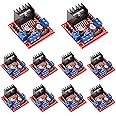
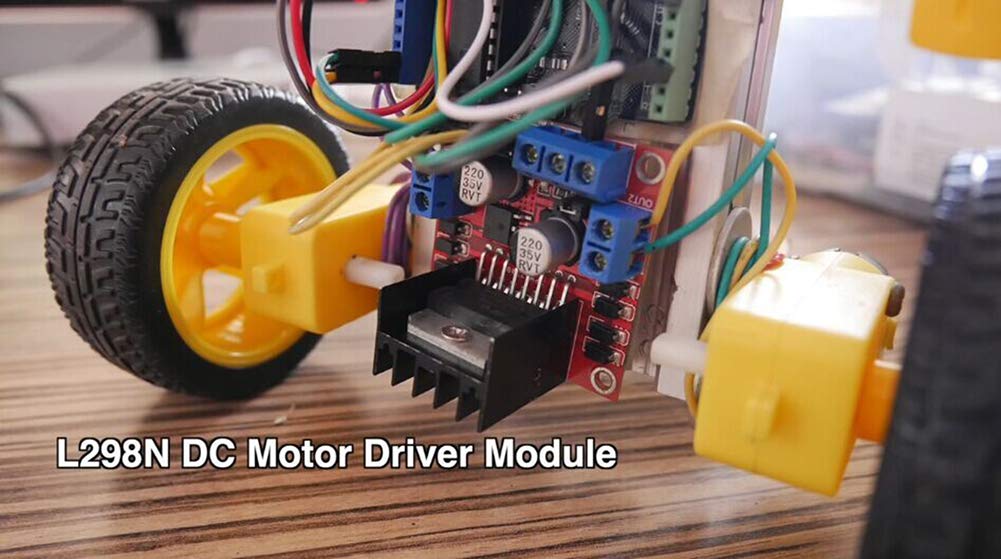
This 10-pack L298N Motor Drive Controller Board set features dual H-bridge drivers with built-in voltage regulation and high-capacity capacitors, delivering strong, stable, and interference-resistant motor control. Perfectly compatible with Arduino UNO, MEGA R3, and Mega2560, it empowers makers to build reliable smart cars and robotic projects at scale.
| Manufacturer | AITRIP |
| Item Weight | 9.1 ounces |
| Package Dimensions | 7.8 x 5.47 x 1.65 inches |
| Color | 10PACK |
| Batteries Included? | No |
| Batteries Required? | No |
J**T
Works great / great value! Very low trigger current. ~2V loss from Vcc. Arduino-friendly.
Update:The more I use this board, the more I love it. It's been resilient to my own wiring errors, responsive across the PWM range, and tolerant of varied input voltages. I haven't yet had any functional issues that weren't of my own making! Bumped from 4 to 5 stars.Original review:This little board is fantastic for driving motors from microcontrollers. I'm using it to drive several Lego "power functions" motors (~500ma max current) from an Arduino, using a 9V power brick to supply the driver, and it performs beautifully, consuming only ~20 microamps (NOT milliamps) from the 5V signal pin. Voltage at the output is ~2V less than supply, as is common w/ H-Bridge drivers, so you may need to compensate by using a higher supply voltage, or just plan for reduced maximum power.Connection-wise, the ground pin is a common ground. The 12V pin can accept a wide range (7-30V) input. The 5V pin is powered by the voltage regulator on-board, and can supply power (I measured 5.06V) to other devices, or be used to tie an input high. In each input pin pair, pull one high, one low to drive the motor.The screw connectors were a little tight, but worked well once I got them moving. The connections and heatsinks all seemed solidly connected, and the board has through holes for affixing it to a base.These are a great deal the hobby robotics / electronics experimentation, and are very forgiving with respect to power supply.
A**R
Simple add-ons for driving small DC motors from microcontrollers.
Small size comes in handy for driving small DC motors. Can operate over a relatively broad DC power input range. Best to keep the power voltage as low as practical to cut down on heat dissipation if want to drive at higher amperages. Easy interface to microcontrollers. Can accept 3.3 and 5V microcontroller outputs.
C**K
Works as expected
Had no issues and did not fail after using multiple times, only issue is the battery input got drained faster, wish i had a way to test idle power consumption of this controller.
J**E
Excellent for DC motor control
I really like this DC motor controller. I used this for a toy car project. It uses gears to reduce the standard high rpm (thousands of rpms) toy motor to a reasonable speed (~ 100 rpm) for a car or similar projects. Also allows forward and reverse. I have used this on several projects and will likely order more because of it's versatility and ease of use. And the price is so reasonable.
S**.
Good product
These are good motor drivers and they are a good value. They work as advertised and are nice to have a few on hand for projects
J**E
Easy to use and work great
A good price when doing budget robotics
E**C
Poor quality screw terminals
This is a good product but one or more of the screw terminals on the boards failed out of the box. If you have bought these or planning to buy these, you are most likely the type of person who can find a work around. So, you'll be fine and your project will likely work as expected. But, the extra time required for the work around is still frustrating.
J**Z
Difficulty Connecting
The media could not be loaded. I finally got this wired up and look like it was working just fine. I loaded a different program onto my Arduino to add Bluetooth into it and now after reloading the previous sketch that was working fine, my motor is not working. The light on the driver board has also gone away when I turn on the power and I'm not sure what is going on. When I wire up a new one power light comes on just fine, but if you are using the typical breadboard jumper wires in the screw terminals it is extremely difficult. I've never had this problem with other screw terminal chips
Trustpilot
3 days ago
1 month ago