Desert Online General Trading LLC
Dubai, United Arab Emirates
Desert Online General Trading LLC
Dubai, United Arab Emirates


Full description not available
D**A
must read for the new investor
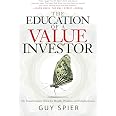
I recently had the pleasure of reading "The Education of a Value Investor" by Guy Spier and I must say it's been an enlightening journey for my investing endeavors. 🌟In this captivating memoir, Spier shares his experiences and the lessons he learned throughout his career as an investor. What sets this book apart is the author's focus on not just financial success, but also on personal growth and ethics in investing. 💼One of the key takeaways for me was Spier's emphasis on developing a long-term mindset in the investment world. He encourages readers to look beyond short-term gains and focus on the intrinsic value of businesses. 📈Moreover, Spier delves into the importance of self-awareness and understanding one's own biases when making investment decisions. This has undoubtedly helped me become more conscious of my own tendencies as an investor. 💡Throughout the book, Spier shares his experience of having lunch with Warren Buffett, an iconic figure in the investing realm. Learning about the legendary investor's principles and philosophy through Spier's personal account was a true highlight. 🍽️"The Education of a Value Investor" is not just a book about finance; it's about life and growth. It teaches us to invest in ourselves, continuously learn, and build strong relationships with like-minded individuals. 📚💬In conclusion, if you're looking to enhance your investing journey and gain valuable insights from a seasoned investor, I highly recommend "The Education of a Value Investor." It's a compelling read that will leave a lasting impact on your approach to investing. 📖🚀Thank you Guy Spier for such insight.
A**R
Superb book - potential to change many facets of your life
I have read this book over and over for the last 7 years. And every few months when I re-read it, I learn something news. About investing, about organizing my life, about conducting myself and about learning from others.While this is pre-dominantly about investing, it does so much more.You learn a great life trait by a simple act of Guy Spier when he writes three thank you notes to all and sundry. You learn a great method trait when Guy tells you that staring at prices every third day could be detrimental. You learn a great investing trait when Guy tells you about the gains he had from a 'posse'.There is lots to like about this book, and some points to disagree with too maybe. But thats what a good book does, in my mind. It makes you think and agree/counter the thoughts expressed.Read it - whether purchased yourself or on loan, and believe me, you wont regret it.
S**J
Serene and true treasure from value investing
This book will not help on understanding how to value businesses but it makes us strong and path to grow to be better human in life so that it makes our investing life calm, poised and dependable. Guy's knowledge in various topic and his views and application on investing has made this book must read. You will find the right temperament for investing which many talks rarely about.
V**I
Difficult to judge this book.
The problem is that I have read so many books on investments that I am suffering from literary constipation. There is only so much you can write about in this particular subject.Some positives about this book- The opening chapter is the best part of the book. It describes his time working in a dishonest Wall Street firm at the start of his career.The author's observation on how corrosive and poisoness the Bloomberg terminal can be if used too frequently is also noteworthy. Those multiple screens with blinking lights and moving graphs and flashing numbers don't mean a thing if the user does not possess a skilled mind.In conclusion I would like to state that I admire the author more then his book
A**I
A humble admission of a value investor
Must read. Haven’t found any autobiography so humble and genuine after “My experiments with Truth”. Some great anecdotes too..
K**K
Life changing !!
Great Book about Value Investing. A Must read !!
P**N
An honest book
The author is very open about his mistakes, learning process, his weaknesses, etc. And offers practical advice to become a better person and better investor. If you are looking for advice how to identify stocks or do valuation, then this is not the book you are looking for. A good read for someone who is starting on his investment journey.
R**R
Learn from Guy Spier
Guy Spier has opened his heart in writing this book. You may not learn a lot about value investing in this book but, if you are interested in making a career in the capital markets, this book will prove very valuable. To err is human but to learn from others' errors is smart. This book gives you the opportunity to learn from the author's mistakes so that you can shorten your learning curve.
M**I
Never to miss
I am glad I bought this book on someone's recommendation. Read it once and loved it. Looking forward to read it once again when I have ME TIME 😆
R**D
Enjoyable read
Very interesting read. Fascinating story of the authors lunch with Warren Buffet. Great investment advice, if you need any further convincing that Value investing is the way to go. Highly recommended read.
P**R
The Education of a Value Investor
"The Education of a Value Investor" by Guy Spier is a fascinating memoir that chronicles the author's journey from a self-centered, greedy investor to a thoughtful, value-driven one.Spier provides an honest and introspective account of his early days as an investor, including the mistakes he made and the lessons he learned along the way. He describes how his experiences working on Wall Street, including a stint as a hedge fund manager, ultimately led him to question his values and rethink his approach to investing.What I appreciate most about this book is Spier's willingness to share his personal struggles and vulnerabilities. He is candid about his struggles with addiction, divorce, and finding meaning in his life beyond the pursuit of wealth. This makes the book much more relatable and human, and helps to underscore the importance of finding purpose and meaning in our work and lives.The book is also full of practical insights and advice on value investing. Spier provides detailed accounts of his investment strategy, including his emphasis on investing in businesses with strong moats, his focus on long-term investing, and his emphasis on building relationships with company management teams.Overall, I found "The Education of a Value Investor" to be a compelling and thought-provoking read. It is a book that challenges readers to think deeply about their values and the role of money in their lives, while also providing practical guidance on how to become a successful value investor. I highly recommend this book to anyone interested in investing or personal growth.
N**Y
In medias res
Only seven pages of Peter Drucker's autobiographical Adventures of a Bystander - a work which should also be on any serious investor's shelf - are devoted to Willem Paarboom, an eccentric financial savant of the nineteen-thirties. Drucker, formed in a culture and a time where polymathy was as realistic and socially desirable an aspiration as owning a Prius is for us, knew many characters of such complexity and richness. Drucker's book is tantalisingly painful because, while his sketches of Paarboom are fascinating, any contemporary reader must suspect that the values which this obscure but great investor practised are now extinct.Which values? Here is Paarboom, a Dutch proto-Buffett, reviewing a special situation in bankrupt bonds:"You're right, these...are worth at least six times what they are selling for. But they're not for me...[a]ll you're doing by buying them...is making a sure profit. I won't invest unless I can also make a contribution and do something for the company into which I buy. I stopped long ago wanting to get paid for being clever. Now I get paid for being right."Guy Spier never refers to this episode but, as his auto da fe reveals, he is one of Paarboom's intellectual and moral heirs. Unlike Paarboom, a consummate activist and trusted adviser to the great names of Europe, Spier avoids contact with the boards and management of his investments and participates on a purely financial basis. However, in choosing companies to invest in (only those that create good outcomes for their customers), in setting the terms of his Aquamarine Fund (no fees until his investors achieve a reasonable hurdle rate) and in seeking to master his own frailties (a great many including status anxiety, the unconscious irrationality we all share and a preference for the abstruse but risky opportunity over the safe but obvious), Spier shows himself as a fellow practitioner of investing as a liberal humanist art.However, as the title suggests, the book is mostly about Spier's formation rather than his present state. He certainly did not begin his career with any strong resemblance to Paarboom. Despite a fine education at Oxford and Harvard Business School and glittering prospects, his inexplicable decision to join a dubious investment bank after graduation nearly wrecked everything.While some will be nonplussed by the narrative's familiar development of decline, insight and a meandering path to redemption, it is Spier's consistently unsparing honesty and humility which make this book so valuable. Spier freely admits to himself - and to us - that even after intense self-reflection and a clean start as a die-cast value investor in the school of Graham and Buffett, he couldn't yet disengage from what others thought a successful money manager should resemble. Within the widening gyre of the global financial crisis, this still fragile self-possession was tested almost to melting point. (For the second edition of this book - and there should be one - Spier might consider a form of counterfactual for the critical points in his journey. We understand his story backwards, as we must, but there were many possible, even probable, alternative histories at those times, most of which would have been deeply unhappy for him and his family.)Spier was luckier than most, though, because he met and befriended Mohnish Pabrai. Through his relationship with this remarkable investor, whom Spier clearly admires across many dimensions, he tests his mettle with Buffett himself. It is great credit to Spier that he recognised the now famous lunch with Pabrai, their respective families and Buffett as his own rubicon rather than just another form of conspicuous consumption. Many of the defining improvements Spier made to his investing style, the structure of his fund and his working and personal relationships came from his realisation that it was this sort of encounter:http://m.poets.org/poetsorg/poem/archaic-torso-apolloSpier's style is often confessional and earnest, which some will find incongruous for a book on investing. He is writing "to himself", though, in the manner of Marcus Aurelius and St Augustine. It is more strange, in my view (and symptomatic of the undue influence of science and engineering mental models) that a profession with the potential to create misery or happiness on a vast scale does not produce more thinking like this. Investing is about mastering oneself and, only then, if one is extraordinarily creative and disciplined, performing slightly better than average over a very long period.It's important not to misinterpret Spier's transparency and modesty (which are consistent with his fully-formed values) as indications of average performance. His fund is one of the most successful in the last two decades, outperforming the S&P500 index by a comfortable aggregate margin.I give this four stars, not through any dissatisfaction with the achievement but in the hope that Spier has more to say.
M**E
Excellent Read!
This book is priceless! It offers practical and thoughful advice. It helped me to recognize how extreme was my approach to investing! I was killing myself trying. Well done Guy!
Trustpilot
5 days ago
1 week ago
1 month ago
1 week ago