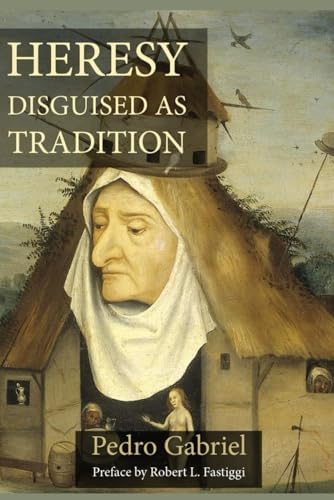

Heresy Disguised as Tradition
Product ID: 589255014
Desertcart purchases this item on your behalf and handles shipping, customs, and support to Cyprus.
Buy Heresy Disguised as Tradition by Gabriel, Pedro (ISBN: 9798888700327) from desertcart's Book Store. Everyday low prices and free delivery on eligible orders. Review: Outstanding - Fantastic book, extremely thorough and a must read for any "Traditionalist". There were so many sad truths, I have seen it myself how people start to convert to the Catholic Faith but get drawn online and end up going deep into heresy instead. One thing that struck me throughout this book was seeing the timeline of events and the example of Tom discovering them online and being scandalized and spending time in 'Catholic' forums arguing the point. It made me realise how incredibly grateful I am to have been able to close all my social media accounts and never visit a Catholic website again. Amazing how all that stress, discussion and scandal just goes away to the irrelevant category at the click of a button. Seeing the examples once more whilst reading this, of that mindset of dabbling with Catholicism online made me realise just how dangerous the internet is and how glad I am that I left. Hats off to the author taking the time to write this, absolutely outstanding in dedication and detail. I was struck by the end, how Tom sitting in his car on Sunday after his huge journey of discovery and thinking about the TLM being miles away and his parish being just round the corner. Such a shame so many of us had to go a huge roundabout journey of decades to end up back in our parishes, what an unnecessary amount of trauma and lunacism. I hope people who have fallen for the lie of Traditionalism find their way back, that this book helps, but I also heartily agree that, a lot of them were never Catholic to begin with. Since my own journey away from Traditionalism, I feel I've been a Catholic for literally only months now and am having to 're Catechise myself and try to undo all the damage especially the internet did. So grateful to be free of it all. This book helped in my own on going journey and I hope it helps others too. Review: I bought the Kindle version of this book during last year’s holiday season. I’ve followed the author’s work on several different websites for a few years. I’ve also interacted with him a little online. I have found him to be a fairly logical individual, and usually quite charitable. I couldn’t pass up on a chance to read this book. From the outset, let me be clear: I am NOT an orthodox Catholic, nor do I want to be. I am culturally Catholic, and attend the Mass with my family. I do not believe in divine revelation or authoritative interpreters of tradition, scripture, or God. In fact, I consider this mindset very dangerous, and I find it regrettable that a mind as logical and rational as Dr. Gabriel would put his intellect to work in service of such a dangerous and, ultimately, oppressive religious system. With that said, here’s my review of this book: Gabriel sets out to establish a few things (basically, Ultramontanism). To do this, he uses a very clever, even delightful, parable: a royal princess named Tradition and a pretender called Heresy who seeks to pass herself off as the real princess. Heresy manages to steal the royal clothes of Tradition and successfully deceives many into accepting her royal claim. She does, after all, look like Tradition and is royally dressed. Tradition, meanwhile, is now naked and seemingly unfit to be considered a princess. It’s so obvious! Gabriel makes references to this parable as he proceeds to offer an impressive intellectual tour de force demolishing the claims of the modern-day servants of Pretender Princess Heresy. I found especially helpful his discussion of different heretics throughout Church history. Hussites and Lutherans in particular seem especially useful in describing a pattern that seems to recur among these heretics. Namely, that they are defending true tradition against the innovations and errors of ecumenical councils and popes. Luther defended his actions by claiming popes and councils contradicted each other. Hussites claimed the Church erred and broke divine law by deviating from communion under both kinds. Old Catholics claimed to be relying on the true tradition by rejecting Vatican I and papal infallibility. In each case, as Gabriel amply demonstrates, they thought they were properly interpreting the true traditions of Christ’s teachings and praxis, while the Church’s authorities had gone into (usually quite serious!) error. This, of course, is what modern radical traditionalists like to claim. That tradition is self-evident and in no need of magisterial authority to interpret. So, when the pope, or Vatican II, present a teaching that doesn’t seem to accord with prior teaching, well, then, the traditionalist is more than justified in rejecting this ‘false’ new teaching in favor of the true tradition! How convenient! But, of course, they’re merely following the same, very ancient pattern of trying to have their cake and eat it, too. That is, they want special and authoritative divine revelation but they want it to be what they already believe and practice. They have become the modern servants of the Pretender Princess who has attempted to usurp the authority of the true princess, Tradition. This recurring pattern could be called Anti-Tradition, a counter-tradition. That’s my takeaway from Gabriel’s book. Now, one might ask why I give this book five stars, given my opening paragraph? While I ultimately reject the beliefs of Gabriel (and the heretics with their fixation on a true divine revelation that is palatable to them), I do not deduct points from someone’s argument simply because I don’t agree with their underlying worldview. Gabriel set out to demonstrate that his position, Ultramontanism, is the correct position within the worldview of Catholic theology. He succeeds rather well. It’s just that I don’t think Catholic theology is any more authoritative than Hindu or Islamic theology. But proving the truth of Catholicism itself was not his goal, and therefore not relevant to whether he accomplishes the purposes which he did intend. For what he intended to do with this book, he deserves recognition for a successful effort.
| ASIN | B0CP751MM8 |
| Best Sellers Rank | 2,130,992 in Books ( See Top 100 in Books ) 466 in Catholic Theology 10,938 in Religious History of Christianity 30,369 in Religious Studies (Books) |
| Customer reviews | 4.6 4.6 out of 5 stars (17) |
| Dimensions | 15.24 x 2.62 x 22.86 cm |
| ISBN-13 | 979-8888700327 |
| Item weight | 767 g |
| Language | English |
| Print length | 457 pages |
| Publication date | 29 Nov. 2023 |
| Publisher | En Route Books & Media |
B**S
Outstanding
Fantastic book, extremely thorough and a must read for any "Traditionalist". There were so many sad truths, I have seen it myself how people start to convert to the Catholic Faith but get drawn online and end up going deep into heresy instead. One thing that struck me throughout this book was seeing the timeline of events and the example of Tom discovering them online and being scandalized and spending time in 'Catholic' forums arguing the point. It made me realise how incredibly grateful I am to have been able to close all my social media accounts and never visit a Catholic website again. Amazing how all that stress, discussion and scandal just goes away to the irrelevant category at the click of a button. Seeing the examples once more whilst reading this, of that mindset of dabbling with Catholicism online made me realise just how dangerous the internet is and how glad I am that I left. Hats off to the author taking the time to write this, absolutely outstanding in dedication and detail. I was struck by the end, how Tom sitting in his car on Sunday after his huge journey of discovery and thinking about the TLM being miles away and his parish being just round the corner. Such a shame so many of us had to go a huge roundabout journey of decades to end up back in our parishes, what an unnecessary amount of trauma and lunacism. I hope people who have fallen for the lie of Traditionalism find their way back, that this book helps, but I also heartily agree that, a lot of them were never Catholic to begin with. Since my own journey away from Traditionalism, I feel I've been a Catholic for literally only months now and am having to 're Catechise myself and try to undo all the damage especially the internet did. So grateful to be free of it all. This book helped in my own on going journey and I hope it helps others too.
L**D
I bought the Kindle version of this book during last year’s holiday season. I’ve followed the author’s work on several different websites for a few years. I’ve also interacted with him a little online. I have found him to be a fairly logical individual, and usually quite charitable. I couldn’t pass up on a chance to read this book. From the outset, let me be clear: I am NOT an orthodox Catholic, nor do I want to be. I am culturally Catholic, and attend the Mass with my family. I do not believe in divine revelation or authoritative interpreters of tradition, scripture, or God. In fact, I consider this mindset very dangerous, and I find it regrettable that a mind as logical and rational as Dr. Gabriel would put his intellect to work in service of such a dangerous and, ultimately, oppressive religious system. With that said, here’s my review of this book: Gabriel sets out to establish a few things (basically, Ultramontanism). To do this, he uses a very clever, even delightful, parable: a royal princess named Tradition and a pretender called Heresy who seeks to pass herself off as the real princess. Heresy manages to steal the royal clothes of Tradition and successfully deceives many into accepting her royal claim. She does, after all, look like Tradition and is royally dressed. Tradition, meanwhile, is now naked and seemingly unfit to be considered a princess. It’s so obvious! Gabriel makes references to this parable as he proceeds to offer an impressive intellectual tour de force demolishing the claims of the modern-day servants of Pretender Princess Heresy. I found especially helpful his discussion of different heretics throughout Church history. Hussites and Lutherans in particular seem especially useful in describing a pattern that seems to recur among these heretics. Namely, that they are defending true tradition against the innovations and errors of ecumenical councils and popes. Luther defended his actions by claiming popes and councils contradicted each other. Hussites claimed the Church erred and broke divine law by deviating from communion under both kinds. Old Catholics claimed to be relying on the true tradition by rejecting Vatican I and papal infallibility. In each case, as Gabriel amply demonstrates, they thought they were properly interpreting the true traditions of Christ’s teachings and praxis, while the Church’s authorities had gone into (usually quite serious!) error. This, of course, is what modern radical traditionalists like to claim. That tradition is self-evident and in no need of magisterial authority to interpret. So, when the pope, or Vatican II, present a teaching that doesn’t seem to accord with prior teaching, well, then, the traditionalist is more than justified in rejecting this ‘false’ new teaching in favor of the true tradition! How convenient! But, of course, they’re merely following the same, very ancient pattern of trying to have their cake and eat it, too. That is, they want special and authoritative divine revelation but they want it to be what they already believe and practice. They have become the modern servants of the Pretender Princess who has attempted to usurp the authority of the true princess, Tradition. This recurring pattern could be called Anti-Tradition, a counter-tradition. That’s my takeaway from Gabriel’s book. Now, one might ask why I give this book five stars, given my opening paragraph? While I ultimately reject the beliefs of Gabriel (and the heretics with their fixation on a true divine revelation that is palatable to them), I do not deduct points from someone’s argument simply because I don’t agree with their underlying worldview. Gabriel set out to demonstrate that his position, Ultramontanism, is the correct position within the worldview of Catholic theology. He succeeds rather well. It’s just that I don’t think Catholic theology is any more authoritative than Hindu or Islamic theology. But proving the truth of Catholicism itself was not his goal, and therefore not relevant to whether he accomplishes the purposes which he did intend. For what he intended to do with this book, he deserves recognition for a successful effort.
B**R
I'm a convert to the Catholic Church from an "Evangelical/ reformed" background. Much of my formation in the Faith has been self-led and assisted by accessible youtube apologetics etc. which I have discovered tends to be simplistic, one-sided and as a general rule implicitly critical of the teachings of the Holy Father. If history has brought you into the Church, let history keep you here! Pedro's book presents a defence of Pope Francis on the basis of Church History and thoughtfully navigates the topics of "Development of Doctrine", "Traditionalism" and "Ultramontanism." The forward from Dr. Fastiggi was also fantastic. Buy 3 copies of this book!
T**Y
Great read! Helpful text
A**S
Dr. Gabriel’s excellent book is just what is needed in these times of rampant confusion about what faithful Catholics owe towards the magisterium, and where there is legitimate room for questions and respectfully aired concerns. This book follows upon his award-winning “The Orthodoxy of Amoris Laetitia.” In many of the same ways, it clears up the most common misunderstandings about teachings of the papal magisterium exercised under Pope Francis (misunderstandings which another cynical reviewer sadly demonstrates), while establishing a true Catholic understanding of papal primacy, drawing on such important, though lesser-known documents as Donum Veritatis, and more well-known ones, such as Pastor Aeternus and Lumen Gentium. Traditionalism, when it denies the Pope’s power to reform, modify or subtract from ecclesial traditions, is a subtle heresy that is just as dangerous, if not more dangerous than heresies of other types, since it undermines so directly the visible center of unity, the Pope. This book will be much cited in years to come, and no doubt could not have come at a better time for the Church. A big congrats to Dr. Gabriel again, on his excellent scholarship and diagnostic insight.
R**M
Pedro's book is not an academic recounting of dry history and theology. It reads like a dense, but fast-paced journey through 2000 years of development. Intensely valuable were two storytelling techniques - invented characters reacting to clickbait and headlines, and the news and events from Pope Francis. Both are used brilliantly to draw attention to how history and heresy have cycled together, prompting church fathers and fundamentalists into discussion. Most valuable of all is how carefully presented it is. It abounds in references, but keeps a conversational tone, like a friendly teacher. Its more than a resource, it is a masterclass, or a course, in how Catholics live in today's cruciform tension of timeless truth on the one hand, and the gentle generosity for the individual on the other.
Trustpilot
3 weeks ago
2 months ago