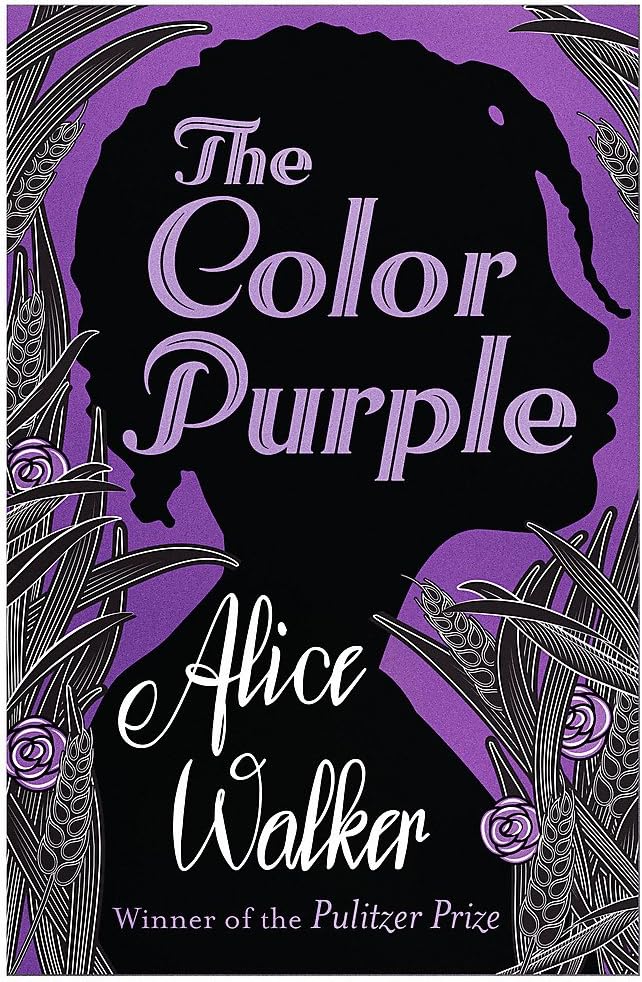
The Color Purple
Product ID: 50014934
Desertcart purchases this item on your behalf and handles shipping, customs, and support to Cyprus.
The classic, PULITZER PRIZE-winning novel that made Alice Walker a household name. Set in the deep American South between the wars, THE COLOR PURPLE is the classic tale of Celie, a young black girl born into poverty and segregation. Raped repeatedly by the man she calls 'father', she has two children taken away from her, is separated from her beloved sister Nettie and is trapped into an ugly marriage. But then she meets the glamorous Shug Avery, singer and magic-maker - a woman who has taken charge of her own destiny. Gradually Celie discovers the power and joy of her own spirit, freeing her from her past and reuniting her with those she loves. 'One of the most haunting books you could ever wish to read ... it is stunning - moving, exciting, and wonderful' Lenny Henry Review: Beautifully written, hard-hitting novel. - Not having seen the film, I promised myself to read this book for years. Finally got round to reading it and WOW!! This was not the book I was expecting. Deals with real adult themes in an honest and heartbreaking manner. Far more hard-hitting than I believed this book to be. Beautifully written. Review: Amazing. How have I not read this already - I have been meaning to read this book for so so so long... I mean, it's a classic so obviously, I have seen it absolutely everywhere and loads of people have been telling me to read it - but with my already-massive TBR pile, I knew it would be a while until I got to it. BUT THEN... I had to read it for university, so The Color Purple got bumped up to the very top of my reading list. And because it was for university, that's why there are all of the different coloured tabs in my book. Each coloured tab represents a different theme throughout the book. Anyway! Let's get into the review! Set in rural Georgia, The Color Purple focuses on the life of women of color in the southern United States in the 1930s, addressing numerous issues including their exceedingly low position in American social culture. Fourteen-year-old Celie is being abused by her father; she is impregnated and then her babies are stolen away from her. Her sister, Nettie is the only support that Celie has in her miserable life, but she would never dream of standing up for herself because of the consequences. Then, one day she is sent off to marry Mr. _______, who beats her into doing what he says. With Nettie no longer there to help Celie through the pain, she starts to think that life is impossible. Then, one day Shug Avery comes to town and gives Celie a glimmer of hope... Wow. Just wow. This book was just... Amazing. How have I not read this already? It is a very hard book to read because of the issues that Walker portrays throughout the novel such as rape and domestic abuse but Walker creates these characters that have so much depth to them, so much love and hurt. There is so much for me to write about this book, but I don't want this review to be a billion pages long, so I'll try and just talk about the main things. However, if I digress, please forgive me, there's just too much to talk about. As soon as you start the book, you are instantly met with pain. Fourteen-year-old Celie is being raped by her father and her dying Mother and her sister does not know. Celie isn't fourteen throughout the entire book; by the end, she is about mid-30s? I'm guessing? Walker describes how her hair is starting to grey so I'm presuming she's around the 30 mark. One of the things that I didn't like about this book were the loooooonnngggg letters from Nettie. Most of them were really enjoyable to read, as they offered insight to racism in different parts of the world and also gave us an insight to how the Olinka people lived in Africa. However, a handful of the letters just seemed a bit boring and I just wanted to get on with Celie's story and see how she was getting on. “All my life I had to fight. I had to fight my daddy. I had to fight my brothers. I had to fight my cousins and my uncles. A girl child ain't safe in a family of men. But I never thought I'd have to fight in my own house. She let out her breath. I loves Harpo, she say. God knows I do. But I'll kill him dead before I let him beat me.” ― Alice Walker, The Color Purple Also... Shug Avery... You gotta love her and hate her at the same time. She's such a dominant force within the book. She stands up for herself and doesn't let anyone walk over her and she teaches Celie about love and how Celie can start standing up for herself. But Avery is also this character who can't seem to commit. *slight spoiler ahead* Celie falls in love with Shug Avery, Avery loves Celie back. So there we go, what would the problem be? Well, Avery doesn't commit to Celie. She goes round taking Celie's feelings for granted as she knows that Celie will always be there, waiting for her. In the end, Celie is just like 'no. I will always love you, but I will not wait for you forever'. GO CELIE! Another character that I absolutely loved was Sofia. She was strong, independent and didn't let herself be dominated by men or white people. Even though she recognised where her place was in the racist society, she was continuously fighting it when she would just do what she wanted. I think she serves as an amazing role model for Celie and also for readers because of how much she fights for herself. Shug Avery annoyed me sometimes and Nettie's letters were sometimes too long, but those things are so trivial in the grand scheme of this book. Who cares about letters being a bit long when you're reading a book that conveys the racial issues that were happening with the 30s - and are also happening now! It's a book about race, transformation, acceptance, lesbian romance and realising that actually, you DO matter. I think that this is a book that everyone should read as it highlights key aspects of society and is very educating about how black women and black people in general are suppressed within society. Trigger warnings: rape, abuse, racial hate
| Best Sellers Rank | 201,106 in Books ( See Top 100 in Books ) 327 in Fiction Classics (Books) 340 in Women's Literary Fiction (Books) 1,261 in Literary Fiction (Books) |
| Customer Reviews | 4.5 out of 5 stars 28,210 Reviews |
M**M
Beautifully written, hard-hitting novel.
Not having seen the film, I promised myself to read this book for years. Finally got round to reading it and WOW!! This was not the book I was expecting. Deals with real adult themes in an honest and heartbreaking manner. Far more hard-hitting than I believed this book to be. Beautifully written.
T**L
Amazing. How have I not read this already
I have been meaning to read this book for so so so long... I mean, it's a classic so obviously, I have seen it absolutely everywhere and loads of people have been telling me to read it - but with my already-massive TBR pile, I knew it would be a while until I got to it. BUT THEN... I had to read it for university, so The Color Purple got bumped up to the very top of my reading list. And because it was for university, that's why there are all of the different coloured tabs in my book. Each coloured tab represents a different theme throughout the book. Anyway! Let's get into the review! Set in rural Georgia, The Color Purple focuses on the life of women of color in the southern United States in the 1930s, addressing numerous issues including their exceedingly low position in American social culture. Fourteen-year-old Celie is being abused by her father; she is impregnated and then her babies are stolen away from her. Her sister, Nettie is the only support that Celie has in her miserable life, but she would never dream of standing up for herself because of the consequences. Then, one day she is sent off to marry Mr. _______, who beats her into doing what he says. With Nettie no longer there to help Celie through the pain, she starts to think that life is impossible. Then, one day Shug Avery comes to town and gives Celie a glimmer of hope... Wow. Just wow. This book was just... Amazing. How have I not read this already? It is a very hard book to read because of the issues that Walker portrays throughout the novel such as rape and domestic abuse but Walker creates these characters that have so much depth to them, so much love and hurt. There is so much for me to write about this book, but I don't want this review to be a billion pages long, so I'll try and just talk about the main things. However, if I digress, please forgive me, there's just too much to talk about. As soon as you start the book, you are instantly met with pain. Fourteen-year-old Celie is being raped by her father and her dying Mother and her sister does not know. Celie isn't fourteen throughout the entire book; by the end, she is about mid-30s? I'm guessing? Walker describes how her hair is starting to grey so I'm presuming she's around the 30 mark. One of the things that I didn't like about this book were the loooooonnngggg letters from Nettie. Most of them were really enjoyable to read, as they offered insight to racism in different parts of the world and also gave us an insight to how the Olinka people lived in Africa. However, a handful of the letters just seemed a bit boring and I just wanted to get on with Celie's story and see how she was getting on. “All my life I had to fight. I had to fight my daddy. I had to fight my brothers. I had to fight my cousins and my uncles. A girl child ain't safe in a family of men. But I never thought I'd have to fight in my own house. She let out her breath. I loves Harpo, she say. God knows I do. But I'll kill him dead before I let him beat me.” ― Alice Walker, The Color Purple Also... Shug Avery... You gotta love her and hate her at the same time. She's such a dominant force within the book. She stands up for herself and doesn't let anyone walk over her and she teaches Celie about love and how Celie can start standing up for herself. But Avery is also this character who can't seem to commit. *slight spoiler ahead* Celie falls in love with Shug Avery, Avery loves Celie back. So there we go, what would the problem be? Well, Avery doesn't commit to Celie. She goes round taking Celie's feelings for granted as she knows that Celie will always be there, waiting for her. In the end, Celie is just like 'no. I will always love you, but I will not wait for you forever'. GO CELIE! Another character that I absolutely loved was Sofia. She was strong, independent and didn't let herself be dominated by men or white people. Even though she recognised where her place was in the racist society, she was continuously fighting it when she would just do what she wanted. I think she serves as an amazing role model for Celie and also for readers because of how much she fights for herself. Shug Avery annoyed me sometimes and Nettie's letters were sometimes too long, but those things are so trivial in the grand scheme of this book. Who cares about letters being a bit long when you're reading a book that conveys the racial issues that were happening with the 30s - and are also happening now! It's a book about race, transformation, acceptance, lesbian romance and realising that actually, you DO matter. I think that this is a book that everyone should read as it highlights key aspects of society and is very educating about how black women and black people in general are suppressed within society. Trigger warnings: rape, abuse, racial hate
A**L
sexual wilderness, violence, abusing women, and entangled relations
From the page one, you will jump into narration in Black American casual talk style early 1900s. If you are not a native English speaker, you may have difficult to go through it, but still enjoying. It is a story of sexual wilderness, violence, abusing women, and entangled relations. Narrator is also character in the story, Celie. Her mother died of mental problems, and her father was a successful store owner, and lynched by resentful competitors. She, and her sister Nettie are adapted by Alphonso; he brings them up like their father. But he rapes Celie, and Celie gives birth to two babies; and Alphonso takes them away and gives to a childless missionary family. Celie, and Netie are grown up without knowing Alphonso is their step father. Celie marries by a widowed character named Mr. ---- to look after this kids, and the house work. And eventually Nettie also escapes and takes refuge at Celies house. Plot goes on with Nettie also leaving Celie, and after ages everybody coming back together again . Book has a great narration style. You will get immersed in it, have no will to give a break. It is a realistic novel, Author is the voice of this culture. Sometimes author uses explicit language like describing the rape scene. You will feel paradoxical on the moral values, and the realities in the field in these entangled relations. Author displays common moral issues, paradoxes through the life of black Americans.
D**Y
Excellent read -
Funny at times. Sad at times. Enlightening all the way through. Written as a series of chats with God and letters to and from Celie and her sister, Nettie, this book takes place over 40 year in Georgia. It highlights the terrible prejudice toward Celie by her own kind. Her life is so bad, being abused, sexually, physically and emotionally by the man she thinks is her father, and having given birth to his two children, she is married off to an equally abusive womanising husband. She is separated from her sister, Nettie, who eventually goes to Africa as a help to a black missionary and his wife. This couple have adopted Celie’s children, unbeknown to her, whose parentage is not known to the missionary couple. Nettie experiences the terrible greed and lust for land and money of the rubber planters, and also the appalling culture of scarification and FGM within the tribe with whom they live. Celie’s life only turns a corner when she meets one of the women her husband is involved with. This lady, Shug, is a strong character who encourages Celie (eventually) to take a stand and be her own person; to fight for what she has a right to – Freedom and equality within the marriage; the right to say ‘No’ and the right to have the letters her sister has been writing to her for years but she has never received. Celie has never had such love and compassion from anyone before Shug and they become intimate. This intimacy is spoken of with sincerity and compassion in the book. Eventually, all things work out okay for Celie, Nettie and Celie’s children but not before they all learn some very important lessons about bigotry, discrimination, sexual and racial relations, their history and our relationship with God.
I**E
A modern classic
In this modern classic, we meet Celie who is raped by her father as a child and then given in marriage against her will. She's had 2 children, both of whom she believes to be dead as they were taken from her at their birth. It's a story of oppression and it could be desperately sad but it isn't. The book is in the form of letters, mostly written by Celie to God, her only confidant. Later in the book, she writes to her sister who is a missionary in Africa. She finds love and a meaning in her life, from an unexpected quarter. In the course of the story, over the 1920s and 1930s we see the characters grown and evolve. I loved the writing; so unconventional but so successful in the way that it forced me to read it in an American Deep South accent. I could just about hear Celie in my head. Her sister, educated and literate, writes very differently. Celie is conscious of her language and indeed, has had her deficiencies pointed out by several people and they have made unsuccessful attempts to teach her. Her homely expressions give the book a real life quality and I was fascinated and gripped through it all. This is a book I'd definitely recommend.
K**N
Definatly used
The bus showed up and its definatly not new. It's good condition, nothing wrong but it's slightly battered like you would find after someone had it for a few days in a bag. Otherwise good book, doing my a-level coursework on it.
C**S
Everyone should add this to their TBR
Trigger warnings for graphic sexual content and situations of violence and abuse. I struggled with this book at the start because our main protagonist is very uneducated so her use of language and punctuation in the letters she writes wasn’t the easiest to read, however I got used to it pretty quickly. This is a very heavy read, with very hard hitting topics that may leave you feeling uncomfortable, but it’s these types of topics that always needs to be addressed. However, besides from this it’s also about strong badass women, who stand up for themselves through the hard times they are put through, which I enjoyed reading. This book mainly follows Celie; but you also hear from her sister Nettie. I loved hearing from Nettie and her stories from Africa. You get to hear what it was like for people living in Olinka, in the slumps, and their native families traditions. Celie life is a whole lot different. Celie is a young black girl growing up in poverty, in the early 1900s. At the age of 14 she was raped and impregnated by her stepfather. This book follows her life throughout the next 30 years of living in a horrible forced marriage to finding love with Shug Avery, who is a bi-sexual character; and becoming a badass woman and learning to use her voice to stand up for herself. ‘… I should have lock you up. Just let you out to work. The jail you plan for me is the one in which you will rot, I say.’ ‘…I’m pore, I’m black, I may be ugly and can’t cook, a voice say to everything listening. But I’m here.’ The Color purple addresses a lot of sensitive topics that Walker definitely does not shy away from. You will learn this just from the first page. However, its also about strong Black women and I immediately was like, this is a brilliant book for feminists. It vividly showed you how women were treated, but how when they find their voices they will stand up for themselves and be a boss while doing so. When Celie stuck up for herself against Mr. I was so proud. The ending plastered a beaming smile onto my face, because I was so happy for the way things turned out for Celie. I also didn’t realise that this book is actually banned from many countries and schools. I can see why, but I feel this book would be fine to read for University students but too heavy for High School students. For it to be banned from schools I understand but for university students and up I think this book is great for them. I did do some research on this book, and apparently there have been different reasons for the book being banned; these include religious objections, homosexuality, violence, African history, rape, incest, drug abuse, explicit language, and sexual scenes. However, everything addressed in this book is true. These things happen, and need to be taught and discussed with many. Was this an enjoyable read? In some aspects, no! Can people learn from this? Yes! So, I would highly recommend.
C**E
The Color Purple
This book is probably the best example of modern literature of our time. I bought this for a friend as I felt she would enjoy it, but had read it myself in A level English Literature. I wasn't sure I was going to like it when I first started, as it is written as diary entries by Celie (a young black girl), set in the the southern state of Georgia. The diary entries, addressed to God, give an account of her life spanning many decades. I am filling up now just recalling the story and how moving many of the entries were. It is a most emotive and beautifully written book. One which transports you to a different time and place, and small wonder it won the 1983 Pulitzer Prize for fiction. Every reader wants to sample different situations, experiences, places, emotions etc; Very few books actually deliver, this one does! And how! Despite it's compact size, this book is filled with a lifetime of emotions. It covers social issues, explores relationships and faith that one day things will be better. That life will be better. This was also made into a film by Stephen Spielberg, and starring Whoopi Goldberg and Oprah Winfrey, which he did justice to, but you will be depriving yourself of a unique reading experience by not reading this marvelous book. Enjoy! As usual, this was delivered on time and in perfect condition by Amazon.
C**G
Item cover was folded
F**R
Magnifique
Subtil, moderne, éclairant et plein d'espoir.
A**S
Muy buen libro y entrega
Llegó en perfectas condiciones y en menos tiempo de lo esperado. El libro simplemente me conmovió profundamente. No pude soltarlo en toda la semana.
M**L
A classic - a must read
I bought this copy to replace my well worn copy from decades ago. Great heartbreaking story filled with engaging characters, violence, racism, classism and bigotry from the eyes of a black woman in the south. A must read for everyone.
I**A
Lettura emozionante
Conoscevo già, più o meno, la storia di questo libro, dato che avevo visto il film su di esso, e conseguentemente anche il musical tratto dal film. Ma nonostante ciò, è stato come rivivere la storia di Celie tutta da capo. Mi sono emozionata con questa lettura, seguendo la storia dal punto di vista di Celie, attraverso le sue lettere. Davvero un libro meraviglioso. Lo consiglio fortemente.
Trustpilot
4 days ago
3 weeks ago