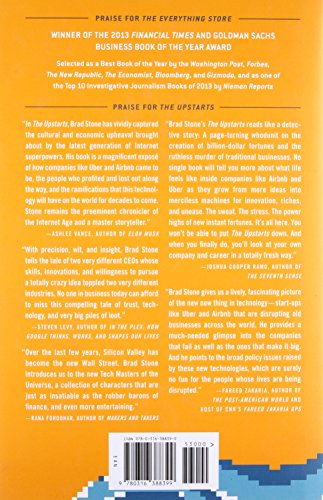
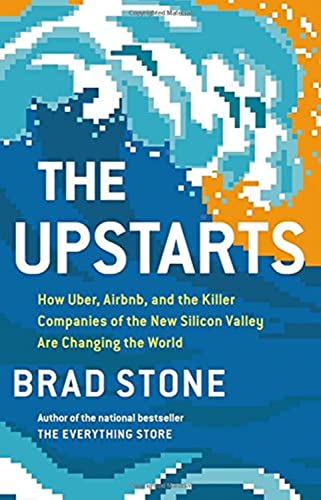


The Upstarts: How Uber, Airbnb, and the Killer Companies of the New Silicon Valley Are Changing the World [Stone, Brad] on desertcart.com. *FREE* shipping on qualifying offers. The Upstarts: How Uber, Airbnb, and the Killer Companies of the New Silicon Valley Are Changing the World Review: I devoured The Upstarts book in 11 days. - Ironically, mostly in the back of Lyft and Uber’s on the way to one of the properties I manage on Airbnb. Here’s a quote from p. 13 when I suspected I was going to be pleased by the end of the book: “It is not a comprehensive account of either company, since their extraordinary sorties are still unfolding. It is instead a book about pivotal moments in the century-long emergence of a technological society. It’s about a crucial era during which old regimes fell, new leads emerged, new social contracts were forged between strangers, the topography of cities changed, and the upstarts roamed the earth.” Translation: This book dives deeper into fewer issues in the 9-year history of both companies rather than covering a vast amount of topics with little detail. Even though Airbnb and Uber are in the title of the book, it must have been about 70% Uber. Overall, I felt the book was really well researched and well put together from a storyline point of view. The Uber/Airbnb stories crisscrossed nicely. Actually, I was surprised at the amount of overlap from the founders both attending the 2008 presidential inauguration (though, from different perspectives) to friendships formed between Chesky and Kalanick in the early days that last through today. The book didn’t try to cover every topic over the past 8 years. Instead Brad Stone focused on fewer topics while adding more substance to them. As a prior Airbnb employee and an early adopter of Lyft and Uber, I still learned much from reading this book. Not to mention it was entertaining and more so based on storytelling rather than analyzing past events. I was pleased to learn that my memory of history is accurate (well, kind of). The Uber as we know it today has Lyft to thank. In 2012 when Lyft put those pink mustaches on their cars in San Francisco and popularized ride-sharing as we know it today, Uber was still a black car service for rich people. Uber copied Lyft about six months later and started allowing anyone to drive while offering lower cost alternatives to passengers. In reality, SideCar beat Lyft by about 2 months, but they no longer exist. The book went into an interesting history of Uber’s Chinese competitor, Didi Kuaidi (which means ‘honk-honk speedy’ in English) starting p. 303. It put some color to the news headlines, ‘Uber loses in China, sells to Didi.’ A couple interesting factoids: Lyft was originally named Zimrides (short for Zimbabwe rides). Designer Harrison Bowden came up with ‘Lyft’. On New Yeas Eve 2015, 550K guests slept in Airbnbs; on NYE 2016, it was 1.3M; by the middle of 2016, 1.3M guests per night was the average. Review: A modern history of Silicon Valley - The book remains captivating by alternating between the stories of Airbnb and Uber every successive chapter. As you read through the book, both companies grow together (and often their stories overlap, such as whenever Travis and Brian meet). The parallels between the companies are obvious: run by young and relatively inexperienced leaders; grow by trending grey areas of legality; periods of turmoil and horrible PR gaffes; and a passionate user base that have become their biggest advocates in their fight against encroaching regulation. A lot of what is written about silicon valley goes back decades to follow the stories of companies such as Intel and Apple. These stories are of course fascinating, but don't leave much mystery as to what the future holds. And yet many of the books I've read which cover a more recent history of tech companies haven't been nearly as interesting as this book is. The book, unfortunately, trails off just before the turmoil at Uber really intensified. The aggressive tactics Uber has employed to fuel their expansion is very well covered, as are several PR failings of the company, but much of it was framed as only temporary setbacks. It would have been interesting to see if this re-framed the story at all, but perhaps it's still premature for a follow up.


| Best Sellers Rank | #610,708 in Books ( See Top 100 in Books ) #210 in Social Aspects of Technology #397 in Computers & Technology Industry #942 in Entrepreneurship (Books) |
| Customer Reviews | 4.5 4.5 out of 5 stars (1,567) |
| Dimensions | 6.25 x 1.13 x 9.5 inches |
| Edition | Large Print |
| ISBN-10 | 0316388394 |
| ISBN-13 | 978-0316388399 |
| Item Weight | 1.4 pounds |
| Language | English |
| Print length | 384 pages |
| Publication date | January 31, 2017 |
| Publisher | Little, Brown and Company |
D**N
I devoured The Upstarts book in 11 days.
Ironically, mostly in the back of Lyft and Uber’s on the way to one of the properties I manage on Airbnb. Here’s a quote from p. 13 when I suspected I was going to be pleased by the end of the book: “It is not a comprehensive account of either company, since their extraordinary sorties are still unfolding. It is instead a book about pivotal moments in the century-long emergence of a technological society. It’s about a crucial era during which old regimes fell, new leads emerged, new social contracts were forged between strangers, the topography of cities changed, and the upstarts roamed the earth.” Translation: This book dives deeper into fewer issues in the 9-year history of both companies rather than covering a vast amount of topics with little detail. Even though Airbnb and Uber are in the title of the book, it must have been about 70% Uber. Overall, I felt the book was really well researched and well put together from a storyline point of view. The Uber/Airbnb stories crisscrossed nicely. Actually, I was surprised at the amount of overlap from the founders both attending the 2008 presidential inauguration (though, from different perspectives) to friendships formed between Chesky and Kalanick in the early days that last through today. The book didn’t try to cover every topic over the past 8 years. Instead Brad Stone focused on fewer topics while adding more substance to them. As a prior Airbnb employee and an early adopter of Lyft and Uber, I still learned much from reading this book. Not to mention it was entertaining and more so based on storytelling rather than analyzing past events. I was pleased to learn that my memory of history is accurate (well, kind of). The Uber as we know it today has Lyft to thank. In 2012 when Lyft put those pink mustaches on their cars in San Francisco and popularized ride-sharing as we know it today, Uber was still a black car service for rich people. Uber copied Lyft about six months later and started allowing anyone to drive while offering lower cost alternatives to passengers. In reality, SideCar beat Lyft by about 2 months, but they no longer exist. The book went into an interesting history of Uber’s Chinese competitor, Didi Kuaidi (which means ‘honk-honk speedy’ in English) starting p. 303. It put some color to the news headlines, ‘Uber loses in China, sells to Didi.’ A couple interesting factoids: Lyft was originally named Zimrides (short for Zimbabwe rides). Designer Harrison Bowden came up with ‘Lyft’. On New Yeas Eve 2015, 550K guests slept in Airbnbs; on NYE 2016, it was 1.3M; by the middle of 2016, 1.3M guests per night was the average.
J**Y
A modern history of Silicon Valley
The book remains captivating by alternating between the stories of Airbnb and Uber every successive chapter. As you read through the book, both companies grow together (and often their stories overlap, such as whenever Travis and Brian meet). The parallels between the companies are obvious: run by young and relatively inexperienced leaders; grow by trending grey areas of legality; periods of turmoil and horrible PR gaffes; and a passionate user base that have become their biggest advocates in their fight against encroaching regulation. A lot of what is written about silicon valley goes back decades to follow the stories of companies such as Intel and Apple. These stories are of course fascinating, but don't leave much mystery as to what the future holds. And yet many of the books I've read which cover a more recent history of tech companies haven't been nearly as interesting as this book is. The book, unfortunately, trails off just before the turmoil at Uber really intensified. The aggressive tactics Uber has employed to fuel their expansion is very well covered, as are several PR failings of the company, but much of it was framed as only temporary setbacks. It would have been interesting to see if this re-framed the story at all, but perhaps it's still premature for a follow up.
S**R
Great human drama !
I just finished reading Brad Stone's new book and here's why I highly recommend it: the story is about technology entrepreneurs but you don't have to even really care about technology to get sucked into the human drama of basically both these companies going to war with regulators almost from their inception. That's the real plot line through this book and it's fascinating and makes you think, about important subjects like are 'sharing economy' companies like Uber and Airbnb actually good or bad for cities? Are they good or bad for workers? Are these 'mega-unicorns' with all their slick Silicon Valley marketing and billionaire founders changing the world with their technology - as they will never miss an opportunity to claim - or is there possibly some kind of subtractive quality to these new kinds of jobs and careers being created? Stone has a very fast and fluid writing style and you'll find yourself zipping through chapters. Another thing I like about this and The Everything Store, which was Stone's previous book, is I feel like I get to know deeply about people who are just on the verge of becoming international superstars, not just in business but in the public awareness in general. Now that Jeff Bezos is on track to supplant Bill Gates as the world's richest man, I feel a lot more educated about who he is, what the culture of his company is (and by extension, what his values are), and what Amazon's rise means for the U.S. economy (good and bad) now that he's truly an international star. I feel like I've gotten ahead of the curve with these two books and that's a really high compliment. The bottom line about the Upstarts is I'd encourage even readers who don't have an overriding interest in technology to give the book a try, because there's not only the thrill of watching these young men improvise their way to becoming billionaires, but also there's a real excitement in getting behind the scenes of both companies as they take on what seems like the impossible task of beating back powerful corporate hotel and taxi-industry interests basically everywhere they go. It's a good human drama and a highly recommended read.
D**X
It is great to get an impartial story of how everything happened. The autjor manages to mention the good the bad about the companies and their founders. To me the on,y thing missing would be a picture of the cereal boxes.
S**Y
just finished, its a great read if you want to know the story of Air BnB and Uber. the writer has done a good job to present the story in a detail and understandable way. language is simple and easy to understand. in the middle part some pages drags a little but its a part of the story so manageable. Uber story is great and the way it started and still fighting. Air Bnb start is inspiring and its growth remarkable. so there story becomes saturated after some time but uber continues to thrill you like a suspense drama. must read for everyone.
M**F
Stone does a fantastic job of chronicling the rise of the two new powerhouses of Silicon Valley - Uber and Airbnb. He provides plenty of insight into the challenges they faced, the incredible growth they've achieved, and proceeds to lay out a vision of how these companies will shape the future of the urban landscape. Uber and Airbnb weren't the first companies in their market, but they are clearly the leaders, and this book helps explain how they've come to dominate. The first half of the book is probably more interesting for the average reader as it covers their company beginnings and rise, while the second half covers a lot of the regulatory challenges and legal battles they've faced. Highly recommended for anyone with an interest in business, technology, and an interest in how these incredibly young (and powerful) companies will shape the future. 5 stars!
K**R
According to Crunch Base Uber has debt of $22.5 billion. According to Uberpeople.net in USA, Canada and Australia Uber drivers after expenses are making less than the minimum wage. A point raised briefly n this well written book. It is most likely that Uber doesn't have a positive operating margin. And for all this they have subsidized millions of taxi rides worldwide, those who remain with Uber are quite likely price sensitive. This sets up a negative spiral that makes a successful IPO most unlikely.
D**S
Excelente libro. Narra y analiza muy bien el mundo de las startups a partir de los casos de Uber y Airbnb.
Trustpilot
3 days ago
2 weeks ago