Full description not available
R**D
Rebecca Scott is a Genius!
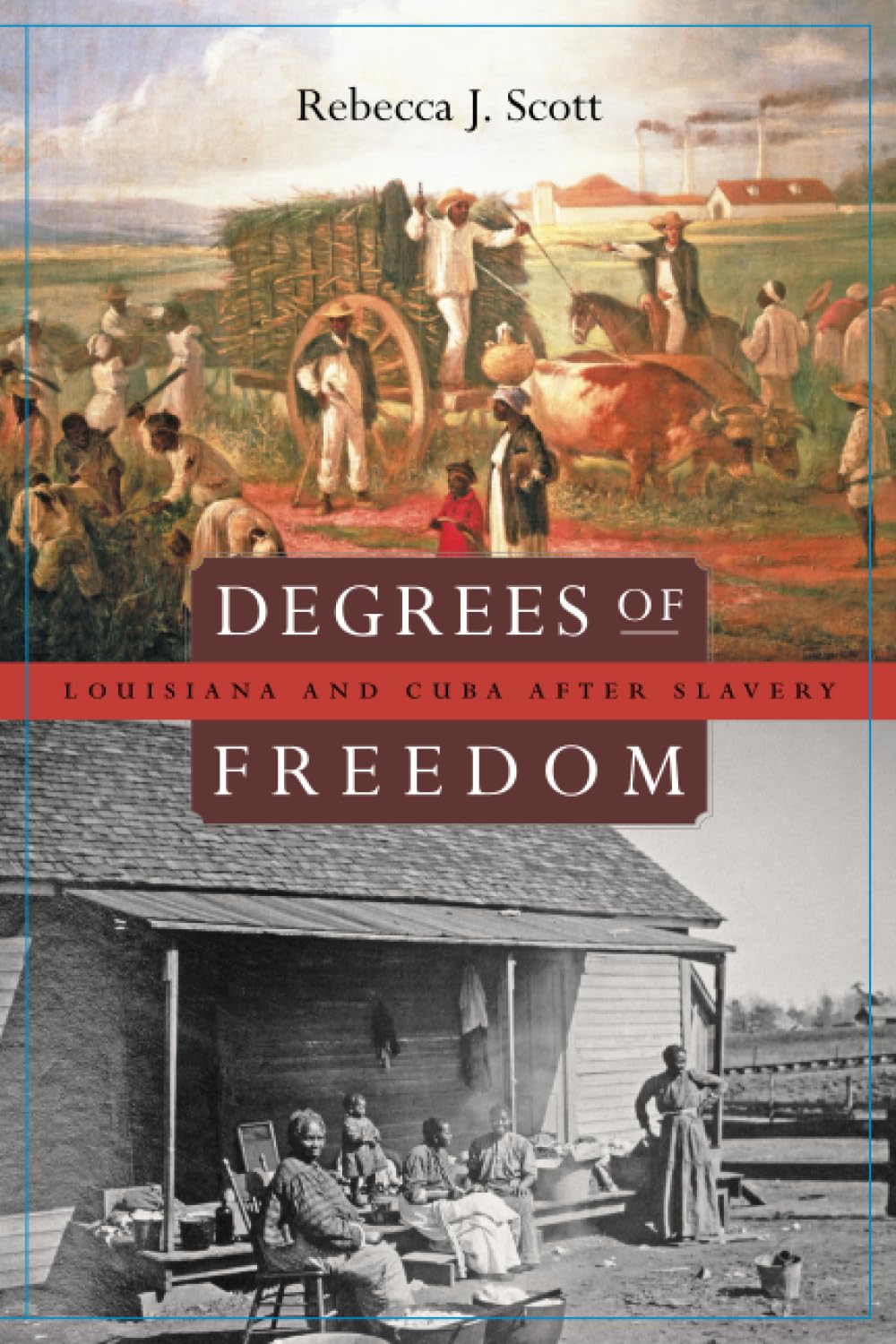
In Degrees of Freedom: Louisiana and Cuba after Slavery, Rebecca Scott writes that at the most basic level, violence played a key role in the transition from slavery to freedom in Louisiana through the Civil War. While Louisiana was under Union occupation, the presence of black soldiers played a key role in encouraging freedpeople to agitate for their rights. Later, freedpeople insisted on their public rights in order to assert themselves after years in which white authorities denied them. Even in the face of armed resistance and massacres, like that at the Colfax Courthouse, African Americans remained committed to asserting their basic rights in a free Louisiana. Finally, the elections of 1874 and 1876 demonstrated the deeply partisan nature of Louisiana politics through intimidation and opportunism.Scott writes, “In central Cuba, the interplay of free, enslaved, and smei-enslaved (including indentured Chinese workers) was almost continuous.” Slaves were in constant contact with “Chinese contract laborers who worked at the same tasks but under different rules.” Later, during the Ten Years’ War, the Spanish military treated free blacks and indentured Chinese equally, as a force for labor or a “runaway” group to be captured and put to work. Later, the 1887 census included the Chinese as persons of color. By the very presence, Chinese laborers offered an alternative to slave labor and the roles available to free blacks. Following emancipation, Chinese Cubans could act as electors in the new post-slavery society, demonstrating their assimilation.Scott writes, “The key legacy in both Cuba and Louisiana was a contest over the right to respect and resources, which increasingly encompassed a contest over the boundaries of citizenship…Louisiana is distinguished from Cuba by the ways in which the scope of this contest came to be successively narrowed.” In Louisiana, “the effects of constitutional disenfranchisement were at once practical, symbolic, and punitive, and they were deigned to undercut alliances along and across class lines – permanently.” African Americans’ political gains resulted from a war that divided the white citizens of Louisiana and the nation, so their disenfranchisement helped to reunify whites in the North and South. In Cuba, the dominant national narrative of a raceless society worked to undermine attempts to unify along racial lines. While this limited Cubans of color from forming their own alliances, as in the case of the Independent Party of Color, “voting and officeholding by men of color were now commonplace” after 1898. Scott writes, “The official ideology of the rebels portrayed racism as a legacy of slavery and colonialism, destined to be eliminated in a democratic Cuban republic.”
N**Y
The best kind of history
The subject is of interest to me, combining as it does both historical and legal issues in a nexus of great immediacy, i.e. the extent to which human beings could dispose of themselves and their bodies or be considered chattel. There was a wealth of information which was new to me. This is a book of discovery for the reader, the result of excellent research, and the text itself is lively and engaging, making it an extremely interesting book to read. A work of scholarship which can be easily read by the non-specialist is always a winner.
R**N
Very Good
First, disclosure of potential conflict of interest. The author and I are both faculty at the University of Michigan, though not in the same department. This is a very good comparative study of the aftermath of emancipation in Louisiana and Cuba. In Louisiana, emancipation was followed by the burst of African-American political participation during the Reconstruction period, then the gradual extinction of African-American civil rights that was the imposition of Jim Crow. In Cuba, on the other hand, emancipation was bound up with the cause of Cuban independence and the attainment of nationhood was accompanied by considerable political participation on the part of Afro-Cubans, and this became an enduring feature of Cuban life.In important respects, Louisiana and Cuba had important common features. Both were slaveholding societies with sugar plantation economies. Antebellum Louisiana, particularly the sugar producing parishes (counties) that are the focus of Scott's narrative, was a highly stratified 'slave' society with relatively small numbers of white owners lording over a large group of slave workers. Free blacks, and whites engaged in plantation labor were relatively sparse. The most important free black community in Louisiana was the urbanized and creolized community of New Orleans. Pre-independence Cuba, in contrast, was more diverse in some respects. There were substantial numbers of free Afro-Cubans, many whites who performed plantation labor, and other forms of ethnic diversity such as significant numbers of Chinese indentured laborers. Emancipation in Louisiana resulted from the Northern triumph in the Civil War (to which large numbers of southern black soldiers and sailors made crucial contributions) and the post-war maintenance of African-American civil rights depended on the sympathy of Northern politicians. The intensification of Northern racism and the desire to placate Southern whites led to the imposition of the Jim Crow system. In Cuba, the long struggle for independence was a multiracial, multiethnic phenomenon in which Afro-Cubans occupied prominent leadership roles. The nature of the Cuban society and the struggle for independence made imposing a Jim Crow like system difficult in Cuba. This was despite the American occupation of Cuba as the American overlords would clearly have preferred a system more like that of the American South.Well written and documented, this book features a number of interesting aspects beyond the main analysis. The narrative about Louisiana is a very good case study of the imposition of Jim Crow. None of this will be novel to knowledgeable readers but this is one of the best 'bottom up' descriptions of this tragic process I've read. Scott provides some interesting discussion of the roles of New Orleans Creole leadership and their pan-Caribbean perspective. All the discussion of Cuba will be new to most American readers and is very interesting While the topic of this book appears relatively narrow, it is generally illuminating.
S**L
Great Transnational Study
Scott lays out a well organized argument and supports her thesis with substantial documentation. Perhaps a bit of overkill on the documentation and stories in some areas but overall she makes a strong argument and provides illuminating insights to a transnational/comparative history topic that reveals a great deal about the dichotomy in attitudes regarding slavery in post Civil War American and in Cuba.
E**R
Substance excellent but print too light.
Very light printing. Made it a little hard to read. I had to be sure I used my reading glasses.
A**S
I am pretty upset.
There are no page numbers? This is completely worthless for a student who needs to be able to analyze the work in depth and discuss it critically in class. I am pretty upset.
Trustpilot
1 month ago
2 months ago