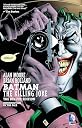


Batman: The Killing Joke, Deluxe Edition [Moore, Alan, Bolland, Brian, Bolland, Brian] on desertcart.com. *FREE* shipping on qualifying offers. Batman: The Killing Joke, Deluxe Edition Review: Alan Moore Does it Right, and Bolland Art Revision is Amazing - The Killing Joke was a comic spawned shortly after the work of Frank Miller, and is probably the comic that established The Joker as one of the most important fictional villains of the 20th century. Batman had become a well thought out, complex character in recent years, primarily due to the work of skilled writer Frank Miller. Batman had been brought into a gritty, modern world of comic books, but I always felt that Miller's The Dark Knight Returns failed to bring the antagonistic Joker into a new light...well it did, but not in the way the character was meant to be. Alan Moore, with the help of Brian Bolland's stunning artwork helped bring to life what is widely accepted as today's standard for the famous Harlequin of Hate. He's crazy, he kills people simply for his own twisted sense of humor, but always has a very zany, cartoonish attitude, which I felt was lacking in Miller's interpretation, where Joker seemed much too serious in appearance, dialogue, and action. The Joker presented in this graphic novel truly is a fiendish jester of fate, who for the most part is truly frightening, but never really acts like anything more than a loon. Bolland's art is very helpful in this aspect, not only bringing the Joker's exaggerated, skeletal body to life, but making it perhaps the most anatomically correct Joker ever seen, while still following the style of the 1970s Joker appearances. The story revolves around the long struggle between Batman and his foe, and their never ending conflict. Joker, having escaped from Arkham Asylum (again), has decided to prove that one bad day can transform any sane man into a monster, such as himself. Taking possession of an old carnival he's ready to do whatever it takes to prove his point, with the assistance of a circus freak show. Meanwhile The Dark Knight questions himself on how this fight will end; coming to the realization that sooner or later one of them would kill the other, unless they tried to reason it out. A hopeless plan by our hero, but he has to at least try a single time to reason with his arch-nemesis, just so he can say he tried. While Batman leads the hunt for the psychotic clown, Joker decides to prove his theory, kidnapping Commissioner Gordon, and shooting Barbara Gordon (Batgirl) through the spine (she never walks again). This is one of the most villainous acts in the history of comics; simply because of how pointless the shooting was, considering Barbara wasn't even in the character of Batgirl. She was just a bystander who Joker decided to use as a tool for his plot. Everyone is a puppet, or tool in his mind. He does this act all of this while wearing a stereotypical beach-going tourist's attire, complete with a large camera, the only exception being his wide-brimmed, purple hat, which conceal his eyes. These are the eyes of a madman, and in one of the comic's final pages his eyes are concealed in shadow once again, before they come out and you see him for the hopeless case he truly is. The story sets the stage for the most widely accepted Joker back-story through a series of flashbacks, showing him as a failed comedian with a pregnant wife, and soon winds up assisting criminals, and falling victim to tragedy. The character is shown to have had one bad day and that is how he ended up as the smiling super villain who has plagued Gotham City for decades. Of course this back-story isn't necessarily true, being that it comes from flashbacks spawned from Joker's mind, and as he famously states in his confrontation with Batman "If I'm going to have a past, I prefer it to be multiple choice!" Gordon's capture and torture leads to a fight between these two iconic characters, where Batman tries to see if it is possible to reason with Joker logically, but the villain doesn't even try to lie about what is obviously in store for them. He can never be reasoned with, and won't stop until he's dead, and Batman refuses to kill him so it's a sick cycle that goes round and round. In the end of The Killing Joke the roller coaster has only been reset and it will only be a matter of time before Joker is back on the streets, killing again with some new, random scheme which will only make sense to him alone, depending on the mood he's in at the time, or which version of his past he remembers. Alan Moore's story is sick, it's disturbing, and doesn't fail to leave the reader in a state of awe. The only problem is that by the end you crave for more! The story practically brings you to the point of begging for a sequel, or expansion which will probably never come. This is a one-shot story, and should remain that way, or else the original's impact may be lost. I don't have a single friend who doesn't think The Killing Joke is one of the most twisted, sick, most perfect stories of the comic medium. It's short, but it delivers a powerful punch! Brian Bolland's art makes this short graphic novel a masterpiece, providing some of the best art ever seen in the characters' long history, only rivaled (in my opinion) by the art of Alex Ross. Joker really is frightening to look at here, because he doesn't look like a real person in most aspects, but Bolland manages to make this character incredibly believable in appearance, without taking any liberties of changing the body type into something more universal. The tall, skeletal body of the 1970s comics is preserved for the most part, except for the narrowing of the chin, which improves the look even further (hence why it's universally used in today's comics). Recently I got the hardcover anniversary edition of The Killing Joke, with the artwork being edited by Brian Bolland, and re-colored by Bolland personally the way he intended it to be seen. I must say that I love the changes to the colors, more so than the cheery, bright colors of the original, which I felt distracted from Bolland's line-art, because the colors were way too traditional comic book, not fitting the intensity of the art. These colors are dark, gritty, and really captures to mood of the story more effectively than the bright colors of the original release. I especially love the flashbacks being in black and white, except for concentrating on objects that reflect the color red, which leads up to him taking on the garb of The Red Hood, before his first confrontation, leading to his ultimate disfigurement and insanity. This is a seriously talented artist and I only wish he was presented with more opportunities to draw these characters. Batman and Joker look their very best in these images, and I'd be hard pressed to find a comic with better consistency of art quality. The Killing Joke is one, if not THE best story in the history of Batman comics, and rightfully earns my rating of 10/10 stars. Review: One REALLY bad day. - "The Killing Joke" is widely considered to be the be-all-end-all of Joker stories, so what better way to pay homage to the greatest comic book villain of all time near the eve of his re-unveiling in The Dark Knight than by reviewing his definitive story? This is the comic that (sort of) revealed the origin of The Clown Prince of Crime, humanizing him to an extent never before, and truly examined -with pictures rather than words- the antagonistic symbiosis that exists between Joker and his arch nemesis, The Batman. A beloved Gotham regular will never be the same and another will be put through hell before this story is done. Oh, and there are creepy little henchmidgets as well. Gotta love the henchmidgets. The art is outstanding, the storytelling superb, and the character examinations are vital to understanding both combatants. The "one bad day" premise highlights the "two sides of the same coin" argument that Batman and Joker are in fact more alike than dissimilar. As if Bruce Wayne took a right when his arch-nemesis took a left. The controversial ending leaves little doubt as to Alan Moore's take on the debate, and I like it like that. While many critics have strongly resisted both the comparison and the somewhat sympathetic look at The Joker's past, the truth is that every great character -villain or hero- needs that sort of intricacy to their story to remain relevant in the world of modern fiction. Comics are no longer for children and adults realize that the world is seldom black and white, that all monsters were once men, and that unspeakable darkness and insanity resides deep inside each human mind. It can take years of suffering to bring them out or it can take one bad day. One bad day could ruin your very existence and everything you were; it's a frightening reality that cannot be overlooked while reading this comic. The more the reader is willing to ponder the ideas put forth by this story, the more you are likely to appreciate "The Killing Joke". An outstanding achievement in storytelling any way you look at it. I was tempted to knock this down to four stars because with this book you are buying a single issue of a comic for what you could easily pay for a full trade paperback or graphic novel of equal quality like, say, Frank Miller's The Dark Knight Returns , which is so good it may very well cure cancer (can you prove it doesn't?). But the fact is no Batman fan should be without "The Killing Joke" and I would rather stick to reviewing based on quality rather than haggling over price. The bonus story at the end (written and illustrated by TKJ artist Brian Bolland) is a killer little mini-comic that serves as a perfect companion piece to the main story and definitely sweetens the pot for those wondering if they should get this hardcover edition. "The Killing Joke" is an absolute mindless must-have for fans of the comic book medium and even more so if you claim to be a follower of The Caped Crusader or his twisted nemesis. End of story.
| ASIN | 1401216676 |
| Best Sellers Rank | #262,039 in Books ( See Top 100 in Books ) #208 in DC Comics & Graphic Novels #408 in Mystery Graphic Novels #722 in Superhero Comics & Graphic Novels |
| Customer Reviews | 4.7 4.7 out of 5 stars (7,812) |
| Dimensions | 7.4 x 0.5 x 11.3 inches |
| Edition | Deluxe |
| ISBN-10 | 5012256263 |
| ISBN-13 | 978-5012256263 |
| Item Weight | 15.2 ounces |
| Language | English |
| Part of Series | Batman: The Killing Joke |
| Print length | 64 pages |
| Publication date | March 19, 2008 |
| Publisher | DC Comics |
| Reading age | 1 year and up |
V**E
Alan Moore Does it Right, and Bolland Art Revision is Amazing
The Killing Joke was a comic spawned shortly after the work of Frank Miller, and is probably the comic that established The Joker as one of the most important fictional villains of the 20th century. Batman had become a well thought out, complex character in recent years, primarily due to the work of skilled writer Frank Miller. Batman had been brought into a gritty, modern world of comic books, but I always felt that Miller's The Dark Knight Returns failed to bring the antagonistic Joker into a new light...well it did, but not in the way the character was meant to be. Alan Moore, with the help of Brian Bolland's stunning artwork helped bring to life what is widely accepted as today's standard for the famous Harlequin of Hate. He's crazy, he kills people simply for his own twisted sense of humor, but always has a very zany, cartoonish attitude, which I felt was lacking in Miller's interpretation, where Joker seemed much too serious in appearance, dialogue, and action. The Joker presented in this graphic novel truly is a fiendish jester of fate, who for the most part is truly frightening, but never really acts like anything more than a loon. Bolland's art is very helpful in this aspect, not only bringing the Joker's exaggerated, skeletal body to life, but making it perhaps the most anatomically correct Joker ever seen, while still following the style of the 1970s Joker appearances. The story revolves around the long struggle between Batman and his foe, and their never ending conflict. Joker, having escaped from Arkham Asylum (again), has decided to prove that one bad day can transform any sane man into a monster, such as himself. Taking possession of an old carnival he's ready to do whatever it takes to prove his point, with the assistance of a circus freak show. Meanwhile The Dark Knight questions himself on how this fight will end; coming to the realization that sooner or later one of them would kill the other, unless they tried to reason it out. A hopeless plan by our hero, but he has to at least try a single time to reason with his arch-nemesis, just so he can say he tried. While Batman leads the hunt for the psychotic clown, Joker decides to prove his theory, kidnapping Commissioner Gordon, and shooting Barbara Gordon (Batgirl) through the spine (she never walks again). This is one of the most villainous acts in the history of comics; simply because of how pointless the shooting was, considering Barbara wasn't even in the character of Batgirl. She was just a bystander who Joker decided to use as a tool for his plot. Everyone is a puppet, or tool in his mind. He does this act all of this while wearing a stereotypical beach-going tourist's attire, complete with a large camera, the only exception being his wide-brimmed, purple hat, which conceal his eyes. These are the eyes of a madman, and in one of the comic's final pages his eyes are concealed in shadow once again, before they come out and you see him for the hopeless case he truly is. The story sets the stage for the most widely accepted Joker back-story through a series of flashbacks, showing him as a failed comedian with a pregnant wife, and soon winds up assisting criminals, and falling victim to tragedy. The character is shown to have had one bad day and that is how he ended up as the smiling super villain who has plagued Gotham City for decades. Of course this back-story isn't necessarily true, being that it comes from flashbacks spawned from Joker's mind, and as he famously states in his confrontation with Batman "If I'm going to have a past, I prefer it to be multiple choice!" Gordon's capture and torture leads to a fight between these two iconic characters, where Batman tries to see if it is possible to reason with Joker logically, but the villain doesn't even try to lie about what is obviously in store for them. He can never be reasoned with, and won't stop until he's dead, and Batman refuses to kill him so it's a sick cycle that goes round and round. In the end of The Killing Joke the roller coaster has only been reset and it will only be a matter of time before Joker is back on the streets, killing again with some new, random scheme which will only make sense to him alone, depending on the mood he's in at the time, or which version of his past he remembers. Alan Moore's story is sick, it's disturbing, and doesn't fail to leave the reader in a state of awe. The only problem is that by the end you crave for more! The story practically brings you to the point of begging for a sequel, or expansion which will probably never come. This is a one-shot story, and should remain that way, or else the original's impact may be lost. I don't have a single friend who doesn't think The Killing Joke is one of the most twisted, sick, most perfect stories of the comic medium. It's short, but it delivers a powerful punch! Brian Bolland's art makes this short graphic novel a masterpiece, providing some of the best art ever seen in the characters' long history, only rivaled (in my opinion) by the art of Alex Ross. Joker really is frightening to look at here, because he doesn't look like a real person in most aspects, but Bolland manages to make this character incredibly believable in appearance, without taking any liberties of changing the body type into something more universal. The tall, skeletal body of the 1970s comics is preserved for the most part, except for the narrowing of the chin, which improves the look even further (hence why it's universally used in today's comics). Recently I got the hardcover anniversary edition of The Killing Joke, with the artwork being edited by Brian Bolland, and re-colored by Bolland personally the way he intended it to be seen. I must say that I love the changes to the colors, more so than the cheery, bright colors of the original, which I felt distracted from Bolland's line-art, because the colors were way too traditional comic book, not fitting the intensity of the art. These colors are dark, gritty, and really captures to mood of the story more effectively than the bright colors of the original release. I especially love the flashbacks being in black and white, except for concentrating on objects that reflect the color red, which leads up to him taking on the garb of The Red Hood, before his first confrontation, leading to his ultimate disfigurement and insanity. This is a seriously talented artist and I only wish he was presented with more opportunities to draw these characters. Batman and Joker look their very best in these images, and I'd be hard pressed to find a comic with better consistency of art quality. The Killing Joke is one, if not THE best story in the history of Batman comics, and rightfully earns my rating of 10/10 stars.
T**N
One REALLY bad day.
"The Killing Joke" is widely considered to be the be-all-end-all of Joker stories, so what better way to pay homage to the greatest comic book villain of all time near the eve of his re-unveiling in The Dark Knight than by reviewing his definitive story? This is the comic that (sort of) revealed the origin of The Clown Prince of Crime, humanizing him to an extent never before, and truly examined -with pictures rather than words- the antagonistic symbiosis that exists between Joker and his arch nemesis, The Batman. A beloved Gotham regular will never be the same and another will be put through hell before this story is done. Oh, and there are creepy little henchmidgets as well. Gotta love the henchmidgets. The art is outstanding, the storytelling superb, and the character examinations are vital to understanding both combatants. The "one bad day" premise highlights the "two sides of the same coin" argument that Batman and Joker are in fact more alike than dissimilar. As if Bruce Wayne took a right when his arch-nemesis took a left. The controversial ending leaves little doubt as to Alan Moore's take on the debate, and I like it like that. While many critics have strongly resisted both the comparison and the somewhat sympathetic look at The Joker's past, the truth is that every great character -villain or hero- needs that sort of intricacy to their story to remain relevant in the world of modern fiction. Comics are no longer for children and adults realize that the world is seldom black and white, that all monsters were once men, and that unspeakable darkness and insanity resides deep inside each human mind. It can take years of suffering to bring them out or it can take one bad day. One bad day could ruin your very existence and everything you were; it's a frightening reality that cannot be overlooked while reading this comic. The more the reader is willing to ponder the ideas put forth by this story, the more you are likely to appreciate "The Killing Joke". An outstanding achievement in storytelling any way you look at it. I was tempted to knock this down to four stars because with this book you are buying a single issue of a comic for what you could easily pay for a full trade paperback or graphic novel of equal quality like, say, Frank Miller's The Dark Knight Returns , which is so good it may very well cure cancer (can you prove it doesn't?). But the fact is no Batman fan should be without "The Killing Joke" and I would rather stick to reviewing based on quality rather than haggling over price. The bonus story at the end (written and illustrated by TKJ artist Brian Bolland) is a killer little mini-comic that serves as a perfect companion piece to the main story and definitely sweetens the pot for those wondering if they should get this hardcover edition. "The Killing Joke" is an absolute mindless must-have for fans of the comic book medium and even more so if you claim to be a follower of The Caped Crusader or his twisted nemesis. End of story.
D**R
Whether or not you want to accept this as the one true Joker origin story it is still a fantastic comic. Alan Moore is so exact in his method (see Watchmen) that every note rings perfectly. Possibly my favourite standalone comic and such an amazing, ambiguous ending. If you're a Batman fan you've probably read it already, but if you're a new fan it's perfect for you as well.
A**N
Brilliant writing, art and quality! It's amazing how much story and emotions can be packed in less than 50 pages. I'll definitely revisit this piece of art again and again and I must recommend it to anyone who is into Batman and/or comics in general.
C**N
Para gente que le gusta leer una buena historia, o que se quieran introducir en el mundo de las novelas gráficas para adultos. Edición perfecta, con tapa dura y dibujos y bocadillos en su máxima expresión. De la historia, me sorprende lo bien hilada que está realizada a nivel argumental, las transiciones entre las diferentes escenas, o esos personajes que demuestran su naturaleza en toda viñeta y en toda sus acciones. Si estás buscando una historia adulta y te gusta Batman, no busques más y disfruta del guión original en inglés de Moore y los dibujos con toda nitidez de Bolland. Es de las mejores obras por méritos propios.
N**N
Before this I had red the Batman: The Greatest Stories Ever Told collection of short batman stories and so as I wanted to read more, this was the first thing I found from the net. And I was totally surprised. You can read reviews of the comic story itself elsewhere but I'll give you a little opinion: The art is aboslutely amazing, very detailed, considered and vibrant, Joker looks just totally sickening and some frames just make your heart stop for . And the story might be one of the best and deepest stories I have ever heard. It's simple but really toughtful as the story explains the motives of joker. Is he trying to prove that the humanity is a hopeless, sickening joke just to get attention and help, or is he gone totally insane, or something else? It's all about characters and their psychologies; what would you do after somebody you really cared about was suddenly taken away from you? How would you survive? In this way Batman's and Joker's characters mirror each other and make you think about the real people who try to prove that their lives are sad and worthless because the world is evil and incurable. In the ending of the Killing Joke there's one frame where Joker's shell starts to brake and for a second this evil character transforms into something sad, or even sympathetic. And it ends with Joker telling a joke that perfectly captures the relationship between batman and joker. And Batman understands. The introduction by Tim Sale and the afterword by Brian Bolland are written with sincerity and are totally worth a read. It also includes a morally questionable short story (8 pages) written and drawn by Brian Bolland that is surprisingly good and effective short story, even though it's pretty shocking and off-putting (even more than the actual Killing Joke story) as a boy implies that he would be ready to tie up a little girl and do perverted things to her just to ruin the lives of her family. But it's still a pretty neat extra. The book also includes a double page with some sketches for the Killing Joke as well as for the extra short story and every picture includes a caption from the artist himself. It's good as long as it lasts: I would have liked to see even more character concepts and sketches, but I'm glad that they included some of them anyway. The overall design of the book is black and beautiful, the iconic art on the dust jacket (which you'll really get only after reading the book)and the black-and-purple hard cover art are just as good as it gets. I think this might be the best comic I'll ever encounter. Or maybe that's going to be Watchmen after I get my hand on that.
G**R
Du très bon Alan Moore et du très, très grand Brian Bolland. Ah, ce dessin, ce dessin ! Brian Bolland à pulvérisé pas mal de confrères et pour longtemps avec cet album. La précision du trait, le mouvement, l'expression des protagonistes et les nouvelles couleurs, magistrales, qui rendent l'histoire encore plus glauque.
Trustpilot
2 months ago
1 week ago