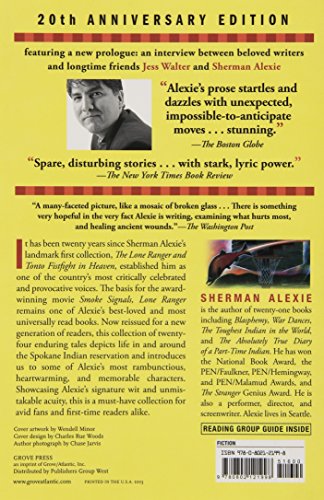

The Lone Ranger and Tonto Fistfight in Heaven (20th Anniversary Edition) [Alexie, Sherman] on desertcart.com. *FREE* shipping on qualifying offers. The Lone Ranger and Tonto Fistfight in Heaven (20th Anniversary Edition) Review: The most eye-opening story collection - "Mr. Alexie's is one of the major lyric voices of our time" New York Times Book Review editor Rich Nicholls wrote of Alexie after reading his work The Business of Fancydancing. Alexie opens The Lone Ranger and Tonto Fistfight in Heaven with this recollection, and I have to agree after reading his short story collection. Alexie shines light on the life of modern Indians, and all the tragedy and humor that goes along with growing up on a reservation. The twenty-four stories in this collection all center around Indians on the Spokane reservation and the different incidents that occur. Alexie writes with such intimacy about his characters that it becomes obvious some of these stories must be based in memory. Through his fiction Alexie manages to bring up painful issues of alcoholism and family strains that ring true for many in reservation life. The characters in Alexie's stories are the real gems of the collection. Victor and Thomas Builds-the-Fire stand out the most, as Victor narrators a majority of the stories either through first or third person. I felt the strongest stories in this collection centered on Victor and his family, whether it was dealing with the absence of his alcoholic father or his own alcoholism in later stories. Even though as a reader I had no experience with Indian Reservation life, through Alexie's exploration of personal relationships I connected with the characters. Thomas Builds-the-Fire, with his endless story telling, added amazing depth to the stories with references to Indian history and insight into the past. For readers not familiar with the past grievances between whites and Indians (Custer and Wounded Knee for example), some passages involving Thomas Builds-the-Fire might be slightly confusing. At times Alexie shifts from the present to the past without any warning, but this only makes the reader think more. Also, the weaving of the past and present adds demonstrates the importance of tradition for Indian culture. Overall, what gripped me about Alexie's story collection was how each story seamlessly flowed into the next while also being able to stand on its own. These stories could be read out of order or individually without losing any of their importance or meaning. My personal favorite, "Because My Father Always Said He Was the Only Indian Who Saw Jimi Hendrix Play `The Star-Spangled Banner"" uses a song to weave a tragic story of Victor's father abandoning him. It is the raw emotion; it is the ability of Alexie to allow his characters to admit their true feelings; it is Alexie's bravery to address controversial issues, that carries this collection. The Lone Ranger and Tonto Fistfight in Heaven is a powerful collection that celebrates the differences between Indians, while never forgetting the shared tragedy that links them. The unique stories, from betraying friends on rollercoasters to missing the winning basketball shot, demonstrate the complexity of the characters and the choices they must make. Alexie writes with such sharpness that readers can feel the haze of alcohol, can sense the ghosts of the past, and understand the importance of traditions they might have never known before reading this collection. This is one of the most eye-opening and magical collections and should be considered not just one of the most important books in Native American literature but American literature. Review: A rich and beautiful mosaic, even if I do prefer ABSOLUTELY TRUE DIARY - My only previous exposure to the work of Sherman Alexie has been his foray into YA fiction, The Absolutely True Diary of a Part-Time Indian, a book that I found hilarious, moving, and profound. The Lone Ranger and Tonto Fistfight in Heaven, meanwhile, is the book that put him on the map, and while I liked it quite a bit, I can say that it didn't connect for me the same way that Diary did. A series of short stories and vignettes orbiting around life on the reservation, Lone Ranger feels like it's playing a similar game to Tim O'Brien's The Things They Carried, using fiction to convey real experiences, and Alexie's notes on the book seem to confirm this, pointing to moments here and there that are drawn from his own life. Sherman's knack for language is undeniable, bringing a poetic sensibility to so many of these vignettes, to say nothing of a willingness to veer from literal to metaphorical without being overly concerned as to which is which or where we are. Sometimes that means plunging into stories told through myth; sometimes that means glimpses of alternate Americas; sometimes it's simply letting characters express themselves. The result is what I think of as a mosaic novel, one where the overall impact of the pieces - the overlapping characters, the motifs, the recurring threads of abandonment and alcoholism, the subsumed rage and frustration, the moments of hope - all create something that's cumulatively beautiful and effective. At the same time, though, these lean more vignettes than short stories - more glimpses of a moment in time than anything - and while I thought there was a lot of beauty here, I also struggled to really separate stories from each other so much as I did characters and moments. It's a beautiful and honest and darkly funny portrait of modern reservation life, and it's told with skill and grace; still, if you ask me, Diary is the one that I would tell people that they have to read, importance or no.
| Best Sellers Rank | #47,505 in Books ( See Top 100 in Books ) #32 in Native American Demographic Studies #109 in Indigenous Fiction #644 in Short Stories (Books) |
| Customer Reviews | 4.4 4.4 out of 5 stars (1,680) |
| Dimensions | 5.4 x 0.8 x 6.2 inches |
| Edition | 20th Anniversary |
| ISBN-10 | 0802121993 |
| ISBN-13 | 978-0802121998 |
| Item Weight | 11.2 ounces |
| Language | English |
| Print length | 304 pages |
| Publication date | October 8, 2013 |
| Publisher | Grove Press |
E**Z
The most eye-opening story collection
"Mr. Alexie's is one of the major lyric voices of our time" New York Times Book Review editor Rich Nicholls wrote of Alexie after reading his work The Business of Fancydancing. Alexie opens The Lone Ranger and Tonto Fistfight in Heaven with this recollection, and I have to agree after reading his short story collection. Alexie shines light on the life of modern Indians, and all the tragedy and humor that goes along with growing up on a reservation. The twenty-four stories in this collection all center around Indians on the Spokane reservation and the different incidents that occur. Alexie writes with such intimacy about his characters that it becomes obvious some of these stories must be based in memory. Through his fiction Alexie manages to bring up painful issues of alcoholism and family strains that ring true for many in reservation life. The characters in Alexie's stories are the real gems of the collection. Victor and Thomas Builds-the-Fire stand out the most, as Victor narrators a majority of the stories either through first or third person. I felt the strongest stories in this collection centered on Victor and his family, whether it was dealing with the absence of his alcoholic father or his own alcoholism in later stories. Even though as a reader I had no experience with Indian Reservation life, through Alexie's exploration of personal relationships I connected with the characters. Thomas Builds-the-Fire, with his endless story telling, added amazing depth to the stories with references to Indian history and insight into the past. For readers not familiar with the past grievances between whites and Indians (Custer and Wounded Knee for example), some passages involving Thomas Builds-the-Fire might be slightly confusing. At times Alexie shifts from the present to the past without any warning, but this only makes the reader think more. Also, the weaving of the past and present adds demonstrates the importance of tradition for Indian culture. Overall, what gripped me about Alexie's story collection was how each story seamlessly flowed into the next while also being able to stand on its own. These stories could be read out of order or individually without losing any of their importance or meaning. My personal favorite, "Because My Father Always Said He Was the Only Indian Who Saw Jimi Hendrix Play `The Star-Spangled Banner"" uses a song to weave a tragic story of Victor's father abandoning him. It is the raw emotion; it is the ability of Alexie to allow his characters to admit their true feelings; it is Alexie's bravery to address controversial issues, that carries this collection. The Lone Ranger and Tonto Fistfight in Heaven is a powerful collection that celebrates the differences between Indians, while never forgetting the shared tragedy that links them. The unique stories, from betraying friends on rollercoasters to missing the winning basketball shot, demonstrate the complexity of the characters and the choices they must make. Alexie writes with such sharpness that readers can feel the haze of alcohol, can sense the ghosts of the past, and understand the importance of traditions they might have never known before reading this collection. This is one of the most eye-opening and magical collections and should be considered not just one of the most important books in Native American literature but American literature.
J**E
A rich and beautiful mosaic, even if I do prefer ABSOLUTELY TRUE DIARY
My only previous exposure to the work of Sherman Alexie has been his foray into YA fiction, The Absolutely True Diary of a Part-Time Indian, a book that I found hilarious, moving, and profound. The Lone Ranger and Tonto Fistfight in Heaven, meanwhile, is the book that put him on the map, and while I liked it quite a bit, I can say that it didn't connect for me the same way that Diary did. A series of short stories and vignettes orbiting around life on the reservation, Lone Ranger feels like it's playing a similar game to Tim O'Brien's The Things They Carried, using fiction to convey real experiences, and Alexie's notes on the book seem to confirm this, pointing to moments here and there that are drawn from his own life. Sherman's knack for language is undeniable, bringing a poetic sensibility to so many of these vignettes, to say nothing of a willingness to veer from literal to metaphorical without being overly concerned as to which is which or where we are. Sometimes that means plunging into stories told through myth; sometimes that means glimpses of alternate Americas; sometimes it's simply letting characters express themselves. The result is what I think of as a mosaic novel, one where the overall impact of the pieces - the overlapping characters, the motifs, the recurring threads of abandonment and alcoholism, the subsumed rage and frustration, the moments of hope - all create something that's cumulatively beautiful and effective. At the same time, though, these lean more vignettes than short stories - more glimpses of a moment in time than anything - and while I thought there was a lot of beauty here, I also struggled to really separate stories from each other so much as I did characters and moments. It's a beautiful and honest and darkly funny portrait of modern reservation life, and it's told with skill and grace; still, if you ask me, Diary is the one that I would tell people that they have to read, importance or no.
J**N
A Most Entertaining Read
Sherman Alexie is a wonderful writer. This collection of short stories is a winner. Whether he’s called Native American, Indian or simply author extraordinaire, Sherman is entertaining, enlightening and educational in his stories about life near and in the Spokane Reservation. This is really a most entertaining book and a pleasure to read.
A**E
Phenomenal
The stories never ended where I expected but took me to places where it felt right. Humor and insight fills this book as it delves into the contemporary Indigenous experiences. The book is haunting yet magical. This is a book for storytellers and their audience. A masterful work.
R**N
Hard To Read, Then Hard To Put Down
I've heard of Sherman Alexie for years, but never read any of his books until now. I wasn't even certain I was going to be able to get through the book, because so many of the stories are heartbreaking, and considering what is going to happen within the next 4 years, I wasn't certain I could take anything depressing before then. But, I did read the entire book, because once I started, I couldn't put it down for very long. All of the writing is beautiful. Some of it is difficult for me to understand entirely. There are pieces and parts of some stories that are laugh-out-loud funny. Others, not so much. My favorite story in this series of short stories is "Indian Education." I ended up liking this book so much that I have purchased another Sherman Alexie book to read.
V**E
Livre reçu en temps et en heure. Aucun soucis à relever il n’est pas abîmé et c’est bien l’article conforme à la description.
M**A
This was a difficult review to leave, as I've read and loved this novel in the past and was excited to add it to my collection. Unfortunately, I paid for a hardcover but received a slightly damaged paperback instead, with noticeable tears on the front cover. I wish there had been a way to contact the seller directly, but the only option was to go through the returns process (a logistical headache when residing in Australia). As for "The Lone Ranger and Tonto Fighfight in Heaven," it's a reckoning. An attempt to translate the grief and grit of indigenous life into language that cuts, lingers, and refuses to be ignored. Through recurring characters, most notably Victor Joseph and Thomas Builds-the-Fire, Alexie paints a portrait of reservation life, exploring themes of historical erasure, systemic oppression, poverty, alcoholism, loss, generational trauma, and fractured masculinity. But it's not without it's weapons... dark humour, cultural resilience, and biting self-awareness. Rather than following a traditional arc, the stories move like snapshots or nonlinear dispatches of memory. Some stories are tender and introspective; others are sharp jabs at racism, media caricatures, and institutional neglect. Alexie refuses to let the reader sit comfortably, leaving a collection that demands to be read, re-read, and remembered.
A**R
Great book
M**8
Bought this after seeing Smoke Signals, but don't expect the same lighthearted tone. The author doesn't gloss over the severe social issues facing North American Indians. Some of these stories were the most depressing reads I've had in a long time. But having my eyes opened to a world I know nothing about is a good thing. Hence four stars.
G**K
A good read
Trustpilot
1 month ago
3 weeks ago