Some deliveries may take a little longer than usual due to regional shipping conditions.

DOWNLOAD THE APP


Customer Services
Copyright © 2025 Desertcart Holdings Limited
DOWNLOAD THE APP

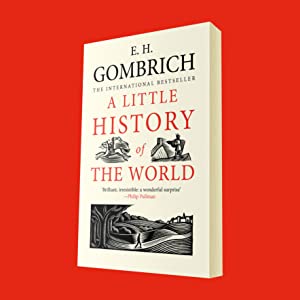
A Little History of the World : Gombrich, E. H., Harper, Clifford: desertcart.ae: Books Review: Muy interesante y facil de leer. Review: We love this book! It is comparable to Susan Wise Bauer's "Story of the World" series, but it does not provide as much in-depth detail. It's more of a sweeping panoramic view of world history, and moves quickly from one nation or stage to another. Gombrich makes very clear the connections between different world events and later ones in history. For example, the connections between the Napoleonic Wars and the advent of WW1 are made obvious. Gombrich does not glorify the violence in human history, and one can see that he might have been unpopular in 1930s Nazi Germany had he remained there. The perspective on world history is much different than Bauer's American/British perspective. Gombrich comes from a more German/European-centred perspective and provides accounts of some historical events that I had completely forgotten about! Gombrich wrote this book for German children, because he wanted to provide a different perspective. It was only translated into English in the late 1990s because he felt that English-speakers would not be interested in his perspective. Despite being aimed at children, it's easy history reading for anyone, and I have enjoyed this as much as, or more than, my children. I would recommend this for children ages 6 and up.

| ASIN | 030014332X |
| Best Sellers Rank | #43,834 in Books ( See Top 100 in Books ) #46 in History Reference Material for Young Adults #161 in Western Philosophy #161 in History of the Americas |
| Customer reviews | 4.6 4.6 out of 5 stars (1,373) |
| Dimensions | 21.39 x 14.17 x 2.41 cm |
| Edition | Illustrated |
| Grade level | 7 - 9 |
| ISBN-10 | 9780300143324 |
| ISBN-13 | 978-0300143324 |
| Item weight | 1.05 Kilograms |
| Language | English |
| Print length | 304 pages |
| Publication date | 15 September 2008 |
| Publisher | Yale University Press |
| Reading age | 13 - 17 years |
E**Z
Muy interesante y facil de leer.
K**P
We love this book! It is comparable to Susan Wise Bauer's "Story of the World" series, but it does not provide as much in-depth detail. It's more of a sweeping panoramic view of world history, and moves quickly from one nation or stage to another. Gombrich makes very clear the connections between different world events and later ones in history. For example, the connections between the Napoleonic Wars and the advent of WW1 are made obvious. Gombrich does not glorify the violence in human history, and one can see that he might have been unpopular in 1930s Nazi Germany had he remained there. The perspective on world history is much different than Bauer's American/British perspective. Gombrich comes from a more German/European-centred perspective and provides accounts of some historical events that I had completely forgotten about! Gombrich wrote this book for German children, because he wanted to provide a different perspective. It was only translated into English in the late 1990s because he felt that English-speakers would not be interested in his perspective. Despite being aimed at children, it's easy history reading for anyone, and I have enjoyed this as much as, or more than, my children. I would recommend this for children ages 6 and up.
L**L
E.H. Gombrich is probably best known as the author of a wonderful book on the History of Art, which I guess must have made its way, at some time, to every Art lovers bookshelf. I recently discovered that he had, as a young man, written a wonderful history book for children, which was published in Austria in 1935, much later, translated into twenty five languages, , but only towards the end of Gombrich’s life (he died in 2001) did he produce an English version. This has also updated the History, taking it to the collapse of the Soviet bloc. Gombrich, born in Vienna in 1909, was an Austrian Jew, and made his home in England in 1936. He originally wrote A Little History of The World, a history book for children, when he had been commissioned to translate an English history book into German. Gombrich was not very complimentary about the history book, instead, suggested to be publisher that he could do rather better, by writing a book about history himself, for children, The publisher took him up on this, and, quite astonishingly, he wrote his wonderful ‘little history’ in 6 weeks . The sweep of this effortlessly readable book starts in prehistory, and in 40 chapters arrives at the tail end of the twentieth century. Whilst there is a major focus on European history, what Gombrich is really looking at is a kind of exploration of empires – whether these are empires of the mind, of ideology, ideas, religions, politics and of course the regrettable history of empires won and lost through club, sword, firearm, bomb and all the rest of mankind’s panoply of destructive devices. It has to be said, an account of several thousands of years of interminable war, war which almost every tribe humanity might belong to (whether city states, nation states, countries, followers of religious, political or other belief systems) seems, if it gets any sort of power, to want to batter another grouping into submission to, makes for pretty depressing, despairing reading. In some ways, stunning though this is, I’m quite glad I didn’t read it as a child, since I’m pretty sure I might have succumbed to hopelessness. What absolutely makes this book at all possible, in terms of a sensitive young mind not getting overwhelmed and distraught by our peculiar species, is the great warmth, the immense humanity, and, yes, despite our bloody history, the compassionate optimism of Gombrich, who at every turn also sees the wonders and the marvels, the intelligence, the curiosity, the excitement and the heart that is also humanity’s heritage. And then there is the far from small matter that he writes like a dream, talks directly to, rather than down to, his intended young audience – not to mention his admiring older audience. He will, I hope, reach small people who might, by this, want to take charge of learning the sad lessons of the past, in order to help us to better avoid repeating errors in the future. Here is Gombrich, with a wonderfully poetic and heartfelt, not to mention wise and encouraging, exhortation to his young audience, on the theme of time, and history itself, as a river. He has taken his audience on an imaginary journey, flying along the river of time, from prehistory to the present, and presents this spacious, soulful image : “From close up, we can see it is a real river, with rippling waves like the sea. A strong wind is blowing and there are little crests of foam on the waves. Look carefully at the millions of shimmering white bubbles rising and then vanishing with each wave. Over and over again, new bubbles come to the surface and then vanish in time with the waves. For a brief moments they are lifted on the wave’s crest and then they sink down and are seen no more. We are like that. Each one of us no more than a tiny glimmering thing, a sparkling droplet on the waves of time which flow past beneath us into an unknown, misty future. We leap us, look around us and, before we know it, we vanish again. We can hardly be seen in the great river of time. New drops keep rising to the surface. And what we call our fate is no more than our struggle in that multitude of droplets in the rise and fall of one wave. But we must make use of that moment. It is worth the effort.” This is a marvellous, fascinating, deeply thought provoking, highly engaging and interesting book
M**N
Originally published in 1935 in German in Austria this wonderful book is still around – and very much worth-reading. It has clearly stood the test of time. Challenged by his publisher to write a history book that children and teeangers might find interesting, Gombrich wrote this book in six weeks – without a PC or internet. Since he was a Jew he left Austria a year after the publication of this book and saved his life by emigrating to England which he he made his new home. Starting in pre-history the history of the world is dealt with in 40 chapters – and not as euro-centric as you might expect from this time period. Basically Gombrich looks at the rise and fall of Empires – whether of politics, of ideology, ideas, or religions. So to start and keep them, just to lose them eventually all the detructive devices mankind has devised are explored. So war is the dominant factor that remains constant throught the history of mankind. Whenever one group acquires some kind of power it used the power to batter another group into submission. That pattern never changes and taking a look a history today there is no change for the better in sight. Gombrich, however, writes about these things in a compassionate way and is even optimistic. His intellectual curiousity is always there as warming light and makes the reading interesting and enlightening. He always stresses the positive aspects of human heritage By addressing young people there is always the hope encourage them to stem the river of histroy and guide into another direction. He really writes about history in a poetic way. Hje comapres historyto a river: „ Look carefully at the millions of shimmering white bubbles rising and then vanishing with each wave. Over and over again, new bubbles come to the surface and then vanish in time with the waves. For a brief moments they are lifted on the wave’s crest and then they sink down and are seen no more. We are like that. Each one of us no more than a tiny glimmering thing, a sparkling droplet on the waves of time which flow past beneath us into an unknown, misty future. We leap us, look around us and, before we know it, we vanish again. We can hardly be seen in the great river of time. New drops keep rising to the surface. And what we call our fate is no more than our struggle in that multitude of droplets in the rise and fall of one wave. But we must make use of that moment. It is worth the effort.” This book provides a great overview on the history of mankind and appeals to children and adults alike. 5 well deserved stars.
N**A
After finishing a book, have you ever felt, I wish I had read it when I was much younger! This is one such book. If you have an interest in History or Non-fiction, you will tremendously enjoy this book. Primarily written for children, it will make a wonderful gift for any child who loves reading. And if you are a parent, looking for good books for your children outside of the ‘school course books’ to encourage their curiosity about reading (and the the world) in ‘general’, gift it to your child. After they finish, you will want to discuss it with them! I have already gifted 2 copies to kids in my family. This success of this book over the past 70 year (or more!) since its first publication has started a whole series of copies – ‘A Little History of Literature’ (then there is Science, Philosophy and United States, that I can remember!) I am quiet sure more topics are on their way. But pleaseremember, this was the one gem that started it all. Highly recommended – for all curious humans ‘big and small’!
Trustpilot
2 weeks ago
3 days ago