We remain fully operational. Our teams are working around the clock to ensure your deliveries continue safely.

DOWNLOAD THE APP


Customer Services
Copyright © 2025 Desertcart Holdings Limited
DOWNLOAD THE APP


🚗💨 Bleed brakes like a pro—fast, flawless, and all on your own!
The Motive Products 0100 European Power Brake Bleeder Kit is a high-quality, rust-resistant tool designed for efficient one-person brake fluid bleeding. Featuring a 45mm threaded adapter compatible with most European cars, it uses pressurized brake fluid to effectively remove air and old fluid from brake lines. This durable, American-made kit offers a cost-saving, professional-grade solution for home, shop, or track use.

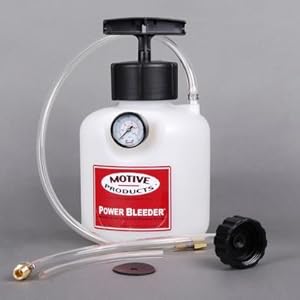
| ASIN | B0002KM5L0 |
| Best Sellers Rank | #27,064 in Automotive ( See Top 100 in Automotive ) #46 in Brake System Bleeding Tools |
| Brand | Motive Products |
| Customer Reviews | 4.1 4.1 out of 5 stars (2,790) |
| Date First Available | July 2, 2004 |
| Is Discontinued By Manufacturer | No |
| Item Weight | 2.65 pounds |
| Item model number | 100 |
| Manufacturer | Motive Products |
| Manufacturer Part Number | 100 |
| OEM Part Number | 100 |
| Position | Rear |
| Product Dimensions | 11.9 x 8 x 6.9 inches |
W**R
Definite Buy! Don't waste money on a mityvac! Get a power bleeder!
I really truly love this device. It is by far both the best and the quickest way to bleed your brakes that I have ever found. I've bought and used every type of bleeder out there, and this style is by far my favorite. I've tried the whole pedal pump method, and let's face it...it sucks. Not only that, but it's actually a good way to kill your master cylinder too! The rod inside the MC is only used to traveling so far, but when you're bleeding your brakes it can easily go too far. It ends up destroying internal seals, and you end up wondering why on earth your brakes won't work anymore no matter what you do. 6 months ago I bought a "MityVac"...worst product ever made! Within a few days it was falling apart, and it honestly just never worked all that well to begin with. It actually snapped in half earlier today. I will say that it was better than bleeding your brakes by pumping the pedal, but not by a lot. The only other method I can really highly recommend for brake bleeding is the gravity method. It works wonderfully in almost every situation. I can't say for sure how it works with ABS systems without a scan tool, but it works great in pretty much every normal situation you can think of. The problem, however, is that it takes forever! It's literally a 12-24 hour long process to gravity bleed your brakes. On the plus side, you only need to be there at the beginning and the end, but still... The Power bleeder...requires the absolute least amount of effort, and you can bleed your brakes in like 10 minutes. You fill it up with fluid. You pump up the pressure, and you go around the car cracking each bleeder screw one at a time. The best part? You don't have to keep an eye on the fluid level. You don't have to go add more every few minutes. You don't have to go through a whole setup process at each wheel. You've got pressure going to all 4 wheels, so crack any one of them you like. Actually, you have pressure going to the master cylinder outlets too for that matter! I did a really half...you know what...job of bench bleeding my new master cylinder, but the power bleeder worked just fine with it. I just used the power bleeder to bleed the MC in the car by cracking the line open for a few seconds before moving on to the wheels. It worked great, and I've got a perfectly firm pedal after maybe 10 minutes of work. I can not recommend this product enough! DO NOT WASTE YOUR MONEY ON A MITYVAC!!! GET A POWER BLEEDER!!!
J**Z
Worked very well
Did exactly what it’s supposed to. Struggled to get it over 10 psi though. I think I had a leak somewhere, probably my fault.
D**.
Why pay the dealer $350 for a job you can do yourself for less than $50 (after you buy this tool)
All cars should have their brake fluid replaced every 3 years. The fluid absorbs water over time and reduces braking performance. Replacing the fluid is called "bleeding the brakes" and requires 2 people unless you have a tool like this. I've used Motive products for nearly 20 years. They are a US company and make a very high quality product. Watch a few YouTube videos to learn how to do it and then have at it. It takes about 2 hours for the novice and will save you about $200 each time you do it. You more than pay for the tool the very first time you use it!
A**R
Junk after a couple of months sitting.
Used once and it worked great. Went out a couple of months later to do another brake job and the hand pump won’t hold pressure. Pumps air in but leaks back out around pump handle shaft. Pretty pathetic for price of one time use. Will look into another company.
M**S
Nice Product
I just used this and the companion bleeder bottle to change out the brake fluid on my VW Tiguan. I have never done this before, but found it to be straightforward and not all that difficult. From the YouTube videos I watched, I knew you don't really need these things, but they make it a lot easier and less chance of messing things up by getting air in the master cylinder. Some points: 1) As the top comment says, there is no swivel between the cap and the pump. You should have the adapter part fairly snug with tape on the fittings (same as you would use in plumbing) before you put it under pressure. I only did it hand tight and did have some minor leakage (no big deal, just put a paper towel under it). When you put the cap on the fluid reservoir, you have to turn the whole bottle along with it. Not too much of a problem without fluid already in it, but a bit of a pain if you dumped a bunch in. 2) Things you will need besides this and brake fluid: Lots of paper shop towels. Brake fluid is nasty stuff. You want to clean it off off any surface or yourself quickly. A cheap turkey baster. Get the old fluid out of the reservoir and have a bottle to put it in. Denatured alcohol. This is stuff you find in a Home Depot paint section. Use it to clean the bleeder and the bottle. The directions make a point of saying to use that instead of brake cleaner.
J**R
An exceptional quality tool
I'm going to do two reviews on this: initial impressions, and impressions in use. All the car nuts reading this know what this tool is for, but maybe you're looking for a gift for a car nut (hint: this would be a really good one) and you're wondering what this is. Follow along. You have hydraulic brakes on your car, and they are fairly simple things: your foot pushes the brake pedal. The brake pedal pushes a piston in the master cylinder. The piston pushes brake fluid into a series of steel tubes and rubber hoses...which are already full of brake fluid. The new fluid pushes old fluid against pistons at the wheels of your car. The pistons push against abrasive pads. The pads push against steel discs that are rotating (because the wheels of your car are bolted to them) and cause them to slow down and, eventually stop. Good so far? All this works great if the only thing in your brake system is brake fluid...but if air gets in there some of the force of your foot will go into compressing the air instead of stopping your car, which gives you longer stopping distances - not what you want. And air looks for ways to get into your brake system. You, therefore, will have to get it out in a process called "bleeding the brakes." There are three basic ways to bleed your brakes. The "classic" way to do it is to stick someone with a very strong right leg in the driver's seat of your car, while you sit beside your car with a box-end wrench on the bleeder valve at the wheel. He pumps then holds the pedal down, and you open the bleeder valve and watch for bubbles. When that one's bubble-free you go to another. This takes forever to do, you go through a lot of brake fluid, and you wind up owing your buddy a lot of beer. Then there's the "vacuum pump" method. It's the same basic thing as the "classic" way but instead of using your formerly best friend, you use a little handheld vacuum pump to suck the bubbles out of your brake system. I've known a lot of people who tried it this way. I don't know anyone who's actually gotten his brakes to bleed this way. The problem is, the vacuum pump pulls air through the minuscule gap between the bleeder valve and the hose you stuck on it. Which brings us to power bleeding, the method every manufacturer recommends. You get a replacement cap for your master cylinder that has a hose sticking out of it. It is plumbed to a tank of brake fluid that's connected to your shop air supply. You hook it all up, hook a hose to a bleeder valve, submerge the other end of the hose in brake fluid, turn on the pressure, crack the bleeder, then stand back and watch all the worn-out fluid, air and crud get shoved out of your brake system, just as pretty as a picture. Which, as you may have guessed, is why manufacturers like pressure bleeding! The only problem with pressure bleeding has pictures of dead presidents on it: they used to cost hundreds and hundreds of dollars. Then someone must have been in the garden aisle at the hardware store, noticed the pump-up weed sprayer, and realized the same basic device could be used to pressure bleed brakes. Which leads us to the subject of this review. The Motive Power Bleeder is made out of plastic that feels like it's at least 1/4" thick. It has a gauge that seems like it will hold up, a nice-quality air pump, some clear tubing and brass fittings. Included with it is a separate little sack that contains the adapter for your master cylinder, and about a foot of hose to shove over the bleeder valves and dunk in brake fluid. You can't lose the instruction book because it's printed right on the container. In all, a very nice presentation. This comes in several models. The difference is the adapter. If you get the wrong one don't worry, they sell adapters separately. Once my new master cylinder gets here I'll review this thing's performance. The quality of the product, and the other million glowing reviews of this thing, make me hopeful.
C**I
Best tool for brakes ever.
I have no idea why I didn’t get one of these sooner. Amazing, efficient, and makes brakes a one person job. Can be a bit messy until you get the hang of it. But amazing.
Y**P
Had some issues with 2006 Audi A6 C6, but ok with 2001 Audi A6 C5
Worked very well on my brother's 2001 Audi A6 Quattro 2.7T V6. Cap was tight and right size, kept pressure most of the time. But then I tried changing brake fluid on my 2006 Audi A6 Quattro 3.2 V6. It was a MESS! The cap seemed same size as my brake fluid reservoir cap and screwed pretty good on the reservoir. Though, if I tried to screw it even more the cap would pop back up and become unscrewed. I screwed it back til I felt it was tight enough without over screwing it and I started pumping air to about 20psi to test out leaks. Everything looked fine and I started pumping fluid. At first everything seemed was going fine. But then cap popped up from under pressure and all the fluid started coming from the sides, dripping on my firewall and driveway floor. I had to unscrew the pump to let the pressure out, to stop the flow. I tightened the cap again, cleaned the area around and started pumping pressure again. Same thing happened the second time. After that I figured to get little pressure in the tank and unscrew the bleeder screw/nipple on the brake caliper to let the fluid out and then pump some more pressure. This way it would have less pressure on the cap and reservoir. And when I screwed the bleeder screw/nipple to stop the flow, I would unscrew the pump to let the pressure out and keep the cap free from pressure. I repeated same procedure for all other brakes. Worked pretty well. Here are some bleeding sequence and instructions for Audi's with ESP: Apply 28 PSI pressure to brake fluid reservoir and open bleeder screw/nipple Bleeding sequence for left and right hand drive vehicles 1 - Left front brake caliper 2 - Right front brake caliper 3 - Left rear brake caliper 4 - Right rear brake caliper - Bleed until brake fluid escapes with no bubbles and foam. - Close bleeder screw. Overall, the product is made very well and sturdy. Not going to break any time soon for sure. I wish they would have made the pressure tube and adapter with quick release coupling instead of screw in. It was a pain to screw the cap onto the brake fluid reservoir or to adapter and rotate the whole pressure tank. The tubes are long and not really flexible so you have to turn the whole together to just to screw something in. It comes in nice packaging, with instructions written right on the pressure tank. Really handy and nicely placed when you need them and you will never lose them. Bleeder tube comes included but it was too big for my brother's front brake calipers. Good thing we had some smaller tubes.
Trustpilot
1 month ago
2 days ago