We remain fully operational. Our teams are working around the clock to ensure your deliveries continue safely.

DOWNLOAD THE APP


Customer Services
Copyright © 2025 Desertcart Holdings Limited
DOWNLOAD THE APP
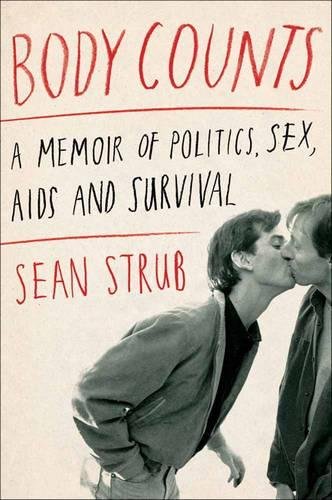
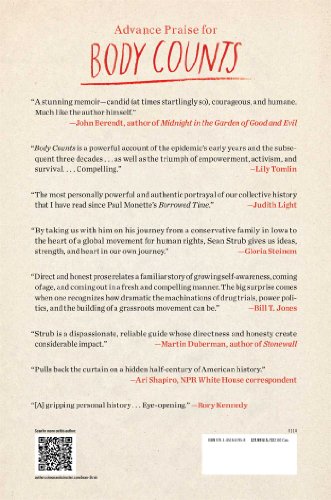
Full description not available
F**N
Required Reading
Sean Strub's BODY COUNTS should be required reading for anyone interested in the AIDS epidemic in this country. It is one of those books that is difficult to put down. As I read it, I was reminded how much Mr. Strub's story mirrors that of all of us who were alive and young in large cities in that awful time in the 1980`s and 90`s until the drug cocktail became available in 1996 when we literally saw our friends come back from deathbeds in a matter of weeks. We first read of gay men dying of a strange affliction in the NEW YORK NATIVE in 1981, then it was called gay cancer, then something called GRID and finally AIDS. And Larry Kramer's front page article in the NEW YORK NATIVE, "1,112 and Counting," in 1983 sent shock waves into the gay community across this country. We found out just how bad homophobia and fear really were when funeral homes refused to accept our dead. We would hear in a casual conversation with friends that someone whom we had not seen in a few months had died. Families had gay sons whose obits in their home town newspaper listed the cause of death as cancer. And like the author, I remember the first person I ever knew who had AIDS. Mr. Strub's memoir brings it all back home.We would expect the man who founded the magazine POZ to write an honest-take-no-prisoners account of what happened, and he does. All the usual villains are here. Here are some of them: when Ronald Reagan spoke the word "AIDS" for the first time in 1987, way into his second term as President, twenty-one thousand Americans had already died of it. Anthony Fauci at the NIH was uncooperative in 1987 in writing guidelines recommending the inexpensive drug Bactrim to prevent PCP in PWA's even though infectious disease specialists had known as early as 1977 of its effectiveness. When the guidelines were finally issued in 1989, 30,534 people in the U. S. had died of PCP, and approximately 16,929 of the deaths had occurred between the time Fauci was first approached and the date the guidelines were issued. And Bill Clinton gets tarred and feathered too. Mr. Strub feels betrayed by him, someone whose candidacy for President he and so many others had supported, hoping for great things from him. What we got was "Don't Ask; Don't Tell," the Defense of Marriage Act that Clinton now admits was unconstitutional and his refusal to lift the ban on the use of federal money to fund needle-exchange programs to reduce HIV transmission. In Strub's words: "Like many other people with HIV, I felt betrayed by Clinton because I'd believed him during his campaign when he told my ACT UP colleague Bob Rafsky, 'I feel your pain.'" (Mr. Strub also outs Donna Shalala as a closet lesbian.) And he recounts in great delightful detail when he and six others put a gigantic condom on Senator Jesse Helms' house in Arlington, Virginia. Helms he describes as the man in public life who was the greatest enemy of people with AIDS. Finally the author begins his narrative with the protest in December, 1989 at St. Patrick's Cathedral in New York when ACT UP protesters interrupt John Cardinal O'Connor's Mass because of his position of safe sex and reproductive rights. When Mr. Strub goes to the altar ostensibly to take communion, the priest sees the pink triangle and Silence=Death logo on his T-shirt under his coat. Mr. Strub begins: "'May the Lord bless the man I love, who died a year ago this week.'" (page 3) (From that moment on, I knew that Mr. Strub had my heart.)In sharp contrast are the Elizabeth Taylors and Matilde Krims of the world, the young people in ACT UP, as well as the multitudes of gay men and lesbians who cared for the sick and dying. Mr. Strub reminds us that AIDS brought gay men and lesbians together as never before. "AIDS helped us cement the concept of a chosen family of friends as the foundation upon which we built a massive and heroic effort to tend to our sick and dying." He closes this book of 400 pages that seems much shorter in a beautiful passage that rises to the level of poetry. He says that even though he has often been furious with the Catholic Church, the church he was brought up in, that he accepts its lesson that life's meaning is found in contemplation, penance and service. In his own words: "Sometimes that service is simply a matter of being present with no other action necessary. Joe Sonnabend [a physician in the thick of treating people with AIDS from the beginning of the epidemic] once let me look at a box of letters and cards he received over the years from the surviving partners and parents of patients of his who had died. . . They all thank Joe for his care and kindness, but I was struck by how many simply thanked him for `being there' for the person they loved. When I see someone very ill or hospitalized and feel helpless, not knowing what I can do to help alleviate their pain, I remember those cards and remind myself that even when all I can do is `be there,' that is enough."There is so much more than I cover in this little review: Mr. Strub's early life in Iowa, his political life in D. C., his producing of the play THE NIGHT LARRY KRAMER KISSED ME, the loves of his life, his many friends in the gay and AIDS community. This is a fantastic book.
T**T
Learning
I was born in the middle of what I call, the Reagan genocide. I was raised to believe, until 12, that HIV was the "gay disease" long before I knew what gay was. This book was an incredible experience in learning what HIV was, why Stern's work mattered, and still does, and where we are now. This book is for anyone; queer, straight and curious. Highly recommended.
J**N
This may be the most honest, forthright memoir you'll ever read
Sean Strub has written a remarkable book that combines personal memoir with a riveting social history of the HIV/AIDS crisis. An activist, entrepreneur and the founder of POZ magazine (aimed at HIV-positive people), Strub tells the story through the events of his own life, forthrightly describing early sexual abuse and the emotional pain of being closeted, to his coming out as a gay man and, later, his own diagnosis with HIV and his close brush with death. Fortunately, he came back from the brink with the help of some of the new drug "cocktails" that became available in the 1990s. Strub is healthy now and still involved in multiple activities, from historic renovations in Milford, PA, to launching the Sero Project, an attempt to decriminalize individuals' HIV status.I have seldom read a memoir as open and revealing in terms of personal details as this one. But I guess no less should be expected from the publisher who used to run his own blood counts and other details of his struggle with AIDS and Kaposi's sarcoma in his monthly column in POZ. I came away from this book with a deeper, richer understanding of the inner life of gay men and their response to the disease, as well as a feeling of love and appreciation for the author, for sharing so much of himself and his experience in these pages. Strub's story helps me better understand other gay men I've known, including someone close to me who died of AIDS in 1990.There's plenty of People magazine tidbits along the way, since Strub seems to have a Zelig-like knack for being on the scene -- whatever that scene might be. He got to know Tennessee Williams and Gore Vidal, and met Bill Clinton, Robert Kennedy Jr. and many other political bigwigs (Strub was the first openly gay man to run for Congress, in 1990). Walking home from a dinner party in 1980, he happened upon the scene of John Lennon's murder, and watched as the police lifted the former Beatle into the back of a cruiser because they didn't want to wait for an ambulance. Later, he met and became friendly with Lennon's widow, Yoko Ono, who contributed to AIDS charities.Warning for straight people: There's the occasional graphic description of gay sexual practices and how they may (or may not; there's debate) have contributed to the AIDS epidemic. As I said in the title, this may be the most honest, forthright memoir you will ever read.
S**N
Essential reading, but perhaps not for those new newly diagnosed with HIV
This book, which I’d eagerly awaited since learning of its impending publication, is one of the most difficult books I’ve read. Not because it’s written in an impenetrable style, or full needs a dictionary of drugs or a medical qualification, but because of its matter-of-fact accounts of the confusion, terror, hope, tears, love, support, defiance and strength that we people with HIV have lived with for the past thirty-odd years.I bought the Kindle edition on Tuesday morning and found myself surprised to have finished it on Saturday evening. Although the Kindle edition doesn’t have real page numbers, the final 25% of the book consists of the most detailed index I think I’ve ever seen, and though the index uses page numbers, they take you to the correct place in the book. You will need paper hankies: I think I cried about every five page turns.It’s largely a memoir, but with one hell of a slice of history. The history of HIV in America seen through eyes of the author. Details aren’t spared: Sean’s description of his pulmonary KS reminded me of a friend who had to sleep sitting upright for fear of a KS lesion blocking his windpipe. (If it seems over-familiar to refer to the author by his first name it’s because there’s so much of himself in the book that I feel I know as much about him as I do about some of my closest friends.)The memoir and broader history are intermingled. Naturally I can’t comment on the memoir, not knowing Sean, but the broader history tallies exactly with what I remember as we pored over imported copies of The Advocate and other imported US magazines. Details are spot on in the 80s, but more sparse in the 90s as Sean’s health declined.From the introduction of protease inhibitors, and “the Lazarus effect” the book becomes more memoir than history as Sean rebuilds his life from being at the point where he had a CD4 count of 1. There’s a lot of name dropping, but then he was at one point before HIV looking to political office. And unlike many people with HIV in America he was never homeless or so poor he struggled for food.Read it: there are times when it hurts like hell; for myself I found myself running almost a side-window of what was going on in the UK at the same time, remembering people and incidents I haven’t thought about in years. It’s not a wallow in nostalgia: it’s the story of the fights it took to get to today.I don’t believe in summarising a book in reviews (as you’d see if you looked at my other reviews here), but prefer to reflect on how a book has affected me. And this one cuts deep. I started keeping notes of things to mention in this review, but quickly realised that it would be invidious to mention one fact over another. I’m going to need time to absorb what I’ve read, and I’m going to have to read it again, perhaps, with slightly drier, more critical eyes.If you’ve just been diagnosed with HIV, wait. You need to have found your balance with your new life before you read this as it’s so blunt, at times, in its accounts of illness. Illness that you’ll probably never see. If you’ve reached an accommodation with your little passenger, you’re comfortable with your drugs and you’ve got used to your clinic visits, then this really is essential reading.This review was originally written for the online magazine [...], hence the assumption that the reader is HIV positive.
A**R
Gives a great personal insight into HIV early days pre effective ARVs
Gives a great personal insight into HIV early days pre effective ARVs. I've worked in HIV for 21 years, and have seen a fair few films, read books etc around similar aspects of HIV. However, this writing, and perspective was compelling, and kept me reading and engaged. The US political perspective - and double standards - were a new and interesting element for me. Thoroughly recommend this book.
F**S
Still haven't finished reading this but am finding it very ...
Still haven't finished reading this but am finding it very interesting. An interesting look at the political, activist side of the fight against AIDS. Some of the protests he was involved in I've read about in other books so it's seeing it from the perspective of someone who was in the thick of these protests and gives me a different point of view.
S**N
Well written.
A great read.
T**M
Ok
It was great, but it dragged on and the author was so deeply unlikeable .
Trustpilot
1 week ago
3 weeks ago