

Desert Online General Trading LLC
Dubai, United Arab Emirates
Desert Online General Trading LLC
Dubai, United Arab Emirates
Full description not available
C**O
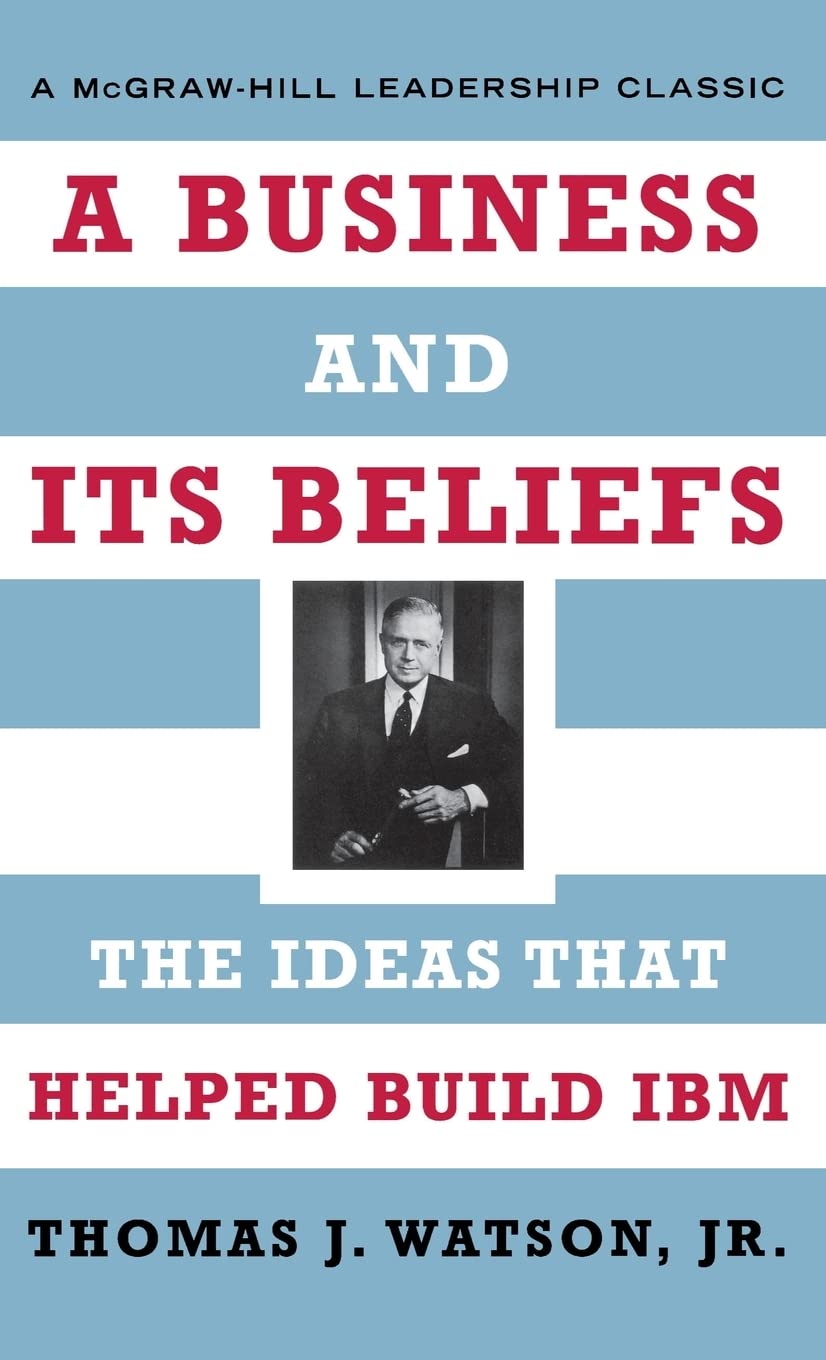
The Ideas that Helped Build IBM
Watson's subtitle is an apt description of what this book is - a brisk walk through the ideas and principles that took IBM from a tiny regional maker of things like meat scales and cash registers to an industry-defining leader in computing.There's very little discussion of technology here - that's what IBM prints journals for. Instead this is about people, culture, and building a company that sees itself as something more than a mere profit-generating machine.The three beliefs themselves are:- Respect for the individual- Striving to have the best customer service of any company in the world- Pursuing all tasks with the idea that they can be accomplished in a superior fashionThey're very simple, but each feeds and enables the next and they all fit together in a way that gave IBM a strong organizational identity and IBMers a great sense of pride in being part of that organization.These core beliefs were eventually watered down, growing in number and diminishing in impact. Most significantly, the point of "respect for the individual" was dropped - something which didn't go without notice within IBM. And Big Blue, while still a major player in the tech industry, isn't what it once was.The loss of these beliefs, both on paper and in practice has spurred an exodus of IBM's best talent as we realized how many other places were more like the IBM in this book than today's IBM could claim to be. Even still, the cultural identity Watson Jr. promoted within IBM and recorded in this book has stuck with most of of us as something worth holding on to.It's also interesting to read the last chapter of this book about the social responsibilities of a business (and of the people made wealthy by those businesses) which, while written in 1963, feels incredibly relevant today. In a nutshell, the book concludes with a promotion of a lot of ideas you'd more expect from an OWS activist than a billionaire CEO - and manages to do so convincingly and without the slightest sense of irony.
M**M
Should be read by every working, and non-working person, once a year...
I believe if every working and non-working person read this book and applied the IBM basic beliefs, their lifestyle would dramatically improve. It's a quick read, with three powerful action statements.-Treat everyone with Respect.-Provide the Best Possible Custmer Service.-Perform all tasks in an Excellent Manor.All I can say is our world would be a petter place.Mike M.
D**S
Its sad to watch a company self-destruct
Everything IBM has forgotten recently. Its sad to watch a company self-destruct.
J**E
Five Stars
Great book! about IBM culture and values!
W**G
A Revisit to fundamental principles that makes a corp great
The IBM official biography have this to say about Thomas Watson Jr." During his leadership, IBM grew from a medium-sized business to one of the dozen largest industrial corporations in the world. When Mr. Watson became CEO in 1956, IBM employed 72,500 people and had a gross income of $892 million. When he stepped down in 1971, employees numbered more than 270,000 and gross revenue was $8.3 billion. Fortune magazine once called him "the greatest capitalist who ever lived."It is a great book, though I initially had misgivings getting the book. Are the principles of 1963 applicable today? When I looked at the Amazon site, it was ranked 433,861 in sales, and I would be the first to review it. Uhmmmm... If I had not been so enamored by his story by another book, "Father , Son & Company" which he co-authored with Peter Petre, I would not have bought this one.Notwithstanding, I will not hesitate to say it is still one of the most important book in building the foundation of a great corporation, much akin to the principles in the bestseller book "Built to Last" by Jim Collins (#31 in Amazon list) . Only it is less sensational, but written by a True Blue practitioner who can really claim to the saying, been there, done that. With plethoras of business books proliferating, it is important to see, before believing, that the authors recommendations match his accomplishments. Or else, there will always be the question -- if he knows the stock market so well, why is he writing the book instead of investing in Wall Street?It is one of those rare books, that is as relevant today as it was published over 40 years ago. According to Watson in laying the foundation on the importance of beliefs ( we call it now VISION) , ""the basic philosphy, spirit and drive of an organization have far more to do with its relative achievements than do technological or economic resources, organization structure, innovation or timing. All these things weigh heavily in success. Buthey are, I think, transcended byhow strongly the people believe in its basic precepts and how faitfully they carry them out."What are these basic precepts? He outlined three:- have respect for the individual- give the best company service of any company in the world.- pursue all tasks with the idea that they can be accomplished in a superior fashionHe says, " The relationship between man and the customer, their mutual trust, the importance of reputation, the idea of putting the customer first -- all these things, if carried out wth real conviction by a company can make a great deal of difference in its destiny."He is a great man, and it is a great book, if only to review what we may have forgotten in our haste to accomplish our everyday tasks. He is a great manager, but the one thing that will always put him in my all time list of great people will be an incident when he refused a higher salary and bonuses from a grateful board saying his pay was already enough, and he said something that I hope I will always remember in my own quest for fulfillment and happiness --- " I do not want to be a pig. "by wilson ng[...]
A**H
IBMers should read this
As an employee of IBM, this is a great historical read and in many was is just as relevant over 50 years later.
Trustpilot
2 months ago
3 days ago