⚡ Power your freedom—wherever life takes you!
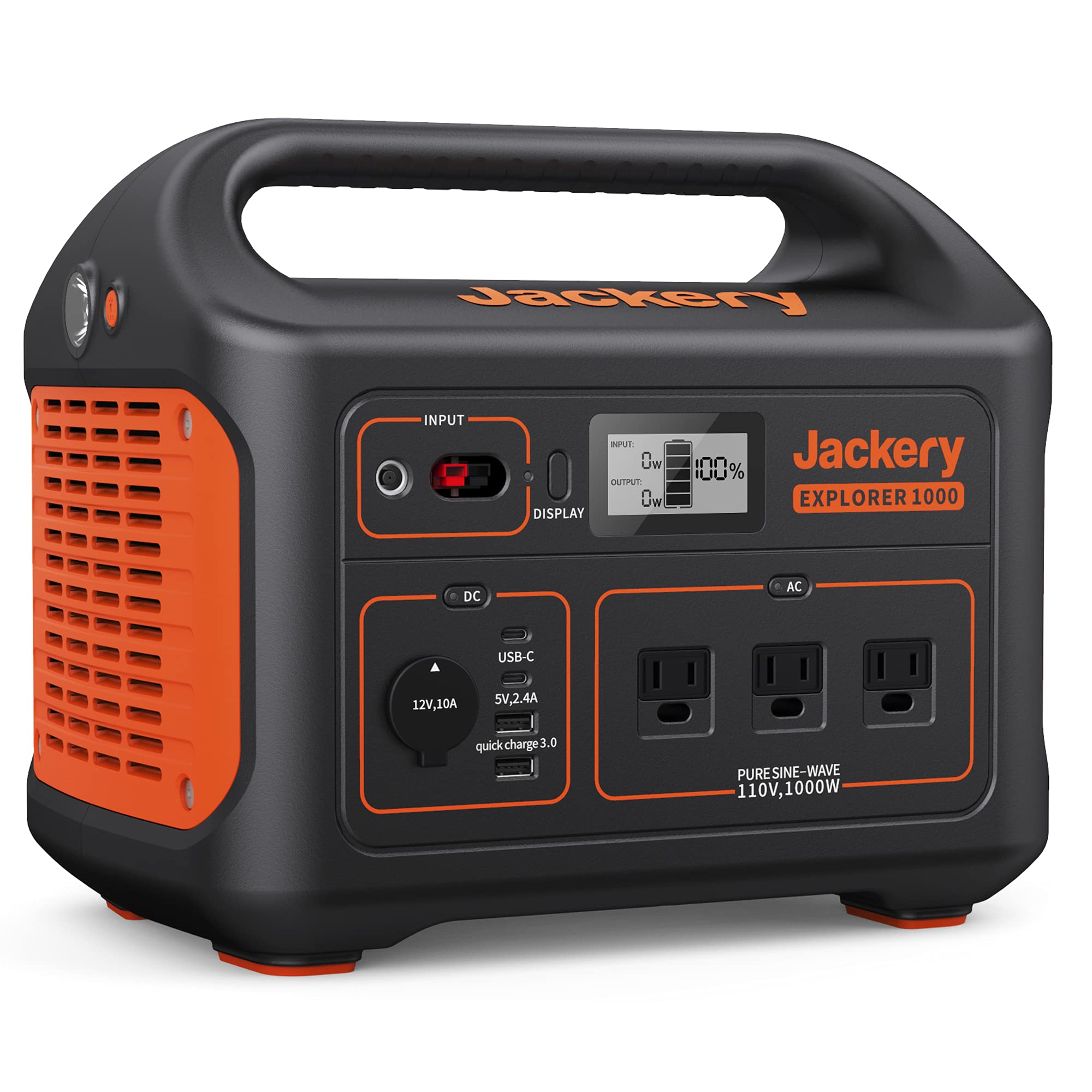
The Jackery Explorer 1000 is a robust 1002Wh portable power station delivering 1000W of clean, pure sine wave AC power through 3 outlets and multiple USB ports. Rechargeable via solar panels, AC wall outlet, or car charger, it features UL-certified cylindrical batteries with impact resistance for reliable outdoor and emergency use. Lightweight and easy to operate, it supports powering most home appliances and outdoor devices, making it a must-have for millennial professionals seeking sustainable, versatile energy solutions on the go.


| ASIN | B083KBKJ8Q |
| Additional Features | 3 Ways to Recharge, Lightweight and Portable, Long Battery Standby, Robust and Durable, Shock and Fire Resistance, Supports 8 Devices Simultaneously |
| Best Sellers Rank | #68,562 in Patio, Lawn & Garden ( See Top 100 in Patio, Lawn & Garden ) #272 in Outdoor Generators |
| Brand Name | Jackery |
| Color | Black, Orange |
| Customer Reviews | 4.7 out of 5 stars 7,901 Reviews |
| Engine Power Maximum | 2000 Watts |
| Engine Type | solar, AC adapter |
| Frequency | 60 Hz |
| Fuel Type | Non-gasoline |
| Ignition System Type | electric |
| Included Components | Jackery Explorer 1000 Power Station, AC Adapter, Car Charger Cable, SolarSaga Parallel Adapter Cable, User Manual |
| Is Electric | Yes |
| Item Dimensions L x W x H | 13.1"L x 9.2"W x 11.1"H |
| Item Height | 28.19 centimeters |
| Item Type Name | Jackery Explorer 1000 Portable Power Station, 1002Wh Capacity with 3x1000W AC Outlets, Solar Generator (Solar Panel Not Included) for Home Backup, Emergency, Outdoor Camping |
| Item Weight | 22 Pounds |
| Manufacturer | Jackery |
| Material Type | Plastic |
| Model Name | Explorer 1000 |
| Model Number | Explorer 1000 |
| Output Wattage | 1000 Watts |
| Power Source | Solar Powered |
| Recommended Uses For Product | Camping,Home emergency, RV, Road Trips, Off-grid Living |
| Running Wattage | 1000 Watts |
| Runtime | 5 hours |
| Starting Wattage | 2000 Watts |
| Tank Volume | 5 Gallons |
| Total Power Outlets | 3 |
| UPC | 850006304523 |
| Unit Count | 1 Count |
| Voltage | 110 Volts |
| Warranty Description | 2 year manufacturer |
| Wattage | 1000 watts |
S**E
Greatest product available aligned with best company service in business
Okay, I will start out by saying I am a U.S Service-member with over twenty years of Honorable service. With that being said I’ve done multiple tours to almost every desert in the Middle East, tours in tropical environments, tours in some pretty secluded off grid undisclosed locations. I only put this out there because I’ve had the pleasure of being a Jackery customer for years and years and the Jackery 240 portable power station, , the Jackery Solar Saga 60w tri-fold panels, and the small Jackery portable chargers were compact and lightweight enough to fit into my pack with ease and leave me room for the other essentials. Imagine being in the middle of nowhere and have a weeks worth of power at your fingertips for recharges, lights, portable fans, small burner for coffee and cooking. Then being able to say it never failed you, always recharged quickly, and has been through the worlds harshest conditions and environments, yet functions like the day you pulled it out of the box. So this began my Jackery passion. Which led me to purchase the Jackery 500. Everything I’ve said above applies to the 500 ten fold folks. Being Military my pay isn’t great so I’ve had to accumulate these items over the course of years, however never have I had to justify spending the money to my wife, as long as I said the word Jackery. Because she’s used the items as well here at home guard. My son plays Football and daughter plays soccer in the Nevada desert just miles away from where the annual Burning Man event is held. Hot dry desert climate, no trees for shade, just direct unrelenting heat. This genius woman, the love of my life used our Jackery Portable power stations to run dual fans, and a small refrigerated trucker cooler during daytime practices in a pop up sunshade tent, all neatly placed in one of those little soccer mom wheeled totes, and a folding low loveseat chair. Talk about super mom, with lots of friends who also wanted to stay cool. Then when night fell and the kids weren’t finished with practice, my lovely wife handed over the Jackery 500 to the coaches who then plugged LED lights into it and lit up the field for the kids giving us an extra hour or two to practice without the heat. This convinced her to give me permission to buy the SolarSaga 100w panels. Money was tight but she gave me the go ahead and we’ve never looked back and haven’t got an ounce of regret or buyers remorse for a single product. But this review is neither for the the Jackery 240, the Jackery 500, the SolarSaga 100w or 60w panels. It’s not even for the Jackery portable chargers. This review is to let you know, the day the Jackery 1000w Portable Power Station became available we did not hesitate for a second to buy it. With the stories we heard from friends about California and Washington power outages, the Covid-19 Pandemic, and any one of the many RV trips we take into Gods country to get away from it all for a few weeks, we both agreed this was the best thing for our family. Why use heavy loud generators, carry fuel, deal with all that monotonous nonsense, when you could literally live off the Jackery Families products. I say Family because over the years I’ve had multiple email contacts and numerous phone calls with them, and every interaction was amazing. Courteous, professional, and the products are literally second to none. The Jackery 1000 is my newest addition and there’s nothing I can say about it that the 240 or 500 don’t already represent. Twice the power, twice the life, multiple solar panel options, can recharge through car, wall, or good ol sunshine. I could get technical and go down the path as some of these reviewers do, but you anyone can read the box. I can sum everything the box says by just telling you that these products, put out by this amazing company, can enhance anyone’s life, save somebodies life, and will probably last your the rest of yours. It’s a no brainer for us. I’ve purchased every product so far with a smile knowing its perfect and the people handing it to me care enough to treat you as if you were family.
D**R
YES, IT IS AS AWESOME AS YOU READ!!!!!!
I was in the market for a generator and after reading all the reviews and watching videos explaining how great their products are, I decided to make the purchase on a Jackery 1000 generator. I was looking for a way to camp in desolate areas where there was no electric available. I have a camper van set up and I needed a way to charge my devices, have light and be able to keep my fridge/freezer running. In my head I had imagined the perfect set up and having a Jackery was the only way it would work, meaning a gas-powered generator wouldn’t work with the set up I had in mind. I’ve been on a couple trips now and I believe I have my system down pat and it works great. I wanted to keep my van as versatile as possible so by buying the Jackery 1000 I eliminated the confusion and extra money it would take to put a deep cell battery system in, which would be permanently fixed in my van. With the Jackery 1000 being portable and so light weight, if I don’t need it and I need space in my van then I simply take it out – not like it takes up a lot of room, it’s small for how much power it puts out. When I need power, I simply put it back in and I don’t have to worry about running wires, or fuses, or converters. It so simply to use and it’s basically just plug and play. I keep it behind my driver’s seat, so it reaches the 12V plug I have in the front of the van, I place my fridge/freezer next to it and plug it right in. Here’s the cool part, when I’m driving, I have the Jackery plugged in the van, so it is charging, but it also has pass through charging, which mean I can run the fridge through it at the same time! So, when I’m driving the Jackery 1000 is charging, yet the fridge/freezer can continue to run. If I have to stop for lunch or I want to get a quick hike in I don’t have to worry about the fridge because when I turn the van off the 1000 switches right over to provide it power – then when I’m back in the van, I start it up and the charging cycle starts again. It’s literally so easy and such a great way to not have to worry about your food getting warm. The great part about having the unit behind my driver seat is that when I reach my destination, I simply crack my driver’s window and run the wires to the solar panels and place them on the roof of my van. It’s all so simple and it’s such a great set up for what I need it to do. Do not hesitate, their products are top notch quality!
P**H
Great Unit, Works As Advertised! Jackery, Please Release an Explorer 1500 Also!
I have been the last few years a very happy Goal Zero customer (bought numerous Goal Zero products in the last few years) with the Yeti (lithium) 400 Power Station (retail $599) being my favorite purchase from Goal Zero due to its lightweight (16.3 lbs) and offering a reliable 400 Watts (for the AC inverter there's a guaranteed 300 Watts continuous). However I have found that during power outages and for other uses it just wasn't powerful enough for me. I have been mulling over the purchase of a Goal Zero Yeti (lithium) 1000 for $1,199.95 the last 2 years since it has an AC inverter with 1500 Watt capability) however it's bulky size and heavy 40 lbs make it extremely difficult for me to handle since I have a bad case of Lyme disease. It was the need for a more powerful unit with the capability of a continuous 1000 Watts for the AC inverter which was also lightweight that led me to the looking Jackery Explorer 1000 Power Station (it's only 22 lbs). I watched some user reviews of the Explorer 1000 on YouTube a few weeks ago before the March 17, 2020 release date, and I was impressed so I signed up on Jackery's website to be notified via email when it was officially released and ready for purchase. When the March 17 release date arrived, I decided against purchasing the unit since it can wait until Summer since I really won't need it until the bad summer thunder storms hit my area which cause power outages. However to my surprise Jackery emailed me a $200 off code on March 18, 2020 for what they called #JackeryExplorerDay . This was the incentive I needed, so I purchased on Amazon the Explorer 1000 for $799.99 ($999.99 with $200 off coupon code applied) on March 18, 2020. The Explorer 1000 arrived on March 25, 2020 and I immediately put it through the paces charging a 15-inch Macbook Pro laptop and other items, it worked flawlessly. I also put Jackery's 1000 Watt claim to the test by plugging in my 1000 Watt rated trusty space heater into the AC Inverter and ran it for a couple of hours with no issues until the Explorer's batteries were drained. With this heavy load the Explorer 1000's internal fan was running continuously (to keep the Explorer 1000s internals cool) but the Explorer's fan is fairly quiet and I had no problems watching TV while it was running. The internal fan does it's job well even after running over an hour continuously at 1000 Watts, the exterior case was the same temperature it normally is when it's not in use (this really impressed me). While I charged the Macbook Pro from 0% to 100%, the internal fan only came on briefly twice during the charge that lasted a little over an hour. One small item that I noticed is that when using the provided wall power supply to charge the Explorer and when the Explorer has been changing for an hour or two you can feel very slight warmth around the 8mm power input area where the wall power supply plugs into. Nothing to be alarmed at since it's less than the normal warmth that is felt when touching a laptop power supply after a laptop has been charging for a while. I wasn't able to test the solar power charging capabilities of the Explorer 1000 yet since I haven't yet received my Goal Zero (8mm to Anderson connector) adapter kit (which I have on order) for my Goal Zero Boulder 100 Solar Panel Briefcase (100 Watts). This kit will allow me to charge the Explorer 1000 with my Boulder 100 Solar Panel Briefcase. I also received an email from Jackery that their SolarSaga 100 Watt Solar Panel ($299.99) is out of stock and that they will send an $100 off code for "2 x SolarSaga 100W solar panels" when they are back in stock (which I assume you must purchase 2 100 Watt solar panels to get the discount). I am interested since my Goal Zero Boulder 100 Solar Panel Briefcase weighs 25.9 lbs, and 1 SolarSaga 100W (with the same power) only weights 9 lbs. Pros and Cons of Jackery Explorer 1000 Pros: - Lightweight - Cool running temperature - Inexpensive price compared to competitors - Provides up to a genuine 1000 Watts of continuous power - The flashlight type light on the side of the unit is great feature especially when the power is out or when camping - Plenty of different output connectors - Uses the industry standard Anderson connector for solar panels, this allows you to use just about any solar panel that use Anderson connectors with the Explorer 1000. - It has a cover for the 12 volt output, Goal Zero doesn't provide one on any of it's Yeti models with 12V output. - Well made, the exterior construction is solid and not flimsy. - Easy to read display screen the provides both real time input watts and real time output watts. Cons: - The solid fixed top handle is not the best design, you can't put items (on top of the Explorer 1000) you are powering such as iPad, laptop, a portable lamp on top of the unit. The Goal Zero Yetis have handles that are either flush with the top or are retractable so that they are flush with the top. Because of this some of the Goal Zero Yetis can be stacked on top of each other for better storage or to take less counter space. Explorer 1000s can't be stacked on top of each other due to the fixed handle. - display screen won't stay lit for more than a minute or two and then it goes back to dark and the display screen button has to be pressed again. The Goal Zero Yeti units will allow you to keep the display screen lit continuously. Conclusion: I had high expectations for the Explorer 1000. After using it and testing it for a day it far exceeded my expectations. Of course I can't really give a full accurate review because I'll need to use it on a regular basis for the next few years and see how the unit holds up. My Yeti 400 has stood the test of time, I have used it regularly for the last few years, it still charges to 100% and works flawlessly every time I need it. As mentioned previously I would have purchased a Yeti 1000 had it not been for the bulky size and heavy 40 lbs. The Explorer's light weight, great features, and capabilities have me so very pleased with this purchase. And thank you Jackery, for the $200 coupon code that you sent me. I look forward to purchasing more Jackery products in the future. Which leads me to one request for Jackery, I can see a need in the future for a lightweight 1500 watt Explorer unit, please release a lightweight Explorer 1500 that weighs less than 30 lbs.
K**.
Works great on my full size fridge, or small microwave, or 40 inch TV (not all at once though).
I've had the Jackery Explorer 1000 for just over a week now. When I first received it, the charge was at 43%. I plugged it in and it charged at a rate of about 144 watts. Took about 5 hours to fully charge it to 100%. -- Microwave Test: First device I tried it out on was my very ancient 0.8 cubic foot microwave. I'm not sure of rated wattage, I'm guessing 800W. It ran on high for 10 minutes straight no problem. The average draw was around 1,040 watts. Keep in mind that actual wattage drawn is normally higher than the rated wattage for microwaves. I ran the microwave for a total of 20 minutes on high. It used up about 35% of the total battery capacity of the Jackery Explorer 1000. -- Full size Kenmore Fridge Test: My fridge is an 8 year old, 19.7 cubic foot, Kenmore fridge with bottom freezer. I just put the Jackery Explorer 1000 on top of my fridge and plugged it in. I just used some books under the Jackery to tilt it just enough to clearly see the display (I'm only 5' 6" tall). I had estimated by calculation that it should last around 17 hours of effective run-time. Upon start up my Kenmore fridge pulled about 600 - 700 watts for a few seconds. Once running the fridge averaged about 120 watts. Keep in mind that fridges tend to only run about 1/3 of the time. I used a "Kill-A-Watt" meter ($34 on Amazon) to verify wattage and total watt hours (Wh) used. In the end the Jackery Explorer 1000 ran my full size Kenmore for 16 hours, 10 minutes. That was within an hour of my original run-time estimate of 17 hours! For reference the ambient room temp was 70 degrees F, and the internal fridge temp was 37 degrees F. The total amount of energy put out by the Jackery Explorer 1000 was 830 Wh. That is basically an inverter efficiency of 83%. That's not bad considering that when the fridge is cycled off, the inverter still draws power. All in all I was very happy with the real world run-time of over 16 hours. That will be very useful in a power outage; very common here in Napa County. -- 40 inch Sony LCD TV & cable box Test: I have an ancient Sony XBR 40 inch LCD TV. I found out that it uses 175 watts, and my cable box uses just 20 watts. Keep in mind that most newer LED TV's would only use about 1/2 that wattage. Anyway I ran the TV and cable box for a full 4 hours, 40 minutes, before the Jackery ran out of juice. I think that a newer 40 inch LED TV would run for at least 8 hours or so. What surprised me is how efficient the Jackery's AC inverter was on this test. The Jackery put out a total of 900 Wh (watt hours) of energy (according to my "Kill-A-Watt" meter). This represents a 90% inverter efficiency. I was expecting closer to 85% efficiency. -- Overall Impressions: When I first got the Jackery Explorer 1000, it look really big. Especially compared to my much smaller Honda/Jackery Explorer 290 (discontinued). Fortunately with the nice sturdy handle, the 22 lbs does not feel like that much. I think what I like most about the Jackery Explorer 1000 is the simple and straightforward display. Watts in / Watts out / Battery %. I also like the fact that the 12V (10 amp) cigarette lighter outlet is regulated at 13.3 volts. Your voltage is the same whether you're at 100% charge, or 2% charge. That is very important for running 12V fridges and CPAP's. I can think of 3 things to improve the Jackery Explorer 1000: #1 Upgrade the USB-C port to 60 watts, instead of just 18 watts. This would be very useful for people with USB-C laptops. Plugging in a laptop wall charger to a Jackery AC inverter outlet is not very efficient. #2 Have a customer replaceable lithium ion battery pack. They could design the unit with a detachable battery pack on the bottom. This would make even more sense when they come out with larger units in the future. A bigger and heavier unit could be split into 2 modules for easier transport. #3 Have an option to keep the display light on longer than 15 seconds. All in all I'm very happy with my Jackery Explorer 1000. In the future I plan to try it out on more devices, and update this review. I'm looking forward to next year when they come out with a Jackery Explorer 1500, or larger model. Hope all this is helpful. :)
S**Y
Got perishable? No problem. Got big fridge? No problem. Awesomeness that is portable.
Pros: Great for my fridge. Solid design. Multiple outlets. Cons: TBD (but has 2 year warranty - tip, go register your product) The shipment came in an outer carton and then the product box itself. The packaging was pretty basic with foam inserts to protect the battery. I like that they didn’t include a plastic bag over it since it would have meant more waste in the planet. Sitting on top you notice a feel nice pouch which houses your power supply for the battery. In it also has the 12V cigarette plug. I was surprised to see a gift box which is an adapter to allow two solar panels to be connected at the same time (in parallel). I’d say the overall design and feel of the battery is what I expected for this price. Plastic felt great and the handle didn’t feel like it was going to break. The weight distribution is excellent and I will appreciate that when I go outdoor with it. **The weight of this battery is 20lbs-22lbs. It has non-slip rubber feet at the bottom. The printed text are all easy to read but I was slightly confused about the “5V, 2.4A” since I didn’t know which port it belonged to. Read further down below for what I found out. Separate on/off buttons for AC/DC with an LED indicator. Same goes for the Input – you just plug it in and it will automatically charge. The display button is basically a backlight button for the LCD and is excellent for night/day time. It has 3 main indicators from what I saw during my testing (I’m assuming errors/warnings will display and you can reference the manual). It has the Input: how much power is going into charging the battery, Output: how much power your device(s) are consuming, and Level: how much power you have left via percentage/visual indicator. **It would’ve been nice if (at minimum) the Display button is a glow in the dark type to help locate it more easily. Once the LCD backlight is on you can kind of get a feel of the other buttons/plugs. On the side of the battery there is a flashlight with its own dedicated button. **One thing to note about the LCD is that it’s easy to read from front, top, left, right but not from bottom. During my testing when I looked up into the battery I could not read anything from it. I had to use a camera to see what my stats were since it was above my head. The input/output connectors I would say is fairly standard. I do appreciate that it has 2 USB-C connectors to future proof it. In order for me to figure out what the rating for each of the outlets are I looked at the label and from what I could tell the AC plugs are rated for 10A each, USB Type-A are 5V/2.4A, and USB Type C it can go up to 5V/3A, 9V/2A, or 12V/1.5A. See my picture to see full spec. Before I jump into the test I did, here are a few things to note: 1. Power cable fully extended is about 100in – if you need more length be sure to bring an extension cord. 2. It says to fully charge your battery the very first time. 3. It says to keep your battery charged every 6 months or keep it plugged in when not in use. Charging/Discharging Summary (if you don’t want to read the full text) 1. Charge from 36% to 83% for 3.5 hours (power ranged from 140W-145W) 2. Discharge from 100% to 14% for 4.5hours (might be less if summer time) Charging: When battery was first turned on it had 36% capacity at 843am, 45% at 920am, 64% at 1041am, and 83% at 1213pm. I forgot to check up on it so I don’t know when it was 100% after that. The power supply is rated for 180W and the battery measured the input to be 140W-145W. Not the worse for efficiency. Discharging: Ok, so my 2006 refrigerator is 35.75in x 34.25in x 69.75in and rated at 115V/4.5A (up to 517.5W). I placed the battery on top of the fridge since I needed walking space in the kitchen. When I used the battery the refrigerator was using 258pm/100%/0F/39F/64W and I suspect that the temp didn’t change inside or it was booting up. To ensure it was working fine I changed the temp to 3pm/100%/6F/39F/317W and then decided to go with 302pm/99%/-2F/38F/302W for my test. 343pm/87%/170W, 420pm/77%/170W, 516pm/61%/155W, 555pm/49%/167W, 631pm/38%/163W, 726pm/14%/190W. This is when I stopped the test since you don’t want it to get too close to 0%. I must admit that I was surprised the refrigerator didn’t go 500W and could be that it’s no longer summer. It should last long enough for power to come back up. Overall, I’m very pleased with this battery and it performed well with my massive refrigerator. I expect this to translate very well for other appliances/toys/gadgets. I hope this will have a long life (3year warranty) and they have an office in CA if I have questions. I will start looking at solar panels someday and likely review that as well.
C**K
Great for specific situations. Not great for others.
I've owned this through several power outages now. I did a lot of research before buying this over a gas-powered generator. My main insights are: CONS: 1. This is not suitable for needing to run a heater during power outages. Even tiny 200W heaters will drain the Jackery 1000 quickly. Do not buy this if your main need is to power a space heater during winter storms. 2. The solar panels are somewhere between a novelty and a necessity. They get exactly half their rating (50W each instead of 100W each), and become nearly useless if even one part of the panel gets block by shade (by a tree branch shadow, for example). If the weather is very sunny, the charge can produce maybe a 2-3% batter charge per hour. PROS: 1. The generator is silent and produces no emissions. You can have it running in your bedroom to power your devices. It is extremely safe to use and overcomes the problem of needing to acquire and store fuels for gas generators. 2. The power output is totally sufficient for charging phones, laptops, etc many times over from 0-100%. Powering a fridge works well too. 3. The ability to output power while being charged by solar is great! Provided you have full sun, you can have the solar panels contributing up to 100W combined (not 200) while you have devices drawing power. For a few phones, this is like getting free power. OVERALL: If you're needing to power small electronics because of a power outage, or are going camping or out on a boat, this generator does great. The solar panels are half of their rated output, but still are useful during fully sunny weather. It's safe, and easy to use. It's not suitable for powering space heaters. It's not suitable for powering things like refrigerators long-term.
S**7
CPAP compatibility & use data RESMED S9 &10 Aug 2020
I bought the Jackery 1000 (July 2020) for power outages which might be many days (hurricanes for example) to power a CPAP-for both Resmed S9 & Airsense 10 Auto Set. Resmeds use 24VDC where most others use 12 VDC before conversion to A/C by the wall brick. The Jackery 1000 puts out 12VDC so the 12VDC CPAPs do not require a converter if plugged into the DC power outlet of the Jackery with a cigarette lighter jack. The Resmeds however, use 24VDC & so DO require either using the A/C outlet or an adapter to use with the Jackery 1000 to get to 24VDC. All batteries are DC. These adapters require some extra (wasted) power but much less than the transformer/inverter brick needed for A/C plus the sinewave transformer/ inverter inside the Jackery since with it you are going DC to A/C then A/C to DC again also voltage change twice which is very inefficient. Using a DC to DC adapter helps efficiency & allows DC-DC use. The Jackery has DC voltage regulation; a huge advantage for CPAP use. Resmed sells a DC to DC adapter for the 10 only. There are after market ones for both the S9 & 10. Search under “CPAP adapters Resmed” if you see a cigarette lighter type connector jack you are probably looking in the right place. Prices are $32 to $90. Because the plugs into the Resmed CPAPs 9 & 10 are different you will need separate plugs/cords. Some kits come with plugs for both S9 & 10 some do not. Data shows me generally about 30-40% greater efficiency with DC to DC compared to A/C. With pressures of 7 going up to 16 for short periods with WATER CHAMBER ON, power use with A/C averaged 21% (reads 79% on screen) for 7-8 hours & 14% (reads 86% on screen) using DC-DC. The efficiency of the 2 adapters I compared was not very different comparing a Resmed transformer, to a white non transformer type. Bottom line: at least 6 or 7 nights seem probable DC to DC with the Jackery 1000 & 4 nights with A/C with some margin for error. Tube temperature was a low drain at 70 degrees. With water chamber heat off power use would be substantially less; I measured about half -7% (screen reads 93%) for 7 hours, but I have limited data. The questions & reviews for these adapters have a lot more data. There is no sound warning for when the Jackery loses power so CPAP will just shut off. The screen flashes but since you are asleep it is not helpful. A wake-up warning option would be a nice feature. A more reliable high drain DC plug/jack than the very unreliable, extremely antiquated, cigarette lighter connector is REALLY needed; competitors have them. A 24VDC outlet 8mm barrel connector like on other Jackerys would be nice. Fan noise will wake you up unless you isolate the Jackery (in another room, or cover it with a large box to allow air flow) you may need a “car type” extension. The order of plugging things in matters. Plug into the Jackery & turn it on also switch on the cord if there is one THEN plug into CPAP & turn on. It won’t work unless you do this. Unplugging (not just turning off) in the morning is very important as the vampire load is huge. Jacery will turn off a load less than 10 watts by itself after 12 hours so it does turn off the vampire load later. I measured the vampire load at 70 watt hours or 7% of total capacity in 12 hours-A LOT!! Compared to the competition the Jackery 1000 is pretty good & simple to use. I would guess the cheaper competitors are using lower capacity li-ion cells although possibly more of them & probably not pure sine-wave inverters also cheaper circuitry as other reviews suggest and non regulated DC; a CPAP killer. Li-ion have superb longevity, are not known to leak generally & have great longevity -10+ years, 500++ charging cycles. They do need charging at least every 6 months or so. Self-discharge rates vary but can be substantial. The price at $1000+ is high considering two 500s might be less and give more choices of ways to use. The “manual” for the Jackery 1000 is a joke with incredibly little information. Basically only a diagram. You are on your own getting needed data & details. It is available if you look. You are in one good place now. Look at video reviews too. Recall issue -turning off early- (March 2020) is hopefully fixed. A deep cycle wet cell is another choice but far heavier, far less portable, cheaper <$200 with nice charger but has its own issues- weight ~70lb, charging, hydrogen gas, acid, limited longevity etc. The li-ion system Resmed sells is very expensive for the limited watt hours/nights available. It is 24v however. Freedom battery is 12v, needs the adapters & is also expensive for the capacity. Resmed & freedom batteries ARE far more portable. Jackery is a far better choice if portability is not a big issue ~22lb.
W**T
Lifesaver for CPAP users. Simple to charge and use. Holds its power.
In early January 2021 our area had a storm that knocked out our power for four days and three nights. The cold was a manageable problem. The inability to power my CPAP machine was not. Like many of you, I suffer from sleep apnea -- severe sleep apnea. Without a CPAP machine, I stop breathing 70-80 times an hour. Which is more than once a minute. And those pauses last anywhere from 15-30 seconds each. Which means that I'm only breathing about half of what I need. My blood oxygen plummets to death-risking levels (75-80%). I had no idea this was happening until my VA doctor recommended a sleep study that diagnosed this problem that was destroying my general health. During the 4-day/3-night stretch trying to sleep without a CPAP in Jan 2021, I rapidly became ill. I vowed to find a solution before the next winter arrived. On Amazon I ordered the MaxOak Multifunctional CPAP Backup Power Supply. It was really simple to operate. It came almost fully charged. I plugged it in and topped it off, but we did not lost power the rest of that winter. In October 2021, I decided to check it out to get ready for the next winter. It was still at 95%. I decided to just test its operation, but the controls would not work like they had back in January. I fiddled with it for a few days and then put it back in its box and re-checked it in November. Same thing. It showed the power level . . . now 94%, but you literally couldn't put it into operational mode and use it. Fortunately, we did not lose power last winter. In spring 2022 I remembered and decided not to roll the dice. I did a lot of research and settled on the Jackery product line. I decided to spend more and go up to the Jackery 1000 (rather than the 500). I also purchased two Jackery solar panels just in case. Although I hope and suspect I won't need them to charge this unit which, like most such power supplies, can be recharged by plugging into a regular AC outlet or into a 12V car outlet. In October 2022 I tested it and it was still at 100%. Two nights ago we were in the middle of a tremendous "cyclone bomb/atmopheric river" storm with high winds and rain that lasted a few days. Just as I settled into bed, our house power went out. I got the Jackery 1000 out. The battery was still at 100%. I set it on my nightstand, plugged my ResMed Airsense 10 CPAP into one of its three plug outlets, my iPhone charger into a second outlet, and my lamp into the third. I manually lowered the CPAP humidity level and temperature settings by 1/3rd to lower the draw on the power supply, turned out the light, and went to sleep. I woke in the morning after 7.5 hours of sleep. The Jackery battery was down to 75%. Sometime in the night our power had come back online. I disconnected all my devices from the Jackery unit and then plugged it into a wall outlet for recharging. In an hour it was back at 100%. So I saw that I EASILY can get three nights sleep with my CPAP while using both my CPAP heater/humidifier and heated ClimateLine hose. We are expecting another big storm with high winds tomorrow night. I'm ready. For those of with severe sleep apnea, you know how difficult it is to sleep without your CPAP and you know what being unable to breathe does to your health. This is not a cheap device, but it really delivered for me. I'm sure it would work great for camping, too. This isn't just for CPAP machines. But before you start plugging all your laptops, music equipment, coffee makers, etc. into it, ensure that the power needs of all those devices, individually and collectively, do not exceed its ability to deliver. UPDATE: Last night’s storm was worse and I expected an outage. I didn’t want to wake up gasping with headache so I just set my CPAP up with it even though we still had power. Sure enough, we lost power but I never even knew it. This morning my wife and I made coffee in our Keurig and even used the milk frother. I charged other devices. The unit is still at 60%.
Trustpilot
3 weeks ago
2 days ago