


📞 Elevate your VoIP game—mobility and clarity that keep you ahead of the curve!
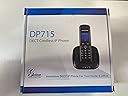
The Grandstream GS-DP715 is a DECT cordless VoIP handset designed for professionals seeking mobility without compromising call quality. Supporting up to 10 SIP accounts and 3-way conferencing, it delivers HD audio and a robust 300-meter outdoor range. Compatible with the DP750 base station, it offers automated provisioning and multi-language support, making it ideal for dynamic business environments and savvy home offices alike.
| ASIN | B008MHQCA0 |
| Answering System Type | Digital |
| Brand | Grandstream |
| Built-In Media | (2) batteries, Handset unit, Quick Start Guide, belt clip, charger cradle, universal power supply |
| Color | Black |
| Conference Call Capability | 3 way |
| Customer Reviews | 3.5 out of 5 stars 179 Reviews |
| Dialer Type | Single Keypad |
| Enclosure Material | Plastic |
| External Testing Certification | FCC Part 15B/15D; CE: ETSI EN 301 489-1 V1.8.1, ETSI EN 301 489-6 V1.3.1, ETSI EN\n301 406-1 V2.1.1, ETSI EN 301 406 V1.5.1, EN60950-1, RoHs, UL (power supply) |
| Global Trade Identification Number | 06947273701040 |
| Is there Caller ID | Yes |
| Item Dimensions | 2 x 0.8 x 6.6 inches |
| Item Height | 6.6 inches |
| Item Weight | 0.9 Pounds |
| Manufacturer | Grandstream |
| Material | Plastic |
| Multiline Operation | Multi-Line Operation |
| Number of Batteries | 2 AAA batteries required. (included) |
| Power Source | Corded Electric |
| Telephone Type | Cordless |
| UPC | 799198441480 611102260614 168141387555 163121109387 601000490145 172302640151 724627308959 712395109410 807320358756 803982909114 012304069287 102930652455 045556018154 066512384373 809390026900 754262013390 132018011775 031112866239 611102217137 694727370104 702071348028 807034909176 806296595844 |
| Warranty Description | One year parts and labor |
A**L
Inexpensive SIP phone - used with FreePBX
I was able to blindly set these up (dp715 & dp710) with an existing FreePBX installation. The SIP registration was dead simple - just make sure to save settings on each page before navigating away to another section of the web config for the dp715. Then make sure your passwords and extensions match the FreePBX configured settings. Update: Feb 2014 - I bought a 2nd dp715 handset for a remote location, and it worked great over our VPN. However the handset display recently stopped working; remains backlit with the blue light, but no text is displayed. I'm in the process of finding out what the warranty there is and I will try and have it repaired / replaced. Also there is a echo bug present when sound is maxed; however beta firmware 1.0.0.26 resolves that issue according to their release notes.
C**W
PERFECT IP phones for home/small business (if you have a provider that will support VOIP phones and not just analog with a ATA)
I recently went away from big old nasty cable company, not named for security reasons. I found a great point-to-point internet service that also provides VOIP services. Well, I threw them for a loop when the installer saw I had IP, not analog, phones. In talking with their "Second Tier" support, we were able to get this base station registered to their SIP service! Call quality is great, setup can be a bit daunting as you'll want to set QOS on your router, It would have been easier to have an old analog handset but why when you have IP service? *update* I returned these phones, I had bought an extra handset, because the VOIP provider couldn't keep the phones from being port swept. That meant the phone ringing at 3am because of hackers. So I went with another provider and didn't want the same problem, so I used the modem they provided which meant using analog phones. It would be nice for companies that provide VOIP service to realize there are phones like this out there and have a plan to connect them for the customer. I mean, what is customer service for anyway? So i reduced the stars from 5 to 3. I know the phones work, it's not Grandstream's fault but in good conscience, I can't give an excellent rating when there is no support.
C**R
buggy as all get-go, works about 1/3 of the time
Very badly written manual, clearly incompatible with many SIP systems. Drops calls after 30 seconds, after about a minute of being connected, it will not receive calls either. Support non-existent. Bought a Vonage adapter and phone instead.
S**R
I returned to DECT
The plastic is OK for the price, nice to hold and light weight. More comfortable to talk than a mobile phone because it's longer. The main con is that it's does not support HD voice or any wideband codec. And I don't think DECT 6 supports it. DECT has a new standard CAT-iq for IP phones. The size is perfect, nothing to block your desk or table or stand. The front indicators are nice to show if you are connected to the internet and registered with your SIP provider. This is important if your base in installed somewhere via a wifi bridge or powerline, that are less reliable than your modem/router. The screen is pretty big and the user interface is rather good, like Nokia phones in the pre-iPhone era. The manual that comes with it only shows you how to get it's IP so your browser can find it and configure it. You can google the actual user manual online before you decide to buy it. There's nothing wrong with the sound and the range of DECT is much better than WIFI of course. The blue black light is off unless you do something on it, exactly the same as a non-smart mobile phone if you remembered. So there's no back light even if the phone is on the stand. If there is problem with the setting or the performance, it could be due to your SIP provider rather than the phone. The SIP standard is old with many options and implementations. The latest phones hardly need any settings if the SIP provider is good with them. I use Callcentric (can I do promotions ?). Their online support list the few items that you need to enter, and say no if you see STUNT and that sort of things. Ex giant Siemens gave up Gigiset long ago and I got the gem 510 IP at close out for less than this phone. It supported HD voice - once tried and I'm addicted. But the user interface is so bad compared to an Android that I returned it. I regretted it because I just needed the phone to talk while all the fancy stuff I can do it on a soft SIP phone using Android, like caller ID reader, custom ring tone / announcer. You can still use your phonebook on your Android and initiate call with it, but talk on the cordless. Because I seldom use landline and that's why I am going IP. Since HD voice phones are hard to find for a price that I seldom use, I tried using my old Android as a soft SIP phone. I have great problems with delay and echo. Finally I have to get a bluetooth handset for the android to deal with them. And even if your wifi is perfectly covered in all corners of the house, once in the yard your phone is on your own fending itself from all your neighbour's routers. So, I don't think DECT can be replaced, not with WIFI anyway. First I got the Grandstream corded IP phone because it's cheaper. I have an old wifi router configured as a bridge so I can install the phone anywhere with wifi coverage, and can also act as a poor men's cordless SIP phone. I'm happy with the HD voice, and the configuration via browser. But that is big and not a true cordless. So I go back to DECT with this.
D**N
decent handsets
i have 8 of these (growing to more than 5 required a second networked base). they are used in conjunction with asterisk and so far do their jobs just fine. just to satisfy possible searches, i'm using these with raspbx, which is freepbx built on top of asterisk and running on a raspberry pi. i recommend the 512MB version - the 256MB version will run the software but will eventually swap, which gets pretty ugly if swap is on your sd card. pros: * they work just as advertised. * i like the feel of the handset. * backlit display * the call button doubles as a speakerphone button - once a call is in progress, the button toggles back and forth from speakerphone to normal. * at least when new, the batteries last a LONG time - 3-4 days, i think. * (only) very basic settings can be provisioned via network * provides phone-to-phone intercom/calling across their shared base, with no need for the pbx to be involved cons: * the charging bases are very light, so are easy to knock over (or off the table) * there is no way to provision the phone book, and no way to load/save - each has its own phone book which has to be populated manually. horrible. would subtract one or two more stars if these weren't the cheapest handsets i could find. * no way to provision the handset name displayed on the handset screen - a problem when they can be carried across the office and you have 8 of them to get confused. get out your label maker ... * the ring tones are cheesy and annoying
S**G
It's the 1980s version of a cordless phone, for VoIP.
Background: I'm a telephone geek, with a collection of various VoIP equipment. I already have a wonderful, but now-discontinued Gigaset C610A-IP DECT phone system, and I bought this Grandstream unit to use as a low-cost (low risk if I get it wet, drop it, or it dies) extra cordless handset. The handset is very basic, with a 1980s style, passive matrix LED screen with a blue backlight. It's unattractive, but the one advantage of this technology is that the display uses very little power, so it can stay on (without the backlight) as long as the batteries last. An OLED screen would have been a lot easier to read. Functions on the handset are surprisingly limited; really, it's just a single-line telephone with a very crude address book. Configuration is done via Grandstream's standard webpage-based interface (same as their ATAs). Others have remarked that it was difficult to set up, but I consider it no better or worse than most SIP VoIP products, which is to say, you really need to understand the terminology. The phone does support the usual star commands (*xx) for features like call waiting, transfer, caller ID control, etc, depending on support from your VoIP service provider. Pros: -Relatively inexpensive -Range comparable to other DECT products -Slim, lightweight handset and easy-to-see buttons -Wish I could come up with a few more pros Cons: -No headset jack at all, either on the base or on the handset. This would have been so easy and cheap to add, allowing the user to comfortably walk around and talk with a wired headset plugged into the handset. -Abysmal, truly awful Chinese "SANIK the batteryman" NiMH batteries included, rated at 500mAh. They barely worked for one day away from the charging base. I tested them with my OPUS charger, and they wouldn't even hold their rated capacity, brand new. This is probably why other reviewers rated the battery life and reliability so poorly. I replaced them with Panasonic Eneloop batteries, which work much better. Don't even waste your time with the included batteries. -Crude, "dumb" battery trickle charger in the base, always shows the state as "charging", with no idea of the charge level. I have no way to know if it is even successfully charging the batteries. This technology went out many years ago. -Can only use one SIP VoIP registration at a time (one telephone number). By contrast, the Gigaset unit could use up to six different registrations, allowing multiple phone numbers on every handset. -There is no way to upload or otherwise manage the contact list (phone book). You have to manually enter phone numbers and names via the phone's 10-key pad, or save entries from inbound caller ID. The phone book only holds one phone number per name, with no other information. It would have been so easy to include a phone book management feature on the web interface. -The volume level is too low for my 60+ hearing, even at maximum level. Overall, it seems like Grandstream put very little effort at all into designing this phone, other than to produce the absolutely cheapest product possible. It's as if "Wally" from the Dilbert comics was in charge of this product. Better engineering talent could have added features to the firmware and hardware, at minimal cost, that could have made this a much more useful product. As is, it does serve its purpose as a basic, single-line phone, if that's all you need. Otherwise, I'd recommend using an ATA (either from Grandstream or Obihai), with a non-IP Panasonic DECT phone.
K**W
Works good...and it's cheap
I bought this phone to keep in the shop so I don't have to do a dead sprint to answer my desk phone when it rings. I managed to set this phone up with my Nextiva account. I really like that: The ringer can be turned very loud The battery lasts for nearly a week without charging (with light use) The sound is good It's cheap! I don't like: The phone is hard to hold with a shoulder while typing because it slips I can't figure out how to set up a shared line appearance The setup guide is pretty lacking Overall, for the price, I'm happy. If I spend over $100 on this, I would not be. I also wouldn't like for this to by my only/primary phone.
K**C
Great Quality at a Fantastic Price Point
I installed this in our home with four handsets and an Asterisk PBX with Flowroute SIP trunk. The DSP has great voice quality, echo cancelation and noise reduction. I sound better with this phone using G711u codec than I do in person! The handsets lack some features, custom ringtones, backlit keypad, headphone jack, each user can have a different extension and voicemail, (at the PBX) so there is no need for multi line. The configuration is similiar to other ATA's, I've heard people say it's difficult. There is an owners manual available from the Grandstream website that is easy to follow, but I have VoIP experience. Overall, for the price I am extremely satisfied! Bravo!
Trustpilot
2 weeks ago
2 months ago