
DOWNLOAD THE APP


Customer Services
Copyright © 2025 Desertcart Holdings Limited
DOWNLOAD THE APP
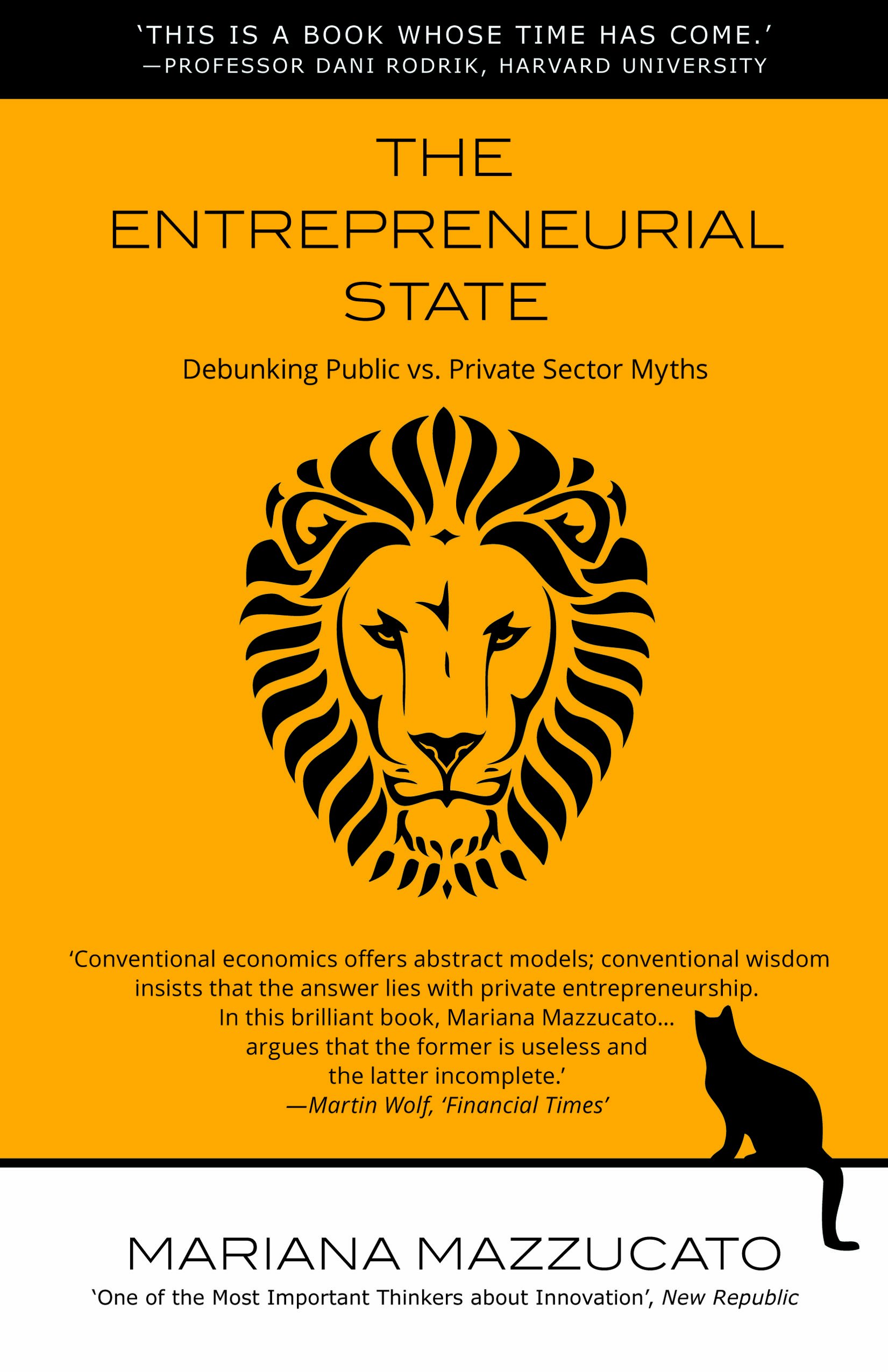
The Entrepreneurial State: Debunking Public vs. Private Sector Myths [Mazzucato, Mariana] on desertcart.com. *FREE* shipping on qualifying offers. The Entrepreneurial State: Debunking Public vs. Private Sector Myths Review: Canonical Views of the State are Incorrect and Purposely Misleading - The Entrepreneurial State is an extremely important antidote to the chest-beating, state-hating masters of the economic universe whose stock in trade is purposeful deception about the role of the state in economic development. In this view, the state impedes the otherwise constant "progress" enabled by the private sector and private capital. Needless to say, this view makes for an all-too-convenient unfair distribution of wealth. In reality, the State's role in innovation, in the very types of risk-taking on which technological progress depends, is profound. Private capital's contribution to fundamental innovation pales in comparison; private capital enters the fray when much of the expenditure and risk has already been borne by the State. If you believe Apple and Google (and the like) are counter-examples, this book is a must for you. A very readable book of manageable length, The Entrepreneurial State will open your eyes to the travesty of a belief system that allows powerful people to privatize gain at the expense of the public/state. The technology sector is --truth be told-- as guilty of this as any other. Review: Innovation for the Public Policy community and the Public - The Entrepreneurial State is a polemic. It is effective at imparting its message, which is critical because the rhetoric it is attempting to counter is both clear and pervasive, though ideologically driven and counterfactual. Perhaps it boils down to its genesis as a shorter report, but this book is unusually fractal. It is as if Mariana Mazzucato intentionally approached the writing knowing that portions (chapters?) would be photocopied and sent to unknown but highly important audiences. No matter how you slice it, her core message is retained, but the cover-to-cover reader emerges from the experience well tenderized, to say the least. A comprehensive and well supported monograph, it does not shy away from its goal : to fundamentally reorient the policy community and the public at large to the realities of the relationship between the public sector, the private sector, and technological innovation. Although plagued by mind-numbing quantities of reiteration, and occasional scapegoating and slighting for rhetorical purposes, it nonetheless is an important addition to the literature and one that will be much cited in the future.
| Best Sellers Rank | #822,474 in Books ( See Top 100 in Books ) #14 in Economic Policy & Development (Books) #14 in Government & Business #20 in Economic Policy |
| Customer Reviews | 4.2 4.2 out of 5 stars (211) |
| Edition | 1st |
| ISBN-10 | 0857282522 |
| ISBN-13 | 978-0857282521 |
| Item Weight | 1 pounds |
| Language | English |
| Print length | 266 pages |
| Publication date | June 10, 2013 |
| Publisher | ANTHEM PRESS |
R**N
Canonical Views of the State are Incorrect and Purposely Misleading
The Entrepreneurial State is an extremely important antidote to the chest-beating, state-hating masters of the economic universe whose stock in trade is purposeful deception about the role of the state in economic development. In this view, the state impedes the otherwise constant "progress" enabled by the private sector and private capital. Needless to say, this view makes for an all-too-convenient unfair distribution of wealth. In reality, the State's role in innovation, in the very types of risk-taking on which technological progress depends, is profound. Private capital's contribution to fundamental innovation pales in comparison; private capital enters the fray when much of the expenditure and risk has already been borne by the State. If you believe Apple and Google (and the like) are counter-examples, this book is a must for you. A very readable book of manageable length, The Entrepreneurial State will open your eyes to the travesty of a belief system that allows powerful people to privatize gain at the expense of the public/state. The technology sector is --truth be told-- as guilty of this as any other.
H**R
Innovation for the Public Policy community and the Public
The Entrepreneurial State is a polemic. It is effective at imparting its message, which is critical because the rhetoric it is attempting to counter is both clear and pervasive, though ideologically driven and counterfactual. Perhaps it boils down to its genesis as a shorter report, but this book is unusually fractal. It is as if Mariana Mazzucato intentionally approached the writing knowing that portions (chapters?) would be photocopied and sent to unknown but highly important audiences. No matter how you slice it, her core message is retained, but the cover-to-cover reader emerges from the experience well tenderized, to say the least. A comprehensive and well supported monograph, it does not shy away from its goal : to fundamentally reorient the policy community and the public at large to the realities of the relationship between the public sector, the private sector, and technological innovation. Although plagued by mind-numbing quantities of reiteration, and occasional scapegoating and slighting for rhetorical purposes, it nonetheless is an important addition to the literature and one that will be much cited in the future.
A**R
vindicating John Maynard Keynes
As a student of english literature, I've come to eschew passive verbs not only from my writing, but also from my speech. Thus, I tend to loath statements such as "government is the problem" or "the the markets are stable". And for all those free market acolytes, Dr. Mazzucato tears down your balcony. Yes, entrepreneurship does improve people's lives, and capitalism does serve as a powerful catalyst in engendering it. However, only a very parochial mindset believes that it falls exclusively within the domains of the private sector. Professor Mazzucato ables conveys how governement funding has given rise to the internet, iphone, and other pedestrian household items that many people today take for granted. Innovation's purpose should first be the ameliorate the quality of living for all, and then about making money. When people prioritize making money, they often make it their sole objective, and often times in achieving that goal, resort to improbity and unbounded exuberance. Want to emperical evidence? Look at the stock market crash of '29, the bubbles of tulips, tech stocks, and subprime mortgages. What got us out of those fiascos? Government spending. So we should not focus on weather governement being stable and the private sector being stable or vice versa, but how they can be used in conjunction to establish steady growth, creating prosperity for all, as did transpire for four decades when FDR got the New Deal implemented. Yes, private sector does fuel growth and innovation, but Government spending does not iterfere with it, at least not good governing. Rather, it regulates it, precluding it from getting too large to manage. The internet, iphone, and even Tesla, got their initial support from the Government, not from Bessemer Venture Partners or Lightspeed. Good government begets great prosperity.
M**I
The Entrepreneurial State by Mariana Mazzucato, review by Mahee Ferlini
Interesting analysis on how the state can contribute to long term economic growth especially through investment in research. I found it in line with some of the seminal contributions of Ken Arrow, Dick Nelson, and Keith Pavitt, among the others. However, I would have expected a deeper exploration of the conditions and the rules that can increase productivity and positive externalities of public investment. Moreover, as shown by the cases of Silicon Valley and Cambridge Ma., the US public research system has properties that other national systems of innovation were not able to replicate. So, I would have expected more emphasis on the interplay between competitive, mission oriented, public investment and vibrant market driven innovation dynamics. A good reading in any case. Mahee Ferlini
H**H
A thorough analysis and a well written book
I learned something new from this book. Mariana Mazzucato has devoted her academic life to this subject and provides convincing evidence of her claim that governments can be extremely innovative and prepared to take risk. It doesn't mean that all governments are like this and all that governments do fall into this category, but it does show how the innovative process and the advancement of societies are based on the interaction between the state and private enterprises. The question of how the state can capture a share of the successful commercial implementations of state funded innovation, is interesting. It is obvious that if all the failures are socialized and all the successes privatized, then we do not have a sustainable model.
P**S
Here is a real eye opener. It turns out that the government has been doing a lot of the important R&D work that private industry uses to make things like the iPhone. This is an economics book but I could still get the gist of the economics part and the part about the development of the iPod and similar was very interesting. Maybe we need to take another look at government, it is doing a whole lot more than advertised.
T**S
Reading The Economist is one of life's pleasures. Well-written, knowledgeable, and with a certain dash of the unconventional to spice it up, as in the paper's views on the so-called War on Drugs. But there's no denying that some of their pronouncements have an ex cathedra feel about them, as if the editorial team has been imbued with a certain infallibility. So it is with their framing of the role of the state in business, that is, that its role is to keep out, to not "pick winners". But as Mariana Mazzucato shows in The Entrepreneurial State, it has been, and should ever be, the role of the state to kick start the kind of research that private business is unwilling to finance. Without the state there would be no Internet, no GPS, no touch-screen technology to power Apple's iPod, iPad or iPhone. The irony, as she points out, is that Apple, beneficiary of a whole raft of state-sponsored technologies which she meticulously lists, is often used as the poster child of market fundamentalists. Mazzucato does not deny the role the firm has played in putting all of the technologies together in an aesthetically and ergonomically pleasing package, and praises Steve Jobs for his role in that respect. She also praises Jobs for his long-termist view, remembering that he always avoided the fashionable but short-termist stock-repurchase and profit-disbursement schemes advocated by exemplary citizens such as Carl Icahn. But the fact is that Apple is a prime example of where socialised risk has been parlayed into privatised return, albeit probably less egregious than banks in that respect. To compound the insult, Apple is one of the firms - she also cites Google, Amazon and Oracle - actively engaged in "tax-shuffling" activities which guarantee that some of the positive externalities of state-sponsored development are not realised, although she is perhaps somewhat overharsh in her assessment of other such externalities such as the number of people Apple claim to be employed as a result of their success. But as a result of some of this tax chicanery, she says as an example, the UK "tax gap" - the difference between actual tax collected and potential - is £120bn, at a time when the national deficit is £126bn. One of the problems with business, as she says, is its relatively short, and ever-shortening time horizons. In what she labels the Old Economy Business Model (OEBM), which was responsible for creating the golden age of the mass-production, Fordist technological revolution, capital, labour and the state shared the benefits, with job stability and real-income growth deemed important. These were the days of establishments like Bell Labs, Xerox PARC and the Alcoa Research Lab. These have now largely disappeared as a part of the New Economy Business Model (NEBM), in which constant job-hopping and insecurity are the norm, especially in the ICT arena. One of the problems with the attack on the state is that it becomes self-fulfilling, with state institutions hesitant in sponsoring research in the fear of failure and further attack. But if not the state, then whom? The usual suspects in this respect, Venture Capitalists and "entrepreneurs", she characterises (and here I paraphrases only slightly) as a bunch of pussies, nowadays particularly overly tied to the NEBM and highly risk-averse; and large, price-dependent corporations have massive sunk costs which make them path dependent, averse to anything which may disrupt their cosy business models. (In analysis I conducted a couple of years ago I attempted to establish a statistical correlation between large corporates, particularly in concentrated markets, and R&D expenditure . Whilst not particularly happy with some of the data available, I nevertheless expected to be able to demonstrate some correlation. After all, part of the pay-off for being allowed to operate as a large firm in a concentrated sector, able to set one's own prices and earn supernormal profits, is investment in ongoing R&D. But the correlation I found was very weak.) There is, then, a danger that the state will withdraw so much from research that much of the ability to develop breakthrough innovations is lost, with private firms reduced to making largely incremental changes to their product offerings. (In the west, at least. China, as Mazzucato points out, is not so shy when it comes to state-sponsored development.) What is needed, she says, is an application of the principles of Keynes and Schumpeter, with a recognition of the key role of the state in creative destruction. Together with that the state needs to work out how it may socialise the benefits of the outputs of this process, as well as being able to tell a better story about its achievements. We hear plenty about the failures, but who, she asks, has ever performed a thorough analysis of, say, the costs and benefits of Concorde, or rather the Concorde programme? Sometimes learning from "failure" is as important as learning from success. In presenting her case, Mazzucato has kept it concise and readable. Her examples are robust and sufficiently high profile that most people will be aware of them (which goes a long way to proving her point!). She is sometimes scathing of private business but never wholly dismissive: as with the case of Steve Jobs, private business has a key role to play as an entrepreneur in the Schumpeterian sense, of someone who adopts an invention and converts it into a saleable innovation. And as a coda to my opening about The Economist, when the paper reviewed the book (August 31st 2013), appropriately enough in its Schumpeter spot, it opined, ex cathedra, that "Quibbles aside, Ms Mazzucato is right to argue that the state has played a central role in producing game-changing breakthroughs". So that settles that, then. With regard to production of the book itself, the editing could have been a little better, although it's not by any means dire. In the Foreword, by Carlota Perez, "led" is spelt "lead", and then again in the early stages of Mazzucato's text, suggesting it is the editor, not the authors, at fault. The Foreword itself becomes the "forward" later on. As common as the error is, it should be noted that "quote" is not a noun, "quotation" is. Similarly, at one point "both" is followed by three things where "both" suggests two. Where we are told about "the Japanese electronics giant Sony" I think "Sony" would have done. But my greatest irritation is this now increasingly common inability to add "apostrophe s" to create singular possessives when the root noun itself ends with an "s". Instead we are given Jobs' instead of Jobs's, and on one occasion Job's. Unfortunately your (and my) spellchecker is wrong, here, and is even now indicating that Jobs's is incorrect and offers the other two as alternatives.
A**O
Lectura obligada para tener una visión mucho más ecuánime en relación a los papeles que juegan sector público y privado en los procesos de innovación. Parece evidente que la innovación más costosa, difícilmente va a poder ser asumida por los agentes privados, sobre todo en campos con tanta incertidumbre y riesgo como la biotecnología, o las energías limpias, dado que en sus fases iniciales, donde hace falta más investigación de base, es muy difícil poder hacer un análisis del ROI y una empresa privada, que tenga que justificar cuentas de resultados cada 4 meses, tendrá poco incentivo para aguantar una fuerte inversión el tiempo suficiente. Aquí las economías de escala cuentan también mucho. Estos son los puntos que el libro deja muy claros con ejemplos concretos sobre cómo se producen los ciclos de innovación.
L**A
La letra es algo reducida
F**E
Mariana Mazzucato, nata in Italia, insegna tra l'altro in un'università inglese sui temi della politica economica e dell'innovazione e ha pubblicato l'anno scorso questo libro che è stato considerato dal Financial Times uno dei libri dell'anno 1913. La tesi sostenuta in questo saggio è che a favorire molti dei successi della silicon valley e delle maggiori società americane che si occupano di elettronica di consumo è stata fondamentale la intelligente politica di ricerca, sostegno e intervento del governo americano e del dipartimento della difesa. degli Stati Uniti. Un libro che smentisce molte tesi correnti sull'austerità e lo sviluppo e fa riflettere sul ruolo positivo che può avere una seria politica di investimento, di indirizzo e di sostegno all'innovazione da parte dei governi europei, quello italiano per primo. Il sunto di un capitolo del libro è stato pubblicato dalla rivista "Left" nel giugno dello scorso anno.
Trustpilot
5 days ago
2 weeks ago