DOWNLOAD THE APP


Customer Services
Copyright © 2025 Desertcart Holdings Limited
DOWNLOAD THE APP
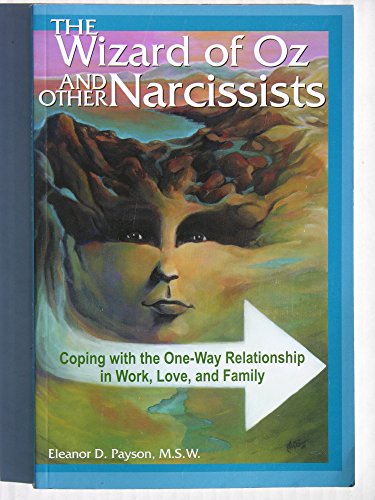
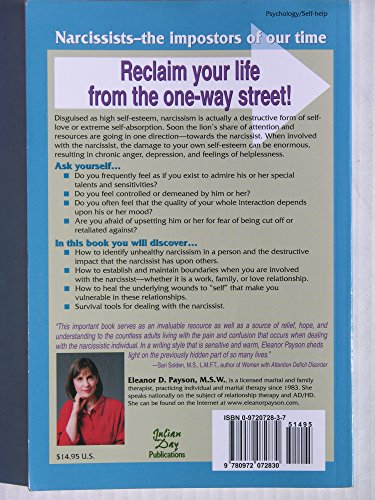

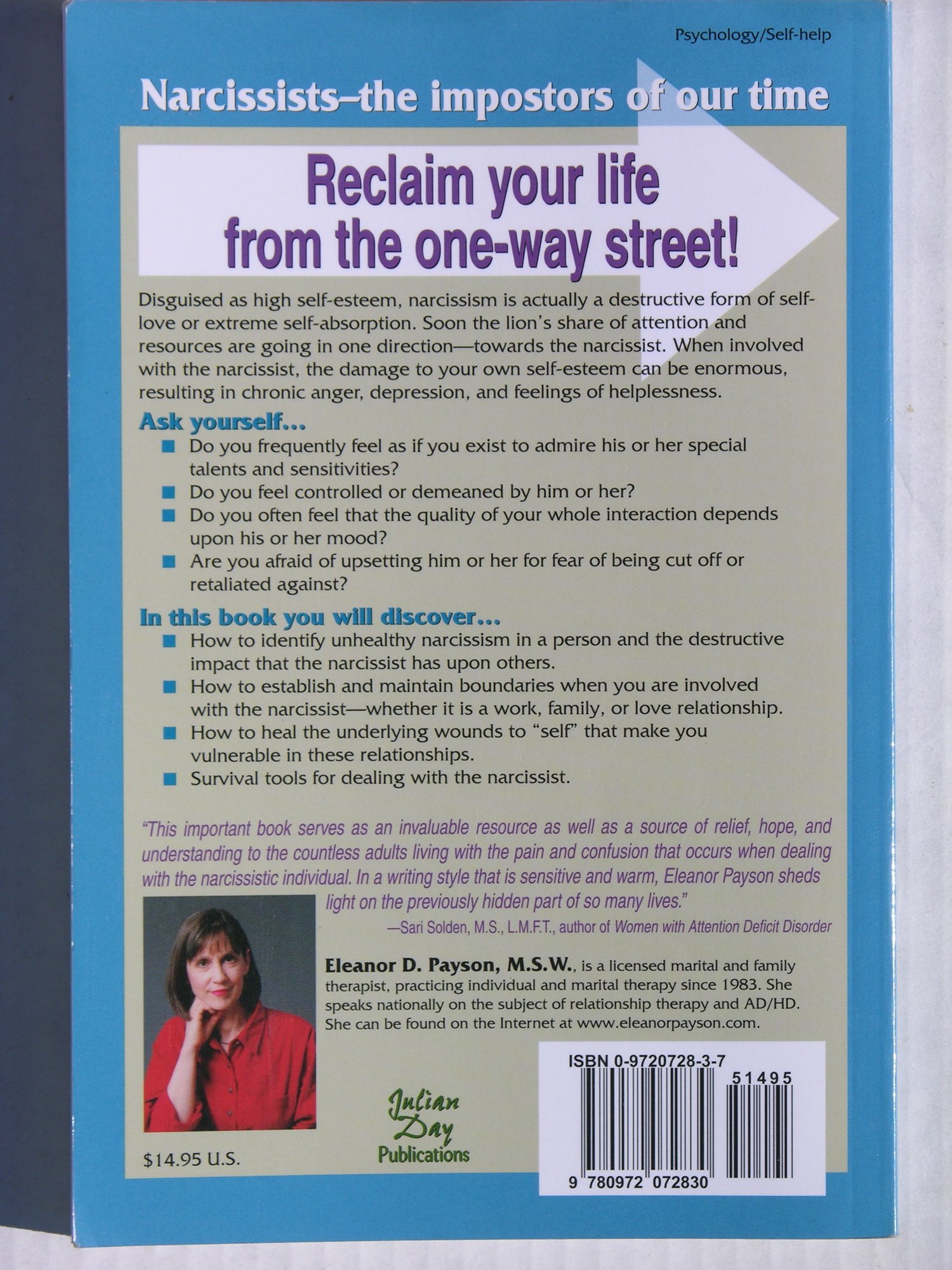
The Wizard of Oz and Other Narcissists: Coping with the One-Way Relationship in Work, Love, and Family [Eleanor D. Payson LMSW] on desertcart.com. *FREE* shipping on qualifying offers. The Wizard of Oz and Other Narcissists: Coping with the One-Way Relationship in Work, Love, and Family Review: Very important book if you find yourself always attached to narcissists - This book has been life changing for me. Like probably anybody else who has found out they are living with a narcissistic partner, I started reading many books on the subject. All books give lengthy descriptions of the Narcissistic Personality Disorder and the NP-disordered person, his behavior, his inner thinking, just so much that while reading, one becomes totally angry and infuriated. How dare this person treat me in such a way? The Wizard of Oz is written by a therapist who has treated many NPD persons and their counterparts as well. This is very important. She is the first author to give a fine and profound analysis of the entanglement between the two of you: your NPD partner and you. Then she asks you, the reader and partner of an NPD, why you are attracted to NPD's. What happened in your life so that now you must be with an NPD person? What is your underlying problem? This has really been an eye-opener to me. This is the first book that made me think about myself in this way, looking for answers deeply within me instead of just thinking about strategies to deal with the NPD and to become stronger in the relationship with him. The author gives an example of one patient of her who started to ask herself the right question. And so did I. I immediately knew which question to ask myself and what was the answer. I was stunned. I knew the answer, I had known it all my life, but I had never asked myself this question, nor had any therapist in my life. Eleanor Payson, thank you. The answer you made me look for in myself freed me instantly. It changed my relationship with my NPD partner instantly and totally, without any effort. I no longer have to put all my energy in suppressing the truth about my own wounding (which was the clue about why I MUST attach myself to an NPD). Our relationship changed. He saw it and accepted. I did not have to break up with him. Something that made me cling to him and all the time need something from him, like me insisting on him giving me a bandage to a forever bleeding wound that is deep like an abyss, has evaporated in the air. It's no longer there. The wound is still there, but the inner urge to look for that bandage and to believe my NPD will give it to me, is gone. My advise: if you are prone to establishing relations with NPD persons, this means something about you. There is an inner wound in you, most probably you grew up with (an) NPD parent(s). Face it, deal with it, treat yourself. No longer look at and be frustrated with your NPD. Find the answers deep in you. Read The Wizard of Oz. Thank you, Eleanor Payson! Review: Payson has written a very helpful book... - I began a project of thinking about narcissism in our culture, and this is the fifth book I have read on individual narcissism, and specifically, narcissistic personality disorder (NPD), and the narcissist's victims and the co-dependents who enable the narcissists through abandonment of their own selves. Of the five books, this one is the most concrete and specific about interactions with narcissists (who may be our parents, or spouse, or other family member): (1) identifying the types of interactions (2) grieving the loss of an illusory idealized wished-for relationship with the narcissist, (3) developing skills to limit the on-going wounding (e.g., assertiveness, boundary formation, and the like), (4) understanding the role of defenses in why we (and he) does not understand our own pain; and (5) developing a true respect for one's self and one's integrity. Despite Payson's extensive examples and commentary, this is not a how-to book; it is a book about how-to-think-about-how-to-grow type of book. I liked her style of writing, her use of myths, parables, and literary stories (Faust, for example) as ways to talk about narcissism. She strikes me as an extremely competent and thoughtful therapist. This book didn't help me in my thinking about narcissism in culture, but it was worth the time and taught me a lot.
| Best Sellers Rank | #63,196 in Books ( See Top 100 in Books ) #92 in Abuse Self-Help #350 in Interpersonal Relations (Books) #1,384 in Parenting & Relationships (Books) |
| Customer Reviews | 4.6 4.6 out of 5 stars (1,544) |
| Dimensions | 8.94 x 6.02 x 0.51 inches |
| Edition | Third |
| ISBN-10 | 0972072837 |
| ISBN-13 | 978-0972072830 |
| Item Weight | 12.3 ounces |
| Language | English |
| Print length | 187 pages |
| Publication date | October 1, 2002 |
| Publisher | Julian Day Publications |
D**R
Very important book if you find yourself always attached to narcissists
This book has been life changing for me. Like probably anybody else who has found out they are living with a narcissistic partner, I started reading many books on the subject. All books give lengthy descriptions of the Narcissistic Personality Disorder and the NP-disordered person, his behavior, his inner thinking, just so much that while reading, one becomes totally angry and infuriated. How dare this person treat me in such a way? The Wizard of Oz is written by a therapist who has treated many NPD persons and their counterparts as well. This is very important. She is the first author to give a fine and profound analysis of the entanglement between the two of you: your NPD partner and you. Then she asks you, the reader and partner of an NPD, why you are attracted to NPD's. What happened in your life so that now you must be with an NPD person? What is your underlying problem? This has really been an eye-opener to me. This is the first book that made me think about myself in this way, looking for answers deeply within me instead of just thinking about strategies to deal with the NPD and to become stronger in the relationship with him. The author gives an example of one patient of her who started to ask herself the right question. And so did I. I immediately knew which question to ask myself and what was the answer. I was stunned. I knew the answer, I had known it all my life, but I had never asked myself this question, nor had any therapist in my life. Eleanor Payson, thank you. The answer you made me look for in myself freed me instantly. It changed my relationship with my NPD partner instantly and totally, without any effort. I no longer have to put all my energy in suppressing the truth about my own wounding (which was the clue about why I MUST attach myself to an NPD). Our relationship changed. He saw it and accepted. I did not have to break up with him. Something that made me cling to him and all the time need something from him, like me insisting on him giving me a bandage to a forever bleeding wound that is deep like an abyss, has evaporated in the air. It's no longer there. The wound is still there, but the inner urge to look for that bandage and to believe my NPD will give it to me, is gone. My advise: if you are prone to establishing relations with NPD persons, this means something about you. There is an inner wound in you, most probably you grew up with (an) NPD parent(s). Face it, deal with it, treat yourself. No longer look at and be frustrated with your NPD. Find the answers deep in you. Read The Wizard of Oz. Thank you, Eleanor Payson!
S**G
Payson has written a very helpful book...
I began a project of thinking about narcissism in our culture, and this is the fifth book I have read on individual narcissism, and specifically, narcissistic personality disorder (NPD), and the narcissist's victims and the co-dependents who enable the narcissists through abandonment of their own selves. Of the five books, this one is the most concrete and specific about interactions with narcissists (who may be our parents, or spouse, or other family member): (1) identifying the types of interactions (2) grieving the loss of an illusory idealized wished-for relationship with the narcissist, (3) developing skills to limit the on-going wounding (e.g., assertiveness, boundary formation, and the like), (4) understanding the role of defenses in why we (and he) does not understand our own pain; and (5) developing a true respect for one's self and one's integrity. Despite Payson's extensive examples and commentary, this is not a how-to book; it is a book about how-to-think-about-how-to-grow type of book. I liked her style of writing, her use of myths, parables, and literary stories (Faust, for example) as ways to talk about narcissism. She strikes me as an extremely competent and thoughtful therapist. This book didn't help me in my thinking about narcissism in culture, but it was worth the time and taught me a lot.
Q**M
Awesome Book!
This is perhaps the most insightful book I have ever read. It answered so many questions lingering in my mind since years. I'm so glad to have found this book yesterday. I finished it in less than 24 hours. Dale Carnegie said that the self is most important for each person and by extension narcissism, is but natural The author endorses this fact as well as she said that all of us exhibit narcissism to some extent, but when it exceeds certain limits and turns toxic, then we have a problematic individual at our hands. Unfortunately, I have dealt with NPD personalities more often than most people. I was baffled by their selfishness and their wanton quest for material success, even as they possessed no outstanding quality. The book gave revealing insights into their behavior. While reading some paragraphs it felt as if they had been written to describe my encounters with certain very unpleasant men and women in social and work settings. To add to the book, in my opinion, co-dependents are not always beset with low self esteem or childhood trauma. They may very well be people who possess an extra barrel of empathy and a genuine regard for their friend/family. Narcissists would latch on to such people and suck the life out of them. However, it's of paramount importance in healing, not to resent our "giving nature" for that can in turn deplete us of empathy, which is ironically missing from the core of the narcissist's despicable personality. If you know what you're up against, you can fight it. This book teaches you exactly that. If there is a shortcoming in the book, it is an absolute lack of tips for a) defining boundaries (it refers to another book for that) and b) for ensuring reciprocal exchange. But even then, it is a great book to read. ****UPDATED TWO YEARS LATER Jan 10, 2015***** The book heavily borrows from "The Drama of the Gifted Child", but adds enough meat of its own to be a very worthwhile read.
F**E
Any information about narcissism is good to have
K**R
This had to be the best "starter" book I have read yet. It put so much into perspective. I really liked the way the author inserted "He or She" into everything. I have been getting really tired of reading about Men being the aggressors. It is a known fact that there are a lot of women that fit into the NPD world. It's Just that most men (like myself) also suffer in silence. This book put me on the path to recovery and I would recommend this to anyone that is trying to get a "grip" on reality.
J**E
This book has excellent explanations of narcissistic behaviours and offers strategies to implement to manage the narcissistic people in your life. I highly recommend this book above any other I have read on this topic.
E**H
Excellent book will recommend it 100%
C**A
written by a Christian which is what i prefer & explains things in laymans language. i had lived for the last 45 years in absolute turmoil & hell, i came across this book on a youtube channel by chance & very grateful, maybe my famillies life saver
Trustpilot
1 month ago
3 weeks ago