Some deliveries may take a little longer than usual due to regional shipping conditions.

DOWNLOAD THE APP


Customer Services
Copyright © 2025 Desertcart Holdings Limited
DOWNLOAD THE APP

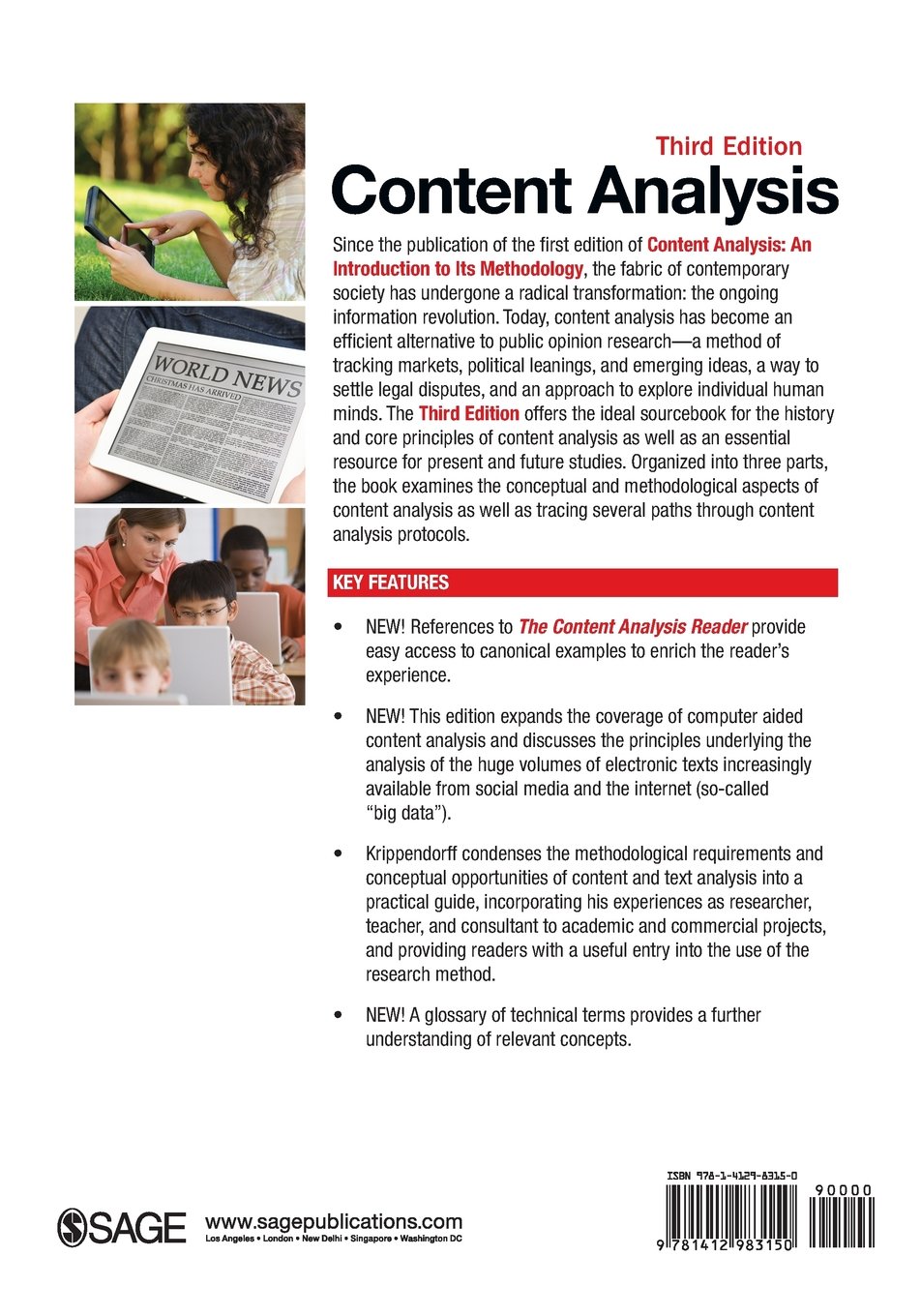
desertcart.com: Content Analysis: An Introduction to Its Methodology: 9781412983150: Krippendorff, Klaus: Books Review: The Leading Content Analysis Methods Reference - Klaus Krippendorff has updated his influential treatment of content analysis methodology ( Content Analysis: An Introduction to Its Methodology ). The author acknowledges that two decades have changed how content analysts work. Changes include the pervasiveness of computers, diffusion of content analysis methods to other disciplines, large text archives on the web, and increased coordination between teams of analysts. The 14 chapters are organized into three sections that present foundational material, content analysis design, and analysis and interpretation. The author begins with the history of content analysis. He includes well-chosen examples ranging from its origins in Renaissance analysis of religious texts, through early 20th century focus on newspapers, World War II concerns with propaganda, and postwar expansion into broadcast media and advertising. Starting in the sixties, he chronicles the emerging influence of computers, electronic storage, and the web. His review of computer-aided content analysis tools does not descend into a "shoot-out" feature comparisons, but develops a framework based on how they support the researcher. Adopting a cautionary tone about the limits of computers, Krippendorff distinguishes between simple text management and search tools, computer-aided content analysis software such as WordStat and DICTION ( Campaign Talk: Why Elections Are Good for Us ), and interpretive aids such as NUD*IST used by qualitative researchers. He emphasizes semantic validity--the need for computer generated solutions to be validated by informed human judgement--and proposes strategies for establishing it. He distinguishes between research projects motivated by knowledge-driven research questions, and those motivated primarily by availability of software tools. Tool-driven approaches merit extra scrutiny because of the possibility that researchers will pursue them carelessly. The book contains some fascinating case studies. My favorite is the subtle differences in meaning of the word "rights" as used by Republicans versus Democrats (p. 266). Researchers will also appreciate his list of large electronic text archives (p. 274) and his guidance for building content dictionaries (p. 287). The review includes not only dictionary approaches, but statistical association, semantic networks, and "memetic" strategies (p.299) which trace the flow of ideas between documents--such as cascades of newsgroup messages and genealogies of plagiarized college essays. The author speculates about future innovations from computational linguistics, artificial intelligence, and the commercial marketplace. This book is the classic methods reference on content analysis by one of the field's senior researchers. Content analysts are its natural audience, but it should be read by computer text analysts, too. Not for its perspective on software, which is limited, but for a much-needed research design perspective on the disciplined analysis of text. Review: In-depth look at a misunderstood methodology - The author takes a deep dive into the methodological considerations of virtually every facet of content analysis. With philosophical viewpoints, literature based support, and instructional how-to's, this text is a complete guide for beginning researchers and content analysts alike. This is a great source for building support for the use of high-level CA in modern academic/scientific/governmental research.
| Best Sellers Rank | #2,562,029 in Books ( See Top 100 in Books ) #2,537 in Communication Reference (Books) #6,755 in Communication & Media Studies #8,228 in Psychology (Books) |
| Customer Reviews | 4.2 4.2 out of 5 stars (20) |
| Dimensions | 7 x 1 x 9.75 inches |
| Edition | Third |
| ISBN-10 | 1412983150 |
| ISBN-13 | 978-1412983150 |
| Item Weight | 1.75 pounds |
| Language | English |
| Print length | 456 pages |
| Publication date | April 12, 2012 |
| Publisher | SAGE Publications, Inc |
J**D
The Leading Content Analysis Methods Reference
Klaus Krippendorff has updated his influential treatment of content analysis methodology ( Content Analysis: An Introduction to Its Methodology ). The author acknowledges that two decades have changed how content analysts work. Changes include the pervasiveness of computers, diffusion of content analysis methods to other disciplines, large text archives on the web, and increased coordination between teams of analysts. The 14 chapters are organized into three sections that present foundational material, content analysis design, and analysis and interpretation. The author begins with the history of content analysis. He includes well-chosen examples ranging from its origins in Renaissance analysis of religious texts, through early 20th century focus on newspapers, World War II concerns with propaganda, and postwar expansion into broadcast media and advertising. Starting in the sixties, he chronicles the emerging influence of computers, electronic storage, and the web. His review of computer-aided content analysis tools does not descend into a "shoot-out" feature comparisons, but develops a framework based on how they support the researcher. Adopting a cautionary tone about the limits of computers, Krippendorff distinguishes between simple text management and search tools, computer-aided content analysis software such as WordStat and DICTION ( Campaign Talk: Why Elections Are Good for Us ), and interpretive aids such as NUD*IST used by qualitative researchers. He emphasizes semantic validity--the need for computer generated solutions to be validated by informed human judgement--and proposes strategies for establishing it. He distinguishes between research projects motivated by knowledge-driven research questions, and those motivated primarily by availability of software tools. Tool-driven approaches merit extra scrutiny because of the possibility that researchers will pursue them carelessly. The book contains some fascinating case studies. My favorite is the subtle differences in meaning of the word "rights" as used by Republicans versus Democrats (p. 266). Researchers will also appreciate his list of large electronic text archives (p. 274) and his guidance for building content dictionaries (p. 287). The review includes not only dictionary approaches, but statistical association, semantic networks, and "memetic" strategies (p.299) which trace the flow of ideas between documents--such as cascades of newsgroup messages and genealogies of plagiarized college essays. The author speculates about future innovations from computational linguistics, artificial intelligence, and the commercial marketplace. This book is the classic methods reference on content analysis by one of the field's senior researchers. Content analysts are its natural audience, but it should be read by computer text analysts, too. Not for its perspective on software, which is limited, but for a much-needed research design perspective on the disciplined analysis of text.
M**R
In-depth look at a misunderstood methodology
The author takes a deep dive into the methodological considerations of virtually every facet of content analysis. With philosophical viewpoints, literature based support, and instructional how-to's, this text is a complete guide for beginning researchers and content analysts alike. This is a great source for building support for the use of high-level CA in modern academic/scientific/governmental research.
A**S
made for very easy reading, with excellent real-life examples
It was surprisingly quite comprehensive, made for very easy reading, with excellent real-life examples. For a book dedicated to one method, it could easily have been adopted as a basic Social Research text for an upper level undergraduate or graduate level class. Tackles the issues involved with reliability and validity in an excellent and less abstract manner. And while some things can't be all things to everyone, I would have been ecstatic if Krippendorff, at a modicum., addressed the qualitative aspects of the methodology, and not made it appear as though content analysis is exclusively "quantitative," or though necessarily bi-polar - which appears to be somewhat the notion. Although, in all fairness, he does address that very issue in the very first chapter of the book, by questioning the marked differences and fuss over "...the validity and usefulness of the distinction between quantitative and qualitative content analysis" (p. 22). According to Krippendorff whether a researcher calls him / herself qualitative / quantitative, all text, when ultimately read is qualitative, even if that text is later converted into numbers. However, because of Krippendorff's lengthy career steeped in a quantitative content analysis practice, the book is "unfortunately" bent in that direction as well, without much of any semblance of a qualitative focus. He does give examples of qualitative analyses here and there, but not much into its mechanics as much as to that devoted to the quantitative methodology and strategy. Regardless, that is not to say, this is a detractor for an otherwise excellently written book, this is expected to be all things for everything "content analysis!"
C**S
Five Stars
Good direction of analysis and collection. Highly advise reading this if you're doing a document or textual analysis.
K**M
too low image quality in e-book
The quality of all e-book images that have detailed fomulas and information is too low to identify. AMAZON must update image quality, if AMAZON wants to sell this e-book.
H**.
Krippendorff's Content Analysis
Studying with this book along with the ebook helped me to learn content analysis in preparation for my MBA thesis.
A**R
Five Stars
THE BOOK IS CLEARLY WRITTEN, CONCISE AND INFORMATIVE.
K**N
Five Stars
As expected
M**I
An absolute reference for anyone interested in content analysis.
S**K
Positive: topic rather rigorously treated, a must read for content analysts. Negative: specific themes like case studies not enough covered.
Trustpilot
2 days ago
2 weeks ago