
DOWNLOAD THE APP


Customer Services
Copyright © 2025 Desertcart Holdings Limited
DOWNLOAD THE APP
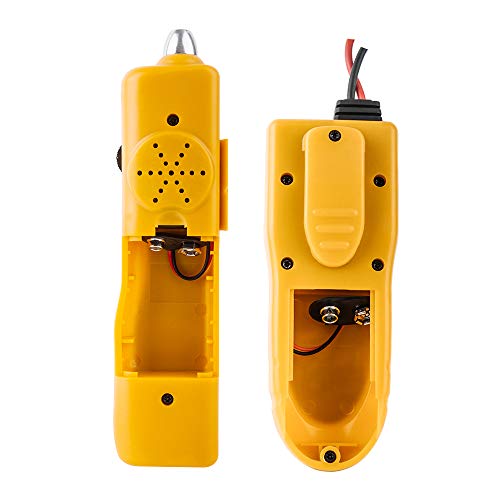

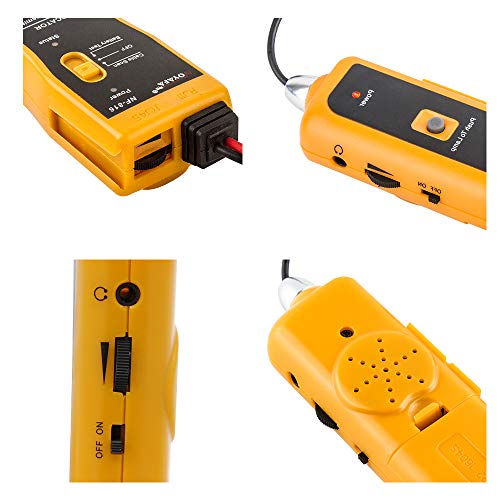
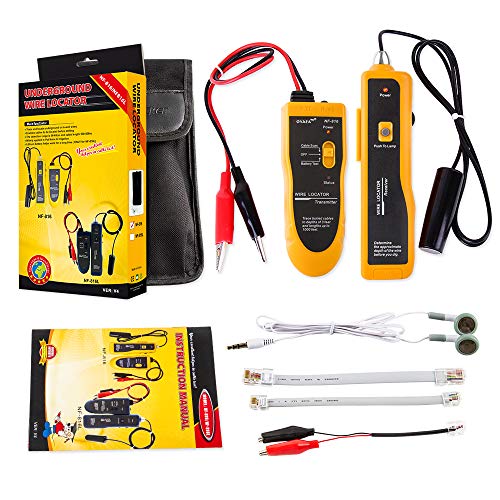

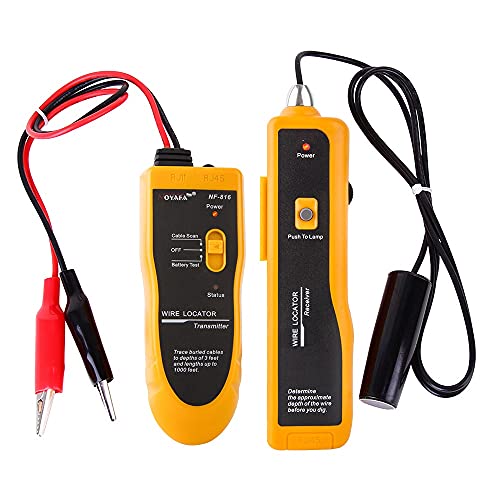

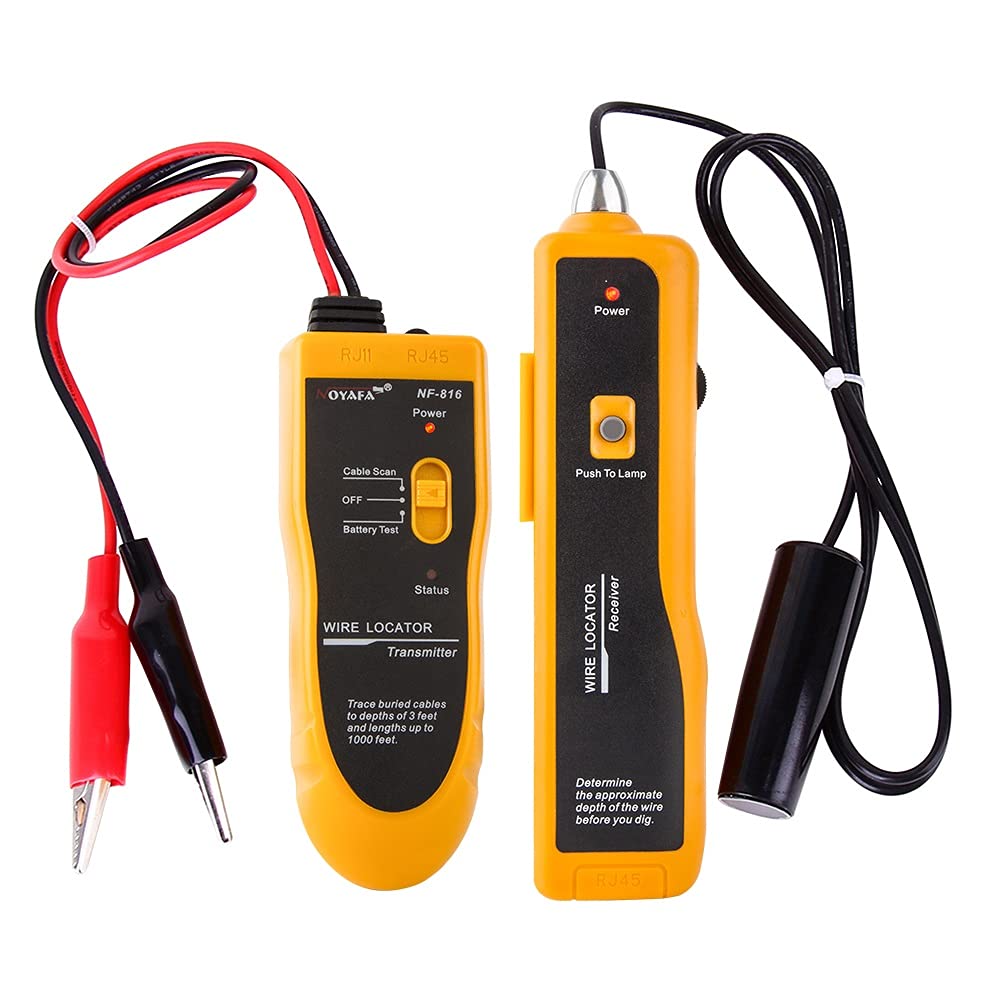
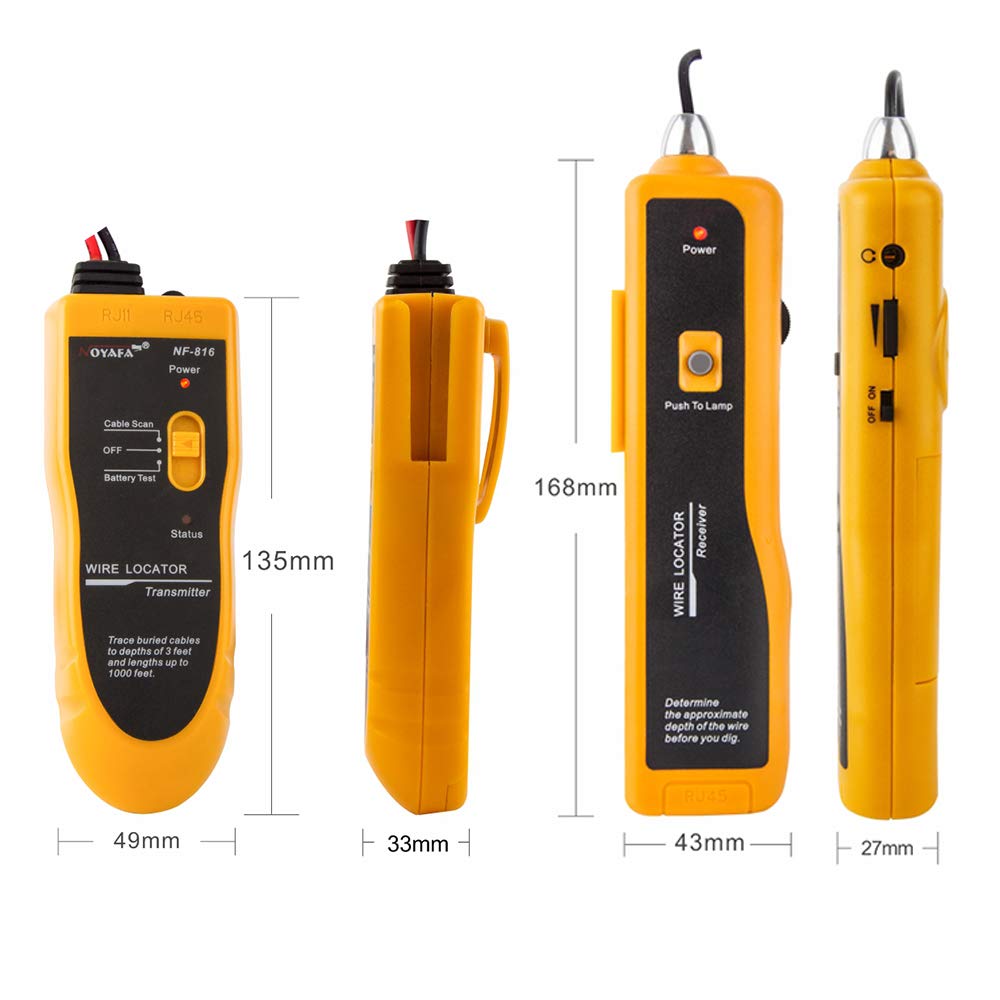

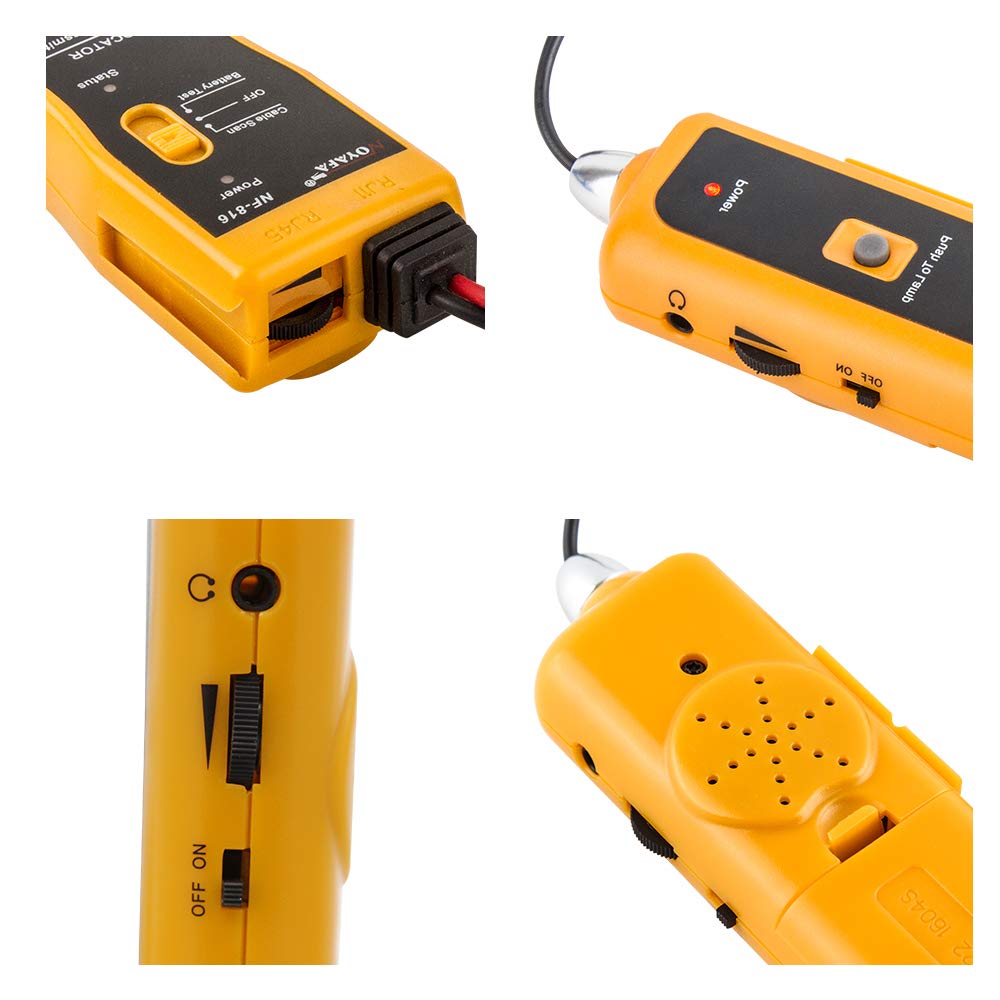


🚧 Never dig blind again—locate with confidence and lead the way!
The NOYAFA NF816 is a digital underground cable locator designed to accurately trace and identify non-energized single or two-core wires up to 1000 feet in length and 2 feet underground. Ideal for locating pet fences, electrical cables, metal pipes, and telephone wires, it operates on a standard 9V battery and features a compact, user-friendly design. This tool empowers professionals and savvy homeowners to avoid costly digging mistakes and confidently map hidden wiring paths.

| ASIN | B00JWQNHRG |
| Brand | NOYAFA |
| Color | Yellow |
| Date First Available | December 6, 2013 |
| Global Trade Identification Number | 00700064564189 |
| Is Discontinued By Manufacturer | No |
| Item Weight | 1 pounds |
| Item model number | NF816 |
| Manufacturer | NOYAFA |
| Package Dimensions | 10.28 x 5.94 x 1.93 inches |
| Power Source | Battery Powered |
| Style | Digital |
| UPC | 887898409913 700064564189 |
T**N
If you can follow directions, it works great.
It's not perfect, but for the price, it sure beats using a shovel or hiring someone to find/map power lines. I used it to locate my well pump power lines that run about 400' from my house to the submersible pump. Thanks to several reviews here that described how the signal tone works (and of course reading the manual), I was able to locate the entire run. Not only that, but I was able to determine the depth - which at some points was more than 5 FEET below ground. When my contractor laid the water line, he did so in the same ditch as the cable. Since I was trying to find the water line (to add a tee so I could plumb the water into a new garage), I searched for the electric wires instead. By swinging the receiver antenna like a pendulum, I could hear the tone go silent each time it swung directly over the line. I then spray painted that spot, and repeated the process for the entire length up to the point where the garage was to be built. When I got to the point where I wanted to bring water to the surface, I marked the spot. I then held the probe in my hand, tilting it to 45° (you can use a carpenter's square to make sure the angle is precise). Then, I moved away from the spot listening to the tone. When the tone abruptly disappeared, I marked that location (which was 36" from the initial spot directly above the wire). Since I now have a right triangle (90°, 45°, and 45°), the distance between the spots is the same distance (depth) between the cable and the spot above it. I now knew exactly how far to dig down before encountering the wire. THat provide a reasonable level of confidence so I could swing my shovel aggressively until the last 6 inches or so. When I got to the suspected depth, I found the pipe and cable. It was perfect. The cables run directly under the pad for the new building. The pad, which consists of 14 dump truck loads of dirt to bring the grade up by 3 feet, put the cable 5' under grade. I did not think this device would scan that deep, but it did. And, as an added benefit, with the precise path and depth of the cable clearly marked, the building contractor can avoid hitting them when they dig their post footings.
C**D
Works if you know how the tool functions. Needs a better manual.
This is version 1.0 of the product and it has flaws, so be prepared. The instruction manual is a poor translation and appears to be written by someone who did not understand the theory of operation behind this device. That said, it can definitely serve a purpose. I traced out a 50 foot pipe buried about 14 inches down to an accuracy of a couple of inches. I used a nylon rope to show the precise path. The trick is knowing which mode to use. The device i have (October 2014) has a "battery test" position which is the position to use for sending a current through the wire. An LED lights when you have a closed circuit. So in order for directional mode to work, you need a closed circuit with the far end of the cable. A ground or large wire loop is OK if the return path is far from your wire of interest. The advertised workable depth of 3 feet seems correct. I think this will work on automotive wiring because regular steel did not seem to interfere with the RF signal. There is also an omni-directional mode where this unit functions much like a standard toner. You only need the red transmitter lead connected for this mode. If you have a broken wire this mode may help locate the break.
F**A
Throw away the documentation and read reviews posting on this site.
Documentation sucks. Took me three days to figure it out. Here is what you need to know to track down an underground wire: a) SHUT OFF power to that wire. Buy one of those touch testers (lights up when wire energized) to be 100% sure. Is your life worth $26? b) Disconnect the black wire from your breaker box. c) Connect the red NF-816 wire d) Here is the first trick: don't connect to the neutral or ground wires in the breaker box. Instead, get a long screwdriver and drive it into the ground outside. Get a long wire (mine took 30' of wire to get outside) and connect one end to the screwdriver and the other to the black clip from the NF-816. Make sure your dog/kids don't trip over that wire, it would mess with your head... d) Turn on the NF-816 to max volume and max Cable Test e) Take the remote part of the NF-816 and go outside. Turn it on on max, don't use the headphones (unless you want to go deaf) f) Here is the second trick: it makes crackling noise all the time, various sounds, burps and other insanity. Once you are above the wire it goes silent. Go back and forth, you'll find the wire. g) Here is the third trick: depth? Never figured it out, I just dug until I hit the conduit.
E**1
Works as advertised
This device has received mixed reviews so I was skeptical that it would work. The documentation is not good, but after playing around with it I can report that it did an excellent job finding sprinkler wires that were buried about 16" deep. Once I had it set up, it took me about 10 minutes to accurately locate over 200 feet of buried cable. I think that some of the negative reviews are due to operator error, that is to say that they didn't understand how this device is supposed to work. I figured out that it actually works two ways. One method uses both leads as when locating underground wires. One wire is attached to a good earth ground and the other one is attached to the wire in question. When used this way, the wire will be located under the "null" . The other method uses only one of the leads. When used this way, the wire will be located under the "peak" tone. This method would most likely be used when trying to locate a wire in a wall. It appears that this device is marketed under several brand names, so I would assume that all are actually the same unit. Also, for some reason, the power control wheel on the transmitter works opposite the indicated power (volume) scale. I verified this with a digital voltmeter. All in all, I think that this locater is a great value for under $50.
L**E
Excellent appareil selon mon mari pour retrouver des fils électriques dans des murs ou enterrés
C**H
Had to find a breakage in our under ground wire over 2 acres. It safe us a ton of time to find it
S**W
It worked had to do so test runs to know what I was listening for
J**R
I bought this item to help locate a inlet pipe in my underground cement pool.. I had cut the pipe at the one end of the pool, and threaded a heavy wire through the poly pipe, to a depth where it was practically coming out of the jet, in the pool (which I had blocked off).. I had dug down, on the outside of the pool, and 2 feet under, where the pipe should be.. I connected the one end to the wire, and went to the end of the pool.. No beeping.. Even though there would have been at most 5" of concrete for the signal to go through, from the threaded wire....
A**R
I have used this to find buried broken Husqvarna automower wires and I love it. Super easy to use and very very accurate. My wires were down about 4 inches and it worked like a charm
Trustpilot
1 week ago
1 week ago