
DOWNLOAD THE APP


Customer Services
Copyright © 2025 Desertcart Holdings Limited
DOWNLOAD THE APP
Full description not available
C**G
Looking at Technology Through a Biblical Lens
When I first began to read this book I wasn't sure. I didn't understand where he was going and how he was going to turn it to the point, but it came like no other book I have ever read. I like this book so much because it gives a really close look at all the technology that is being developed and how it is affecting our personhood.The overarching question to me was; "How are we rejecting the image of God when we embrace technology?" I think that he not only answers the question with some key insights but also gives some practical steps for changing our mindsets in a digitally clouded world.Read the whole book through and I promise that you will learn something that surprises you about the way technology has conditioned you to view the world. Once again I highly recommend this book to anyone who is studying computer science or is just generally interested in figuring out how the world of technology and Christianity mesh.
B**.
An important book on Christianity and transhumanism
This is a thought-provoking, critical analysis of transhumanism and how Christians can and should engage with it—and with the various forms of technology that influence who we are and how we live, for better or for worse.The author penetrates beneath the claims and goals of transhumanism to identify its underlying values, exploring both the forces shaping those values and the degree to which they are consistent with Christianity. The book is generally critical of transhumanism, concluding that its aims are largely at odds with the Christian faith, especially with regard to what it means to be human.I appreciate Dr. Shatzer’s willingness to explore underlying values rather than remain content with a surface-level analysis of technology and attitudes toward it. I also appreciate his desire to respond to the various questions technology raises from a firm grounding within the Christian tradition. More hard work like this needs to be done if Christians are to address technology in a way that’s both relevant and fruitful.
M**R
Transhumanism And The Image Of God
Interesting read on how technology affects humans and how human affect technology. Many issues about the topic are addressed, including:1. How technology can impact our spiritual formation.2. How technology can change the way we see the world.3. Technology can be used for good and bad.4. The impact of addiction to technology has on us.5. How technology can affect our relationships with each other.Thoughtful and smoothly transitions from topic to topic. Enlightening read on a topic that will grow in importance as time goes on. I was given a review copy by IVP Academic in exchange for a fair review and appreciate the opportunity.
A**R
Well written! Excellent read!
It often takes others twice as many pages to say half as much as Jacob Shatzer says in just 180 pages! No wasted words. No high-minded rhetoric. No technical jargon. Just a readable, informative book that any lay person can easily follow and digest. And...there is quite a bit to digest here! Transhumanism And The Image Of God is well written. I have learned something on every page! Thank you!
M**R
Solid Case and Sound Counsel
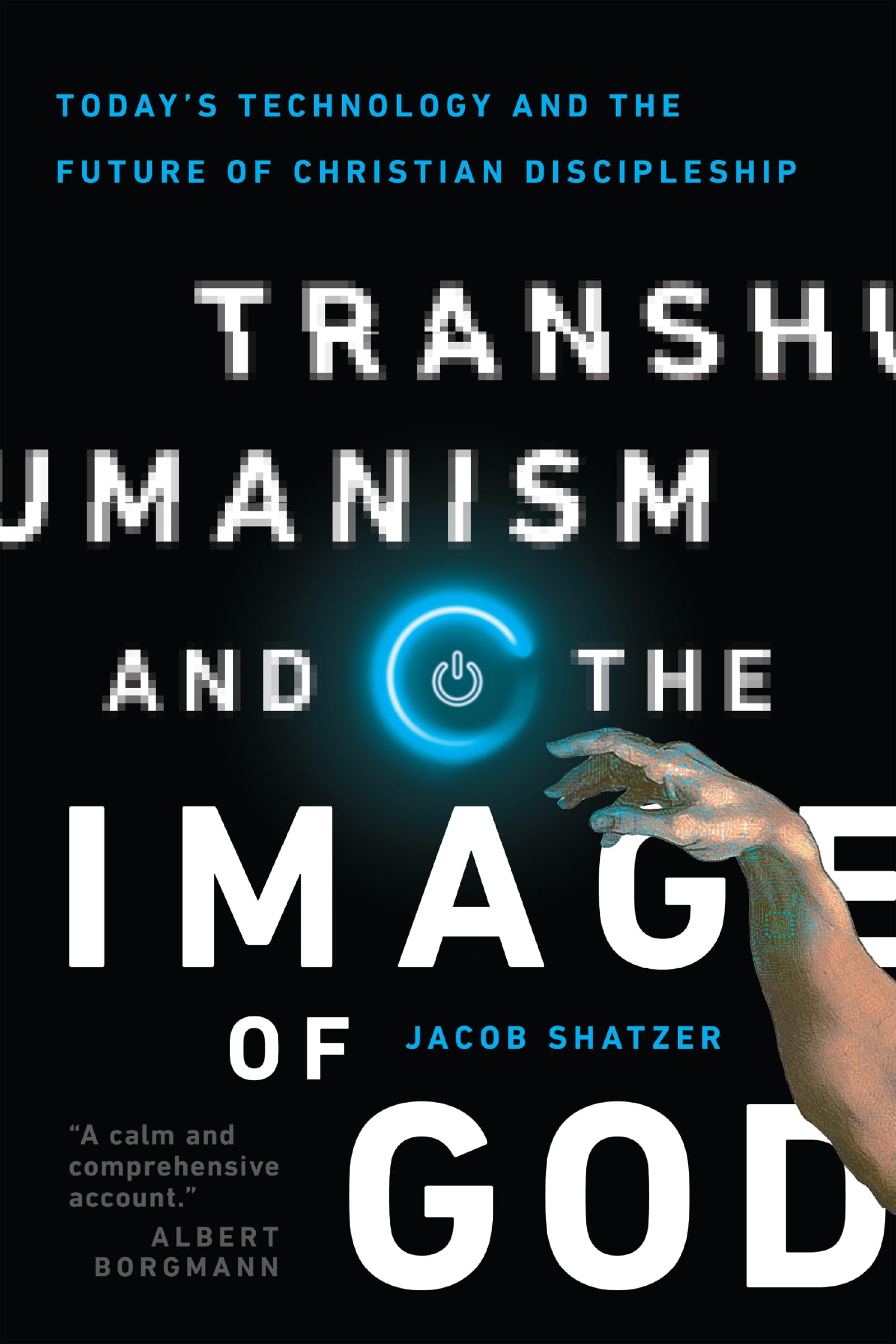
With the growing matrix of social media, artificial intelligence, robotics, and prosthetic enhancements, people should be asking all types of questions. And they are, just not always the right ones. Some are asking “What more can be done?” while others are inquiring “What should be done?” Jacob Shatzer, assistant professor and associate dean in the School of Theology and Missions at Union University, ordained Southern Baptist minister and author, addresses more of the “What is going on, why, and how are we to rightly engage?” queries in his new 192 page softback: “Transhumanism and the Image of God: Today's Technology and the Future of Christian Discipleship.” Shatzer focuses on technological advances, the thinking going on among transhumanists and posthumanists, and searches out ways for Christians to decrypt the ought from the is. He writes for a broad spectrum of interested people, and those who should be interested.The main concept running through “Transhumanism and the Image of God” is that we humans make tools, and then tools make us. We construct technological tackling and it in turn molds our perceptions and directions. Which means that technologies are “shaping us. And shaping people, after all, is just another way of talking about discipleship” (8). Therefore, “part of responsible, wise, faithful of tools is analyzing the ways that certain tools shape us to see the world in certain ways, and then to ask whether those ways are consistent with the life of a disciple of Christ” (7). Thus, the author argues “that Christians must engage today’s technology creatively and critically in order to counter the ways technologies tend toward a transhuman future…Human making is happening, and technology is a powerful part of that making, sneaking its values into us at almost every turn” (11).The first half of the book pointedly examines the issue. In these first five chapters the author explains what transhumanism is and how it undergirds a posthumanist aim. He unpacks the various pedigrees and personalities that formed transhumanism and where they are (from Google to Facebook and beyond). He looks into several of their tenets, where they are beneficial and how they are problematic. Shatzer also attends to the transhumanist notion of morphological freedom, which “means the ability to take advantage of whatever technology a person wants to in order to change their body in any way they desire” (56). This momentum continues, progressing to the place where the human and machine merge bringing humans to augmented reality as well as to potential mind clones.The author perceives that many of these aspects are already in their early stages, and we are unthoughtfully employing them from our smartphones to our newest cutting-edge gadgets. Therefore, Shatzer helpfully works through each item, and after explaining them and their advantageous uses, thoughtfully works around how we should think about these advances and changes, and where we should go; “If we want technology to serve the community, then, it must be useful to move people toward the ultimate good not defined by technology itself” (35). He further moves, in the last five chapter, to guiding the reader to a more critical position by asking important questions, such as what is real, where is real, who is real, and am I real? I appreciated how the author exposes the clearly gnostic underpinnings that flow through our technological advances – the desire to transcend the body because it is expendable – and he grounds our rightful concerns and corrections in the incarnation: “The doctrine of the incarnation shows us why full, embodied humanity is the goal, and the importance of this doctrine warns us of danger in embracing a version of humanity that rejects “in the body.” Jesus’ physical presence is foundational” (122). The book, and especially the concluding chapter, offers multiple suggestions on ways to manage technological uses in a reader’s life.“Transhumanism and the Image of God” is neither shrill nor panic-stricken. The author helps the readers to keep their heads about them while seriously engaging technology, transhumanists and posthumanism. Clear and comprehensible, Shatzer makes a solid case, and gives sound counsel. This volume is ideal for Christians involved with IT (which is almost everyone I know!). If you have a smartphone, iphone, android, ipad, laptop, tablet, etc. you should pick up a copy and make it a reading priority. I highly recommend this book.My thanks to IVP Academic for sending, at my request, a copy of the book used for this review. They asked nothing in exchange other than my honest opinion. And so all of the thoughts and remarks are mine, freely given and freely bestowed.
T**I
A thought-provoking book to help frame questions for the Brave New World arising
I just heard Kerby Anderson interview the author of this book, Jacob Shatzer, on his superb Point of View commentary show for Dec. 17, 2019. It was fascinating, the author is well spoken, creative, informed, and wise. His book is breaking new ground. The publisher of this book, InterVarsity Press (IVP), founded in 1947, is a peer-reviewed press with excellent reputation. Based on Kerby Anderson's interview with Dr. Shatzer (PhD Marquette University) and reading excerpts, I'm buying the book and in fact assigning it for my graduate-level course in worldviews in history. We are entering a "Brave New World" and this book helps frame the questions that will be at the heart of it.
R**N
Highly recommended
Thought-provoking, well written work. Highly recommended
Trustpilot
2 weeks ago
1 month ago