We remain fully operational. Our teams are working around the clock to ensure your deliveries continue safely.

DOWNLOAD THE APP


Customer Services
Copyright © 2025 Desertcart Holdings Limited
DOWNLOAD THE APP

Full description not available
B**C
First Rate Piece of Historical Reporting
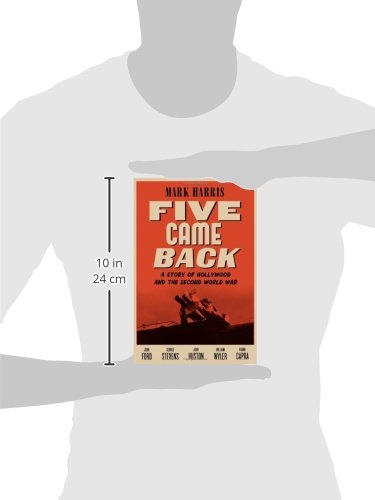
Mark Harris’ “Five Came Back” is a first rate piece of historical reporting; the book details how five (John Ford, John Huston, George Stevens, William Wyler, Frank Capra) well known directors (and in the case of Capra and Ford, arguably Hollywood’s two most powerful directors) joined the military in WW II and what each of them went through. It takes some time to get going and there are moments in the first third where it feels over-detailed, but Harris maintains a critical eye throughout and never allows himself to dip into mushy praise for any of the filmmakers’ films, before, during and after the war (he’s particularly strong on the documentary films where these directors re-enacted battle scenes without fully acknowledging it, the most famous being Huston’s “The Battle of San Pietro” which has almost no actual footage, though Huston refused to his death to admit that and always made it seem like he was there to witness the battle, which he was not) and he includes a short chapter on their post war careers with astute insights about the ways in which their experiences did (and in Capra’s case did not) influence their post war films. It’s no surprise that Wyler’s The Best Years of Our Lives is the most personal of the post-war films and he manages to make all three main characters in some ways an extension of himself.Mostly, their experiences were far more harrowing than I imagined, particularly for Wyler and Stevens. Though none of the five was ever in serious danger of dying, Wyler lost most of his hearing while shooting footage on a B17 and Stevens who seems the most affected by the war (he was considered a master of the light comedy before the war and never made another after), shot an immense amount of film during the liberation of Dachau, something he never really fully recovered from emotionally. Significantly, Wyler and Stevens are the two who are least enamored of returning to Hollywood after the war, they weren’t sure they could return to a normal life and both struggled when they finally did, Stevens in particular.The book is full of information I knew little about. For example, I didn’t know that Stevens’ footage of Dachau played an important part in the Nuremberg trials (it seems to me that much of the footage we have of the residue of the Holocaust – the piles of bodies, the bulldozing of those bodies -- came from Stevens and his people) or that Capra really never left Washington DC. There’s nothing here about Ford that would surprise anyone, he was devoutly pro-military and joined up before anyone else, got himself into a position of power early on, hooking himself to William Donovan’s OSS train (Donovan provided a lot of cover for Ford over the years of the war), and understood how to play the system. The most important footage he shot was of the Battle of Midway and though he claimed credit for all the footage shot, he actually shot only a small part of it. He also in later years seriously inflated his experiences and while his unit was deeply involved in filming D-Day and Ford claimed to be the first filmmaker to hit the beach, Harris thinks it unlikely he actually left the ships in the English Channel until at least a couple of days after the initial invasion. Harris also thinks that the vitriol which Ford directed at John Wayne for not joining up (and Ford’s incessant trolling for medals post war) masked guilt at not having done enough during the war.And though Capra is seen as a preening neurotic (and his career seems the most ruined by the war; of the five, he was the one who struggled the most to figure out how to integrate his experience with his work and beyond It’s a Wonderful Life, which was a box office failure, never made another significant film) whose films pre-war in particular were confused politically, mostly because Capra was confused politically (for example, in 1937, he supported Franco’s fascists in Spain), he comes off better than Huston, who joined up because he wanted an adventure, saw a tiny bit of battle (mostly some dead bodies), freaked out, and started drinking and whoring like a mad-man and generally was in way over his head and desperate to get back to his Hollywood career, though he undoubtedly did some interesting work during the war (most notably a documentary about vets and post traumatic stress, which clearly Huston was also suffering under, which was a serious effort than no one saw until the 70s).It’s also amazing how many Hollywood figures crossed their paths during the war as part of the military; writers, directors and cinematographers in particular, and at various times these five worked with Gregg Toland, Budd Schulberg, John Sturges, Mel Blanc, Chuck Jones, Carol Reed, Paddy Chayefsky, Carl Foreman, Anatole Litvak, William Clothier, Dr. Suess, Frank Tashlin, Stuart Heisler, Garson Kanin, William Keighley,At one point, Stevens runs into Andre Malraux and his band of resistance fighters (he said Malraux’s men were fanatically loyal to him), at another, Wyler via Stevens employs Hemingway’s brother (said to be fearless) as his Jeep driver on a harrowing drive to his home town in Germany, a place he left in the early 30s because of growing anti-semitism. It's a book well worth reading.
M**D
A Tear closed the book with me
My tears helped close the bookMaybe I am one of the oldest reviewers so myperspective is different. The Second World War affected me as a child to thepoint that I had to write a book about it myself, from that childhood point ofview. It was something I could not forget all my life . I saw 'the great movies'as a child and yes, I mentioned them in my books. They too, affected me as a child.The generations since, can only try to understand what it was like. Harrishimself may not know the collective consciousness of the time but his excellentbook brought it back to me.Through the patriotism that infused thedirectors I felt the message we got in the news shots of war in theaters of thetime. Through the thoughts they had about the " total waste of war" and thedamage it did to our souls , I could feel the thoughts I had between the age of7 and 11.My uncles came alive again as the Directors moved through the warwith the different branches of service. When the war ended, luckily all myuncles and other relatives came home, at least two wounded, but alive. I knewHarold Russell and his family.Filming the atrocities of war so we could see it on the big screen on Saturdaymatinee made us all aware of the tremendous sacrifice of life. For what? Forone man to rule the world , I often thought .It was the pictures of thesouls in the death camps that raised the hackles! The final sickening straw!How , why ?The damage done to Director George Stevens who saw photographed ,and experienced, was so real and profound . I visualized once again thosehorrors. One can only imagine the soldiers who stepped up to soothe, calm, andcomfort the barely living survivors who rose from among stacks of dead bodies.I screamed once again inside me at the utter horror of evil men who walked theearth with us.The horrid cruelty of prisoners and the Red Cross by theJapanese came back and I remembered asking why the Emperor got away with this ?Harris answered that question after all these years. I still think the Emperorshould have done something to stop the war and should have paid a price forit.Through the lives of five men , the war came back and though these menwhere older than me by 39 plus or minus years , we shared a common collectiveconsciousness . I wonder if this is proof of that and how we make ourworld?I know none of us wanted war, but once we were in it we all were in itto win. Yes, when it was over we "had enough ".Yes, a great narrative ,stirring and so enveloping about the time. The investigation into Communism inHollywood and more are all there.Yes, a few tears peeked out as I closed thebook for the last time and put the era back to sleep in my mind , but not beforeI had made comparisons about the rise of Hitler with the rise of terrorism.History is repeating itself !
M**L
An exhaustively detailed account of an extraordinary moment in 20th Century (and not just cinematic) history
This is a fascinating book about the war experiences 5 of the greatest names in cinema: Frank Capra, John Ford, John Huston, George Stevens and William Wyler. It is clearly a labour of love for its author, since he writes with passion and an obsession for detail. There were definitely moments when this erred on the side of geekdom, rather heavy-going for all but the true cinephile only.But I was buoyed along by this book's broader scope, its unexpected window into the life and times of 1940s America. Cinema was the iconic art form of the 20th Century, and Hollywood was the king of cinema. Taking a cue from Leni Riefenstahl's exploitation of its power for German propaganda, Washington unsurprisingly appealed to the era's great film-makers to come to the fore. They were important to Roosevelt's determination to overcome the USA's isolationism, and then to sustaining the war effort after Pearl Harbor. The 5 that Harris focuses on were very different men, politically, culturally, temperamentally, artistically. That certainly lends the book its variety. But they were masters of their art.The most powerful part of the book for me, however, was the account of George Stevens' work as they probed further west into Germany. Like the rest, he had only the vaguest sense of what he would find. He was in fact part of the group who were first to meet Russian soldiers approaching from the east.'The first Russian soldier they saw at the Elbe was "a bald-headed private... They had some quite old privates in the Russian army... He had a big spool of wire on his back and he came up to me... and grinned. 'Capitaliste!' he said, to me [Moffatt, a colleague of Stevens], then pointed to himself and said 'Communiste!' and grinned again." The footage Stevens's shot at Torgau is cheerful, almost manic in its desire to seek out comedy.' (p368)But a few days later, they arrived at Dachau, the infamous concentration camp, only days after its liberation. Stevens, for one, was never the same again. "At first he was numb. Not knowing what else to do, he loaded his camera and started to film." (p370) Because now, he wasn't making propaganda, still less, a movie. Now, he and his team were collecting evidence.'Stevens aimed the lens of his camera skyward to film the smoke that was still drifting from some chimneys, then back down to eye level, where piles of naked bodies - hundreds of them - were mounted six and eight feet high. "We went to the woodpile," he said, "and the woodpile was people."' (p370)But then this American film-maker finds himself echoing one of the 20th Century's greatest, and most honest, writers, Aleksandr Solzhenitsyn. When one of the camp's survivors tried to embrace him, Stevens found himself recoiling.'Everything evil will be exposed in a day in a concentration camp. I hated the bastards [in the German army]. What they stood for was the worst, the worst possible thing that happened in centuries. And yet, when a poor man hungered and unseeing because his eyesight is failing grabs meand starts begging, I feel like the Nazi in any human being... I feel a Nazi because I abhor him and I want him to keep his hands off me. And the reason I abhor him is because I see myself as being capable of arrogance and brutality to keep him off me... That's a fierce thing to discover within yourself, that which you despise the most.' (p373)Stevens had made a name for directing comedies as well as his other work. But he would never direct one again after that. He said, "After the war, I don't think I was ever too hilarious again." (p418) And who could blame him?Perhaps it's because I am not in the book's target audience of cinéastes, but I could have done with a bit more ruthless editorial culling. I for one would have preferred to do without the exhaustive accounts of each film made during this time - although I can clearly see why it was felt necessary for this very specific story.Still, what I did learn about these individuals, their conflicts, and passions, as well as this rarely discussed corner of 20th Century history, was enough to keep this history nut more than satisfied.
M**D
Fascinanting Book
This is a fascinating account of five Hollywood directors just before and during Americas involvement in the second world war . John Ford , William Wyler, John Huston, George Stevens and Frank Capra were all established Hollywood directors when Japan attacked Pearl Harbour bringing America into the war, this is the story of their contribution to the war effort. Against the background of studio Mogul's power and the political climate of the time it gives a fascinating insight into the Hollywood era of the time and the prevalent attitudes and feelings of the general public and media. It also brings to life the five men's life's and careers and their personal commitment (all volunteered ) and how their participation shape and influenced their work. The book is written in a style that takes you along with the story , never boring always informative, always holding your attention, not unlike a great Hollywood Movie. If you have a interest in Movies and the Second World War or even just a good tale well told this book will be a real find for you.
M**S
Snapshot of cinematic history
Had wanted to read this book after seeing it in my local book store but never got around to purchasing it, then saw the documentary based on the book, produced by Steven Spielberg et al and had to learn more. Found it on amazon and bought it and loved it, enjoyed it immensely. It’s a period and aspect of ww2 history I’ve been very interested in,
N**Y
History and movie magic
Great read especially if you are interested in the history of Hollywood during this time- well written and researched . Worth your time
M**N
'Five Came Back'
Only just started to read it but very interesting so far and with a good zippy style.
Trustpilot
3 weeks ago
2 months ago