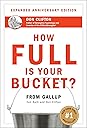
How Full Is Your Bucket? Expanded Anniversary Edition
Product ID: 1257441
📚Expanded Anniversary Edition with updated research
📝Includes removable workbook for personal & team growth
🧠Grounded in 50 years of proven psychological insights
Desertcart purchases this item on your behalf and handles shipping, customs, and support to Cyprus.
💡 Fill your bucket, fuel your success — the ultimate guide to positive leadership!
How Full Is Your Bucket? Expanded Anniversary Edition is a bestselling, research-driven book that reveals how brief daily interactions impact your emotional well-being, productivity, and relationships. Featuring updated content and a removable workbook, it offers practical strategies grounded in 50 years of psychological research to help professionals cultivate positivity and meaningful connections at work and beyond.
| Best Sellers Rank | #29,042 in Books ( See Top 100 in Books ) #95 in Popular Applied Psychology #154 in Emotional Mental Health #278 in Business Management (Books) |
| Customer Reviews | 4.6 out of 5 stars 1,391 Reviews |
K**E
A short important read
I think we forget how important it is to keep our own buckets full but also to fill up others. This quick little read reminds you of the importance of simple compliments, good friendships, and how it impacts your mood, life, and job!
J**S
Helpful information
This is helpful for realizing we only have limited energy and time. Using the bucket analogy we see how full and empty we become throughout the day along with its implications. There are techniques in this book to help the reader as they go through their day.
J**K
Quick Read / Well worth it
The 'bucket book' is a good little book. This whole book focuses on being more positive than negative. Sounds easy right? Probably because it is if you try. Gallup, specifically Tom Rath and Don Clifton have put together a workable theory that states you need to try and have 5 positive interactions with people you meet before you have 1 negative thing to say. They cite research that shows most marriages will fail if the ratio of positive to negative is not better than 1 to 1. So, keep it positive, and life will be better. A simple and important concept. Bravo Gallup Also, you get to take the StrengthsFinder assessment tool, the best tool out there to figure out how you are wired. That is worth buying the book all on its own. Joseph Dworak
K**L
A Simple, Little Book with Simple Big Solution
This book is so wonderful, I ordered one for a gift already and expect to order more as the year goes by. It was an easy read - only a little over a 100 pages of actual reading. The rest is diagrams and worksheets to give you solid ideas for implementing the tools it's selling you. The premise is simple (but not simplistic) yet thorough explanation of how focusing on the positives in our own personalities and those around us can change our world, and everyone's we come into contact with. Not too many hints here, because I can't say it anywhere near as well as the authors have. The free assessment test that comes with the hard copy is invaluable. Learn to start building on your strengths and appreciating the good qualities in your spouse, your children, your co-workers. Buy this NOW! [...]
S**A
Excellent in many ways
A few mentors of mine were reading Bucket and so I decided to as well. This book is very easy to read, and it is written like a friend is talking to you. You can probably read it in a day. I liked how it described the bucket concept in brief in the beginning which prepared me how read the book going forward. The book describes the analogy of a bucket to our life. The positive things are what fills our bucket, and the negative things empty our bucket. It provides a great balance of visuals, statistics, strategies and stories that help you with your relationships and health which also lead to a more productive and longer life. It comes with colorful activity cards as well. A positively well thought-out and life changing book!!!
C**C
Change your life, and everyone elses
I read this book the day I received it. In a sentence, I can tell you that the biggest statement that the book relayed is that if you fill someone elses bucket with positive energy, words and praise, it fills yours. In a few sentences... I will say that the authors vision and recommended actions, as well as reading examples in the book, really hit home. I was able to realize that by speaking in negative terms about things in life, whether they pertained to me, someone else, or life, really dipped from my own bucket of positivity. Positive actions reinforce one's ability to adjust and heal from within. Good words are contageous. Caring discussion with another spreads not only between you and who you are speaking with, but the energy from positivity spreads from individual to individual, a domino effect. A must read. Buy this book!
S**A
Good - but strong workplace orientation
The concept behind this book is good - focusing on the positives in your interactions with others. I was disappointed by the heavy focus on office interactions (which is fine, just didn't happen to suit why I bought the book). Also disappointed by the lack of depth. Not including the intro and epilogue, book is less than 100 pages with very large type and margins. That includes over a dozen pages with a graphic of a bucket with a single quote inside. Good news/bad news - you can read and get all of the content in under an hour. Certainly not worth the full retail price, questionable even at Amazon's discounted price. I gave it 3 stars because the concept is good and I got some worthwhile tips, but this felt more like a pamphlet that a motivational company would use as a giveaway rather than a book. HOWEVER, If my work team were having interpersonal issues, I might very well give this 5 stars for providing a good discussion foundation in a group setting.
J**S
How Full is Your Bucket
The book "How Full is Your Bucket," by Tom Rath and Donald Clifton is a great book for all leaders to read. This easy to read book helps you as a leader reflect on your interactions with others. Throughout the book the reader is given several facts on the importance of positive interactions with others. I was amazed that approximately 65% of people surveyed last year said they did not receive recognition last year, in addition the number one reason people leave a job is because they don't feel appreciated. I really appreciate The Gallup Recognition Interview questions found on page 87. I envision this being used with staff members to discover how they like to be recognized for their accomplishments. If you are in a leadership position or are an aspiring leader, this book is a must read! ~Jenny
F**E
A simple metaphor for every interaction
Each of us has an invisible bucket. It is constantly emptied or filled, depending on what others say or do to us. When our bucket is full, we feel great. When it's empty, we feel awful. Each of us also has an invisible dipper. When we use that dipper to fill other people's buckets - by saying or doing things to increase their positive emotions - we also fill our own bucket. But when we use that dipper to dip from others' buckets - by saying or doing things that decrease their positive emotions - we diminish ourselves. Like the cup that runneth over, a full bucket gives us a positive outlook and renewed energy. Every drop in that bucket makes us stronger and more optimistic. But an empty bucket poisons our outlook, saps our energy, and undermines our will. That's why every time someone dips from our bucket, it hurts us. So we face a choice every moment of every day: We can fill one another's buckets, or we can dip from them. It's an important choice - one that profoundly influences our relationships, productivity, health, and happiness. In that study, which has now been replicated multiple times, we conducted a randomized survey with more than a thousand employees - asking them where their manager focused the most time and attention: a) On employees' strengths b) On employees' weaknesses c) Neither of the above; the manager ignored employees We found that one person, specifically the manager in this context, can eliminate almost all of the active disengagement in a workplace if he or she primarily focuses on an employee's strengths. When people reported that their manager did not focus on their strengths or their weaknesses (the manager ignored employees), there was a 40% chance of them being actively disengaged on the job. If their manager focused primarily on weaknesses (and presumably was at least paying attention), things actually got better, and there was only a 22% chance of them being disengaged. But when a manager primarily focused on an employee's strengths, there was just a 1% chance of that employee being very negative or actively disengaged on the job. As you can see from the results of this study, it appears that disengagement is a curable problem. our lives are shaped by our interactions with others. Whether we have a long conversation with a friend or simply place an order at a restaurant, every interaction makes a difference. The results of our encounters are rarely neutral; they are almost always positive or negative. And although we take these interactions for granted, they accumulate and profoundly affect our lives. We have all experienced situations when it seems like nothing will go right no matter what you say or do. Maybe you feel like everyone is out to get you, and you even start to fixate on negative things about yourself. Spiraling downward isn't hard to do when your bucket is being emptied. Not only do you feel down, but you are less productive because of it, and you bring others down with you by reactively dipping from their buckets. 65% of Americans received no recognition in the workplace last year Managers, take note: Praise is rare in most workplaces. One poll found that an astounding 65% of Americans reported receiving no recognition for good work in the past year. And we have yet to find anyone who reports suffering from overrecognition. No wonder so many employees are disengaged. Although we need and want recognition and praise, the fact is, we don't get enough - and organizations suffer because of it. But offering Tammy meaningful and specific praise made her day. Her bucket was filled quickly. And the funny thing is, Karen might have thought she was just making a simple comment in passing; she probably couldn't imagine the positive impact. Essentially, you were hired for a job, then you were expected to change who you were to fit the role. If you struggled, then you may have had to endure a program designed to fix the problem. The weakness-based approach follows us throughout our lives, from school to the workplace. They Missed It These recent studies show that negative emotions can be harmful to your health and might even shorten your life span. We already know that one negative person can ruin an entire workplace, but negative emotions can also destroy relationships, families, and entire careers. In contrast, other discoveries suggest that positive emotions are an essential daily requirement for survival. Not only do they improve your physical and mental health, but they can also provide a buffer against depression and illness. According to Nobel Prize-winning psychologist Daniel Kahneman, we experience approximately 20,000 individual moments in a waking day. Each moment lasts a few seconds. They had predicted divorce with 94% accuracy - based on scoring the couples' interactions for 15 minutes. This ratio is critical in the workplace as well. One study found that workgroups with positive-to-negative interaction ratios greater than 3 to 1 are significantly more productive than teams that do not reach this ratio. So while this book focuses primarily on ways to increase positive emotions, it's important to note that we don't recommend ignoring negativity and weakness; positivity must be grounded in reality. A "Pollyanna" approach, in which the negative is completely ignored, can result in a false optimism that is counterproductive - and sometimes downright annoying. there are times when it's absolutely necessary to correct our mistakes and figure out how to manage our weaknesses. To put this in perspective, consider that cigarette smoking has been shown to reduce life expectancy by 5.5 years for males and 7 years for females. So, negative emotions might cut more years off of life expectancy than smoking. There's no surgeon general's warning about toxic emotions, but perhaps there should be. we should gather to celebrate all the great things that a person has done while he or she is still around to be part of the celebration. When he went to funerals, it bothered him that so many people waited until they were eulogizing a loved one to liberally fill his or her bucket. "Why not do this while they are alive?" All of the caring, attention, and genuine bucket filling were making a major difference in my life. My bucket was overflowing, and this allowed me to concentrate on filling the buckets of everyone around me. Ted's boss knew the key to great bucket filling: Recognition is most appreciated and effective when it is individualized, specific, and deserved. Clearly, he understood that writing an e-mail and copying Ted's peers would give Ted a real boost. And perhaps Ted's boss also knows that the same approach won't work for Ted's colleagues, some of whom may prefer a quiet pat on the back or perhaps more boisterous praise in a meeting. The point is, there are unique and specific ways to fill each person's bucket - and most certainly inappropriate ways as well. Generic, one-size-fits-all awards don't work. Neither does recognition that seems forced or false. The lesson here is clear: If you want people to understand that you value their contributions and that they are important, the recognition and praise you provide must have meaning that is specific to each individual. Not only is individualized bucket filling more effective in boosting productivity in the workplace, it builds sustainable relationships and changes people's lives forever. The Five Strategies STRATEGY ONE Prevent Bucket Dipping STRATEGY TWO Shine a Light on What Is Right STRATEGY THREE Make Best Friends STRATEGY FOUR Give Unexpectedly STRATEGY FIVE Reverse the Golden Rule After hearing the Theory of the Dipper and the Bucket, one man we know decided to put it to the test. He was looking for a way to eliminate his own dipping from others' buckets. So he developed a simple habit of asking himself if he was adding to or taking from the other person's bucket in each interaction. He told us it was a difficult habit to get into at first, but after some time, he realized it was working. By catching himself before he uttered a negative comment - and in some cases, making a positive one instead - he started making himself and the people around him feel better. ask yourself: "What would it take for me to reach that `magic ratio' of five positive interactions for every one negative interaction that I read about in Chapter Three?" Never underestimate the long-term influence of filling others' buckets. According to one expert, these positive emotions create "chains of interpersonal events," the farreaching results of which you may or may not get to see in person. But they are there and happening. Every time you fill a bucket, you're setting something in motion. the vast majority of people prefer gifts that are unexpected. Expected gifts do fill our buckets, but for some reason, receiving things unexpectedly fills our buckets just a little more. It's about the element of surprise. And the gift doesn't have to be anything big to be successful. An unexpected gift doesn't have to be tangible either. It can be a gift of trust or responsibility. Sharing something personal or entrusting a friend with a secret can fill his or her bucket. In your own interactions, look for opportunities to give small gifts to others out of the blue - maybe a funny little trinket, a hug, or an offer to grab a cup of coffee. Even a smile can be an unexpected and cherished gift. Consider unexpected sharing as well. What books, articles, or stories could you send someone that would positively influence his or her day? In the case of bucket filling, "Do unto others as you would have them do unto you" doesn't apply. Instead, we suggest a slight variation: "Do unto others as they would have you do unto them." When it comes to robust and meaningful bucket filling, individualization is key. As you learned from Matt, the customer service representative who received the portrait of his daughters, the things that make you unique also determine what really fills your bucket - and vice versa. Now here's our challenge: Set a goal to write at least five drops, or give five specific forms of recognition every month.
S**S
Awesome..
Awesome....fantastic read about the subtleties of how the little things you do can either "fill" or "empty" someone's bucket. Great, quick read. Good book to gift to those who say whatever pops into their mind (and don't use their "internal filter").
W**H
Are you a bucket or dipper or both?
Great metaphor. People need to be encouraged, motivated, and appreciated. This can totally change the behaviour of the one receiving the energy. However, so many of us are stingy with praise, but generous with criticism. Read this to be a better person. If you are a dipper, reduce the size of your ladle. You can only sincerely fill another's bucket when your own bucket is full. Otherwise, it is not authentic or sincere. You will come across as fake. William Teh Investor. Author. Retired.
M**A
Lo elegí en inglés para despertar las neuronas de este idioma.
Los temas de crecimiento personal gustan a mucha gente y los que somos aficionados a esta literatura hemos leído lo mismo en varios libros diferentes. Todos los caminos del conocimiento llevan al mismo sitio, se nombre como se nombre. El día que lo descubrí eso me dejó tranquila, todos vamos a parar al mismo lugar. Esto es una ventaja para poder leer un libro en inglés y despertar las neuronas de este idioma, en letargo hasta que las necesitas. Es un libro de crecimiento personal, que como todos, ha de gustarte el tema. No dice nada que seguramente no hayas leído si eres aficionado a la psicología para neófitos, precisamente por eso lo encuentro un libro interesante para leer en inglés. Me ha gustado leerlo y me ha sido fácil entenderlo (nivel B2 aprox.).
C**N
La recette du bien être
Un ;livre a offrir à tous ceux que vous aimez. Une façon simple de leur donner les bons conseils pour se sentir bien dans la vie!
Trustpilot
5 days ago
3 weeks ago