Some deliveries may take a little longer than usual due to regional shipping conditions.

DOWNLOAD THE APP


Customer Services
Copyright © 2025 Desertcart Holdings Limited
DOWNLOAD THE APP

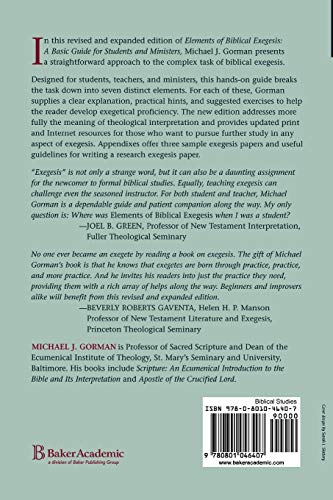
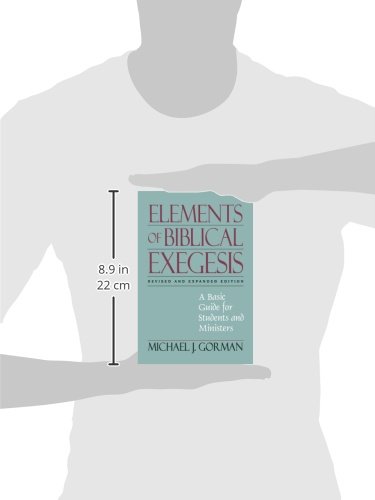
Elements of Biblical Exegesis
S**E
Highly recommended for the serious student (or any serious person)
Michael J. Gorman’s Elements of Biblical Exegesis is a useful book intended to introduce a person to the fundamentals of the task of writing a careful biblical exegetical paper (3). Though the exegetical paper is primarily written in the academic setting of a college or seminary environment, the purpose of learning to write a well-developed and careful exegetical paper is clearly extended beyond the classroom and the finished document itself so that one may appropriate his or her research to be applied in future teaching, writing, or preaching settings.In three major sections the book is written in such a way as to facilitate the exegetical process in a step-by-step fashion. The text itself is designed so as to be made helpful to the student by providing a summary, review exercises, and practical hints at the end of each major chapter. In addition to the introducing the would-be exegete to exegetical methods and process the book provides a very helpful extensive section on “Resources for Exegesis” (181-232). Following the very significant “Resources” section are four appendices which include tables of methods, practical guides for writing a research exegesis paper, three example exegetical papers, and selected internet resources for biblical studies. All in all, the book is designed to be used by student in a classroom setting (though not required) for the purpose of developing his or her skills a biblical exegete. While the book certainly accomplishes its goal to introduce a student to the exegetical process its affect is well beyond the classroom. This book has a significant reach and will be found useful to the person who brand new to the study of the Bible or to the professional Pastor who is looking to brush up his or her skills as a Biblical exegete.Section One, “Orientation”, begins by introducing the task. Exegesis is defined by Gorman as “an investigation” of the “many dimensions, or textures, of a particular text” (11). Additionally, exegesis is a conversation with readers “living and dead” (11). Lastly, the exegetical process requires a method (both in the sense of an art, as well as a discipline) that requires careful investigation and hard work, but which cannot proceed without imagination and intuition (12).The author notes that books discussing the task of exegetical study are numerous. The thesis of this book is that exegetical method is best accomplished through the appropriation of primarily diachronic as well as synchronic approaches to the text (12, 23). The author notes an existential approach(es) but does not emphasize it. Not only is a balance of methodology required, but one must also understand and employ the “circular” nature of the hermeneutical task; that is the text must be investigated at close-up ranges (word studies, sentence structure, genre) as well as from the birds-eye view (canonical, theological, and cultural). This ebb and flow of methodology will continue in a circular (process) fashion as one comes to understand the polyvalent nature of the text and draws from the richness of the biblical spring in its full canonical form (23). This process is done through seven elements of exegesis that proceed in logical order. Following this method, the author contends, will reveal the polyvalent nature of the text. Gorman suggests that this polyvalence is a gift to be embraced, not a problem to be conquered through discovery of the ‘original meaning’ (135-136). This exegetical method, which is best done with a hermeneutic of trust (143), will finally lead the interpreter to make claims that address and affect the nature of our existence as the people of God. This process is ultimately tied to leading the interpreter and the disciple into a life of mission wherein the people of God come to understand the theological implications of their action in the world. Theological reflection and appropriation of the text in a “living exegesis” (160) is ultimately the goal of the exegetical process.Following the introduction to the “Task” (9-33), the author introduces the reader to a section on the “Text” (35-59). Here Gorman leads the reader through a discussion of choosing a particular text, translations, translation methodology and choosing the appropriate translation for the purpose of exegetical study. This section is full of practical and insightful advice. Gorman advises exegetes to choose a text that will not be emotionally charged, but rather choose a text that one can learn from (even if it is a familiar text) and that is limited in scope. Choosing an entire chapter for an exegetical paper is almost certainly doomed to be too much to chew. Instead it is recommended that an exegete choose a natural section (36).The discussion of translations proceeds to a discussion concerning what kind of translation is appropriate for the exegetical process. The author encourages study of the original languages, but does not make it a matter of necessity; instead the exegete should choose a “good” translation, one based on a fairly literal interpretation (formal equivalence) of the original languages (43). This discussion leads the author to make recommendations on English translations appropriate for exegesis. The author concludes that the NRSV, NAB, TNIV, and NET are most suitable for exegetical study. He also concludes (somewhat prejudicially) that the KJV and NKJV are unacceptable for exegesis. This discussion is followed by practical advice for choosing a Study Bible.Section two houses the ‘meat’ of the book. Here Gorman leads the reader through the seven elements that make for successful exegetical papers. This is where the reader is lead through a step-by-by methodology that relies primarily on synchronic methods, but supported by diachronic methods. Element one is the survey. Here the interpreter orients him or herself with the text surveying and observing the text to be studied. It is at this stage that the exegetical paper begins to develop its thesis. Gorman is very clear to note that a successful exegetical paper is not a position paper (a paper laying out different interpretations) or a summary of commentary paper (integration of commentaries), but rather is a paper that seeks to prove a point (66). This requires the interpreter to seek to organize their paper around their thesis statement. Gorman highly emphasizes the necessity to become familiar with the text before the interpreter begins to research the commentaries.The second element is familiarization with the context of the biblical text. This requires a study of the historical, literary, and canonical context of the text at hand. Gorman notes that “Close analysis… requires,… careful attention to its historical and literary contexts” (69). The historical context requires historical, sociopolitical, and cultural contexts to be studied and understood at least in part (72). The literary context clues the interpreter to the text’s place in the broader text as well as the immediate devices being employed especially with reference to its rhetorical power (77).Element three involves formal analysis of the text. Here is where the author argues for synchronic methodology in its clearest form. Gorman argues that the interpreter must be familiar with literary form (genre), the structure of the text (outlines, structural patterns), and the movement (dynamics) of the text.Following a formal analysis of the literary structure of the text Gorman argues that the interpreter should move on to a detailed analysis of the text. Here is where the hermeneutical circle (movement from large to small, small to large, broad to immediate, immediate to broad) becomes necessary. In a detailed analysis of the text the interpreter is trying to discover the many intricacies of the text itself and within relationship to its broader contexts. The interpreter must consider key words, key images, key themes, key literary devices, key historical events, and all of this finds its relationship to the broader movement of the text within the book itself and within the canon itself. Here the interpreter is looking to find relationships (113-116). These relationships can move beyond the biblical canon to include literary and cultural relationship. Gorman argues that this “intertextuality” sees the text as in conversation with the text itself and the culture in which the text finds itself (119).Elements five and six move in the direction of synthesis and theological reflection. This is where the “trees” give way to the “forest.” In the synthesis portion of exegetical study the interpreter is “bringing together” (127) all that has been worked through to this point and the “bringing together” becomes organized around the thesis of the paper. In order to successfully defend the thesis the interpreter is burdened to demonstrate in humility (129) that the intricacies (trees) of the text point in the direction of the interpreter’s exegetical decisions (forest). Gorman moves to discuss the welcomed ambiguous and polyvalent nature of the text. The exegetical process and its synthesis does not necessarily guarantees unity among interpreters given that the text and its interpretation requires multiple points of reference which is impossible for one single interpreter to maintain. Gorman argues that this ambiguity does not induce nihilism or irrationalism but instead “drives us to the text” (132). Given a theological commitment to the text the interpreter can expect a multiplicity of voices among the people of God.Having arrived at a synthesis the interpreter moves to the theological interpretation of the text. Assuming a hermeneutic of trust, the interpreter can move within the text to “appropriate its message as a guide for contemporary belief and behavior within a community of faith” (146). After discussing eight principles of theological interpretation Gorman finalizes his discussion with a treatment of a theological interpretation that moves the reader to the mission dei (155) and its role in appropriation of the text. An exegetical paper is not the end (telos) in itself.Element seven is primarily a treatment of making use of other tools such as commentaries and journal articles that will help the interpreter in the refinement of his or her exegetical thesis.
K**R
internet atheists I regularly encounter will want nothing to do with a work like this, and sadly too many Christians won't eithe
Elements of Biblical Exegesis is meant to be a guide for students who are writing exegetical papers, and indeed it will be a helpful one. Gorman works with writers on all levels, including those who know the Biblical languages well and those who have no real knowledge of them. The rules listed in this book can help you if you're writing an exegetical paper, but they can just as much help you out if you are sitting in a Sunday School class or small group meeting and you're discussing a passage of Scripture and people are sitting together all talking about what the passage "means to them."Of interest from an apologetic nature is the discussion on textual criticism as well as the listing of Bible translations and dealing with the hermeneutic of suspicion where the text is seen as guilty until proven innocent. In fact, Gorman rightly says we should read from all perspectives, not just our own. After all, it is the critics of our position that can often open our eyes the most to the problems that we need to answer for our position. Gorman regularly says that all such reading is going to be beneficial. (Even reading mythicist material as that shows you just how crazy you can go when you don't really know how to do history.)Of course, internet atheists I regularly encounter will want nothing to do with a work like this, and sadly too many Christians won't either who just have this idea that the text should be plain and clear to them. One of the great problems we have in the church is that people no longer work at the text. We go to seminars to learn how to improve our marriage and work at that, and we should! We go to seminars to learn how to be better parents and work on that, and we should! We go to seminars to learn how to better manage our money and work on that, and we should! We go to all of these and while we think we should work at every other area of our life, when it comes to understanding what we say is the greatest facet of our lives (Or we should say it is), we think all the answers should be handed to us.Also, towards the end of the book, Gorman gives a long list of recommended resources. I am sure that the list is helpful, but if you go straight through a book like I do, then it can be a bit tedious in reading. Still, if you just pop open the book and want to know if a resource is a good one, then that is a helpful tool to have.Finally, the book concludes with three exegetical papers, two on a NT passage and one on an OT passage. These are helpful examples to have nearby and the reader of the book will be pleased with how simple the final product looks and even without thorough knowledge of the original languages.This will be a helpful guide to those who really do want to study the text for all that it's worth.In Christ,Nick PetersDeeper Waters Christian Ministries
C**R
Well, I am in class at the time and ...
Well, I am in class at the time and this book has help me to understand how , what, when and when to deliver the word of God . As the Bible would direct a preacher, teacher or a minister in delivering the word of God one must know the correct way to use the word of God. God wholes all who say that God has called them to deliver the word of God to study and show thyself approved.. this book will put you in order. I would tell anyone who is called to the gospel to get this book stidy it and apply it to every level of minister known unto man.
E**N
Good
The book arrived timely, but was crammed into my mailbox. The book was perfect except the back cover was creased by shoving it in so hard. It's good enough, but I did order a new book. I am not unsatisfied and do not want to do a return.
J**U
This book is excellent on the field of exegesis
This book is excellent on the field of exegesis. The author guides the would be exegete step by step on how to do Biblical exegesis. He also provides the reader with very up to date sources for tools of doing exegesis. It is a wonderful book well thought and well written. It should be a MUST book for exegetes and especially for the beginners! Words are not enough to express myself how I found this book useful. It has indeed enlightened me and helped me on the great project that I will soon embark on. Bravo!
H**K
It was required reading
Required reading for a Bible course.
C**D
Good teaching material; Very practical and not too advanced.
Michael Gorman does a great job of addressing the basic steps one should take when doing exegesis of a passage of Scripture. He provides good background material, and exercises to put into practice the reading from each chapter. It's very practical and informative. There are some sections where more examples would have made the concepts easier to understand. It helps if the reader has some exegetical background already and wants to develop a system for good exegesis.
J**S
Top tip for Exegesis studies
For students and non-students alike, this book is well written step-by-step guide for understanding what Exegesis is about. He provides helpful tools to enable anyone to study the bible more deeply. For theology students in particular it provides a useful framework for helping prepare your essays or preparing sermons. Like a favourite teacher, Gorman writes in a congenial and paternal tone that carefully explains each step and provides useful tips and exercises along the way. Highly recommended.
W**L
exegesis.
I got this book on my Kindle and thoroughly enjoyed it. It will be a help to me in the future. My only complaint is that Kindle books very rarely contain page numbers which makes it difficult if not impossible to us as a reference in a footnoted essay.
N**S
Exegesis well exegeted...
Very useful resource.
N**M
This is a great book very good explanations easy to read and understand
This is a great book very good explanations easy to read and understand. it will not write an exegesis for you, you still have to do the leg work. It is well written and of good quality paper.
A**R
Five Stars
Excellent book
Trustpilot
1 week ago
2 weeks ago