
Desertcart purchases this item on your behalf and handles shipping, customs, and support to Cyprus.
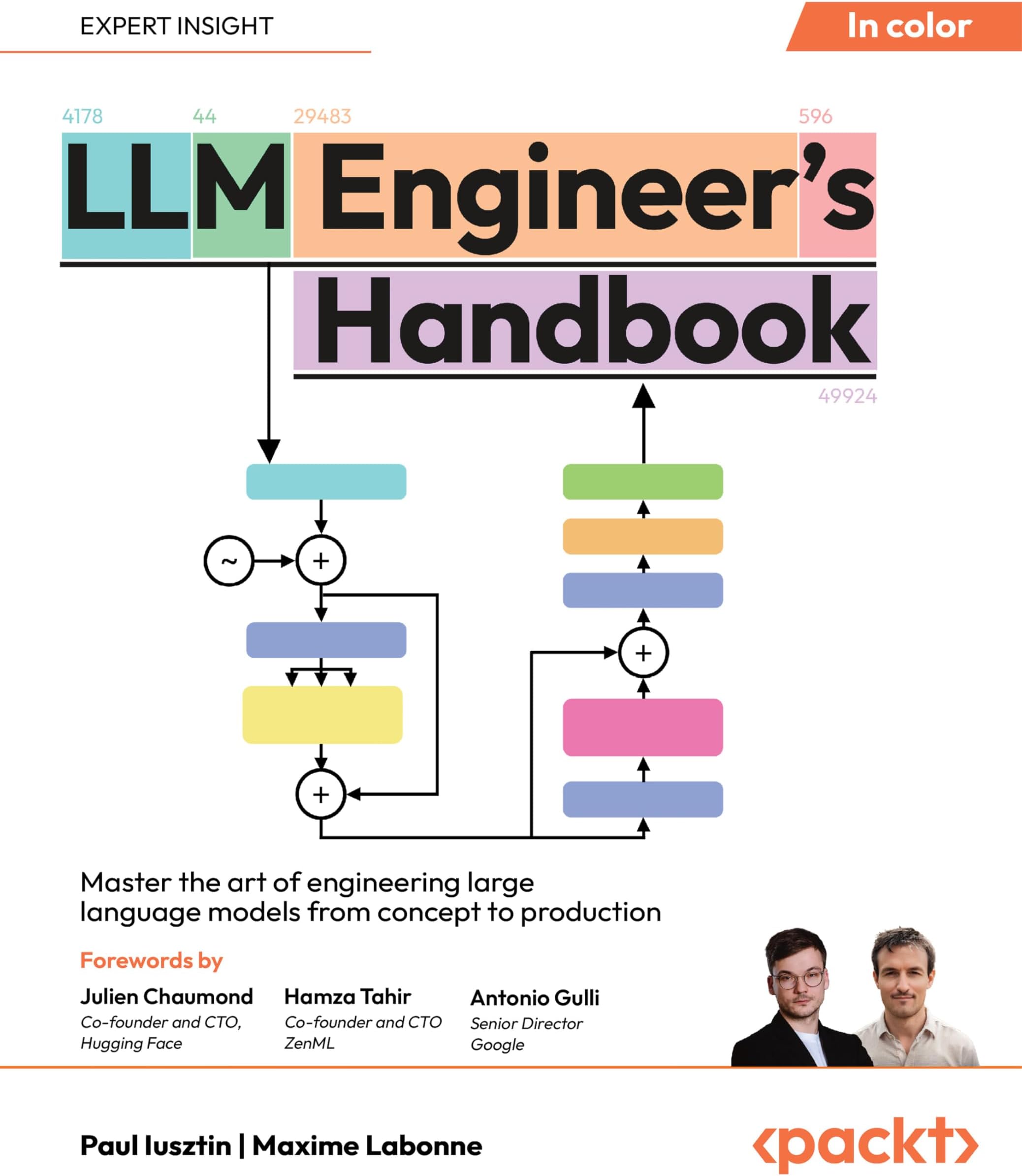
Step into the world of LLMs with this practical guide that takes you from the fundamentals to deploying advanced applications using LLMOps best practices Get With Your Book: PDF Copy, AI Assistant, and Next-Gen Reader Free Key Features Build and refine LLMs step by step, covering data preparation, RAG, and fine-tuning Learn essential skills for deploying and monitoring LLMs, ensuring optimal performance in production Utilize preference alignment, evaluation, and inference optimization to enhance performance and adaptability of your LLM applications Book Description Artificial intelligence has undergone rapid advancements, and Large Language Models (LLMs) are at the forefront of this revolution. This LLM book offers insights into designing, training, and deploying LLMs in real-world scenarios by leveraging MLOps best practices. The guide walks you through building an LLM-powered twin that’s cost-effective, scalable, and modular. It moves beyond isolated Jupyter notebooks, focusing on how to build production-grade end-to-end LLM systems. Throughout this book, you will learn data engineering, supervised fine-tuning, and deployment. The hands-on approach to building the LLM Twin use case will help you implement MLOps components in your own projects. You will also explore cutting-edge advancements in the field, including inference optimization, preference alignment, and real-time data processing, making this a vital resource for those looking to apply LLMs in their projects. By the end of this book, you will be proficient in deploying LLMs that solve practical problems while maintaining low-latency and high-availability inference capabilities. Whether you are new to artificial intelligence or an experienced practitioner, this book delivers guidance and practical techniques that will deepen your understanding of LLMs and sharpen your ability to implement them effectively. What you will learn Implement robust data pipelines and manage LLM training cycles Create your own LLM and refine it with the help of hands-on examples Get started with LLMOps by diving into core MLOps principles such as orchestrators and prompt monitoring Perform supervised fine-tuning and LLM evaluation Deploy end-to-end LLM solutions using AWS and other tools Design scalable and modularLLM systems Learn about RAG applications by building a feature and inference pipeline Who this book is for This book is for AI engineers, NLP professionals, and LLM engineers looking to deepen their understanding of LLMs. Basic knowledge of LLMs and the Gen AI landscape, Python and AWS is recommended. Whether you are new to AI or looking to enhance your skills, this book provides comprehensive guidance on implementing LLMs in real-world scenarios Table of Contents Understanding the LLM Twin Concept and Architecture Tooling and Installation Data Engineering RAG Feature Pipeline Supervised Fine-Tuning Fine-Tuning with Preference Alignment Evaluating LLMs Inference Optimization RAG Inference Pipeline Inference Pipeline Deployment MLOps and LLMOps Review: Gobsmacked - Took me by surprise. The plan was to get a step by step guide of building LLM Twin but I got more — a full package of the whole ecosystem of building any AI systems. Review: Disappointing Guide to LLMs: Shallow Content and Questionable Originality - This book lacks depth and clarity, offering simplistic examples with little real-world value. Over-reliance on vendor services, AWS-centric content, and questionable originality of the text —possibly lifted from online sources—make it feel rushed and unprofessional. Unique phrases and sections of text in this book can be searched online to verify their true origins. Not suitable for those seeking a deeper understanding of LLM building and deployment. There are much better books available by recognised experts in AI.


| Best Sellers Rank | 185,162 in Books ( See Top 100 in Books ) |
| Customer Reviews | 4.5 out of 5 stars 200 Reviews |
C**E
Gobsmacked
Took me by surprise. The plan was to get a step by step guide of building LLM Twin but I got more — a full package of the whole ecosystem of building any AI systems.
L**E
Disappointing Guide to LLMs: Shallow Content and Questionable Originality
This book lacks depth and clarity, offering simplistic examples with little real-world value. Over-reliance on vendor services, AWS-centric content, and questionable originality of the text —possibly lifted from online sources—make it feel rushed and unprofessional. Unique phrases and sections of text in this book can be searched online to verify their true origins. Not suitable for those seeking a deeper understanding of LLM building and deployment. There are much better books available by recognised experts in AI.
P**S
"Master the art of explaining each file in a repo but not the dev process"
I really, really, really wanted to like this book. It's a massive disappointment though. I mean ignore the fact that none of the code from the book works right now because of deprecated and incompatible packages - that's something that each Python enthusiast needs to learn to live with. The main problem with this book is that contrary to it's title, it's not a journey "from concept to production". It does the complete opposite - it takes a completely productionised repo and dissects it, but in a way that's completely unusable for you if you wanted to code a long from scratch. This is not a book for developers, it's a book for archaeologists. It's got a few nuggets, but because you cannot really follow it along, it's purely theoretical, you will learn more by asking an LLM to guide you through it step by step and create this from scratch (ironic, isn't it)
A**A
Ok book + horrible Packt service
The book is ok (not bad), however the Packt service is horrible - they mention in the book that you get free pdf download - and it has been constant back and forth and I have not received the download link. I personally will stay away from Packt books - I believe Manning and O'Reilly usually have much better books and better service.
A**S
MLOps /LLMOps n'est plus un secret
Je recommande ce livre. Ce livre vous accompagne et vous guide de bout en bout dans votre projet LLMOPS
T**P
Junior software engineer to AI engineer
International transport with Amazon is good, my order has damage a little bit (95%+ is good). I buy 3 best seller books for AI Engineer, these are good to open mind to people who don’t have background in AI engineer. They explain from basic to give better understanding to grapes information how AI systems production.
J**I
Highly recommended
Nice diagrams, comes in colors, clear explanation, written by humans (at least, it feels so). Practical and comprehensive at the same time.
S**.
Very good indeed
If you want to learn about Large Language Models (LLMs), LLM Engineer's Handbook by Paul Iusztin and Maxime Labonne offers a practical, step-by-step guide. It’s great for beginners, with clear explanations and downloadable code examples to help you follow along. The book also covers AWS in detail, which is useful for anyone working with cloud technologies. It might be a bit challenging if you don’t have a software development background, but if you’re willing to put in the effort, it’s a solid resource to deepen your LLM knowledge.
Trustpilot
2 days ago
1 month ago