Buy anything from 5,000+ international stores. One checkout price. No surprise fees. Join 2M+ shoppers on Desertcart.
Desertcart purchases this item on your behalf and handles shipping, customs, and support to Cyprus.
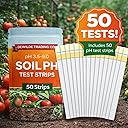
Product description Easy and Accurate to Read The measurement range of soil test strips for garden is pH3.5-9. Accurate results can help you determine the ph of the soil. DeWilde Trading Co Soil pH Test Strips 50 Strips in a pack. Shelf LIfe: Two Years but Best to use within 90 days after opening. Warnings 1.) Keep wet fingers out of the pack 2.) Avoid touching the two test pads on the strip. 3.) Seal the package tightly after use. 4.) Read the results in natural daylight. 5.) Store in a cool dry place. pH Measurement Range 3.5-9.0 Review: Easy to Use, Close Enough To Accurate - First of all, these strips aren't gonna be super duper down to the decimal accurate. However, if you're looking for a general idea of your soil pH you'll probably be happy with these. These were easy to use and the directions for preparing the soil for testing was clear and easy to follow. The test results indicated a pH within the range that I was expecting. I also tested several additional substances for accuracy and was pleased with the results. I wasn't so sure at first, though. I tested the soil from two completely separate garden beds, both of which had been amended with a mix of fresh compost and topsoil from the same source at the beginning of the season, but one of which was amended a few weeks ago with magnesium and an acid-loving fertilizer. Both of the test strips indicated a pH somewhere between 5 and 6, with the amended bed tending closer to 5. I'd been expecting it to be a little bit lower than that, but I wasn't too surprised. Plus, the pH being so close between the two isn't that surprising given the fact that they'd both been amended with soil and compost from the same source at the beginning of the season. In order to get as close to an accurate read as possible, I used distilled water when preparing the soil. They don't tell you to do that and I don't know if it really made a difference either way, but I had it on hand so I figured "why not?". As a control, I also poured a little bit of distilled water into a clean cup that I had pre-rinsed with distilled water (and poured out). On average, the pH of distilled water should be around 7, but these strips indicated a pH between 5 and 6, tending closer to 6. Basically, they looked nearly identical to the two strips from the soil tests. Now suspicious, I decided to test something that should be nowhere near neutral: distilled white vinegar. This time the strips indicated a definitive pH of 3, which is as low as these strips go. The pH of white vinegar is usually around 2.4 so that's what I was expecting. Anyway, I now have a baseline for the pH in my gardens so I can recheck again in a few weeks as I amend the soil to lower the pH a bit. The fact that 3 of the tests came out very close to each other in terms of pH is a little odd, but not too surprising. Since the fourth one definitely responded with what I'd expected - something VERY far from the other 3 - I'm fairly confident in the general accuracy of these strips. Review: Works well - Works well


| Customer Reviews | 3.9 out of 5 stars 115 Reviews |
S**U
Easy to Use, Close Enough To Accurate
First of all, these strips aren't gonna be super duper down to the decimal accurate. However, if you're looking for a general idea of your soil pH you'll probably be happy with these. These were easy to use and the directions for preparing the soil for testing was clear and easy to follow. The test results indicated a pH within the range that I was expecting. I also tested several additional substances for accuracy and was pleased with the results. I wasn't so sure at first, though. I tested the soil from two completely separate garden beds, both of which had been amended with a mix of fresh compost and topsoil from the same source at the beginning of the season, but one of which was amended a few weeks ago with magnesium and an acid-loving fertilizer. Both of the test strips indicated a pH somewhere between 5 and 6, with the amended bed tending closer to 5. I'd been expecting it to be a little bit lower than that, but I wasn't too surprised. Plus, the pH being so close between the two isn't that surprising given the fact that they'd both been amended with soil and compost from the same source at the beginning of the season. In order to get as close to an accurate read as possible, I used distilled water when preparing the soil. They don't tell you to do that and I don't know if it really made a difference either way, but I had it on hand so I figured "why not?". As a control, I also poured a little bit of distilled water into a clean cup that I had pre-rinsed with distilled water (and poured out). On average, the pH of distilled water should be around 7, but these strips indicated a pH between 5 and 6, tending closer to 6. Basically, they looked nearly identical to the two strips from the soil tests. Now suspicious, I decided to test something that should be nowhere near neutral: distilled white vinegar. This time the strips indicated a definitive pH of 3, which is as low as these strips go. The pH of white vinegar is usually around 2.4 so that's what I was expecting. Anyway, I now have a baseline for the pH in my gardens so I can recheck again in a few weeks as I amend the soil to lower the pH a bit. The fact that 3 of the tests came out very close to each other in terms of pH is a little odd, but not too surprising. Since the fourth one definitely responded with what I'd expected - something VERY far from the other 3 - I'm fairly confident in the general accuracy of these strips.
K**.
Works well
Works well
S**T
Works fine for the money
Works as should
A**S
Simple pH test kit
Works fine
S**C
Seems accurate, easy to use
I tested our soil because we couldn't for our life even grow the most basic grass. After using the test strips, the cause was clear, our pH was super low. Knowing this, we could fix the problem by adding lime and fertilizer, and over seeding with rye grass, which is supposed to be more tolerant. If you have issues in your garden, testing the soil pH can be a very easy and inexpensive way to track down the issue.
K**S
SAVE YOUR MONEY
These strips are useless! I tried several of them in four different areas. All the readings were exactly the same each time even tho I know I have Alkaline, Acidic, and Neutral Soil in different locations. I am surprised anyone would say these strips work! I did return what was left as they are certainly NOT what they are advertised to do. I suggest you use the Extension Service in your county for accurate results.
J**N
Test strips are not accurate
No mater how I tested my test strips gave me the same reading Iโm using distilled water and letting that mix sit for 15min before test. Same reading then l came home tested my yard and same reading
S**M
Easy to use, accurate results
I was initially skeptical, but the strips were easy to use, and I could easily match the colors on the strip with those on the packaging. After testing my soil, I adjusted the pH accordingly, and now my grass is growing much better.
Trustpilot
3 days ago
3 weeks ago