
Buy anything from 5,000+ international stores. One checkout price. No surprise fees. Join 2M+ shoppers on Desertcart.
Desertcart purchases this item on your behalf and handles shipping, customs, and support to Cyprus.
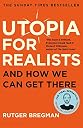
THE SUNDAY TIMES BESTSELLER - FROM THE 2025 BBC REITH LECTURER 'Listen out for Rutger Bregman. He has a big future shaping the future' Observer 'A more politically radical Malcolm Gladwell' New York Times 'The Dutch wunderkind of new ideas' Guardian In Utopia for Realists , Rutger Bregman shows that we can construct a society with visionary ideas that are, in fact, wholly implementable. Every milestone of civilisation - from the end of slavery to the beginning of democracy - was once considered a utopian fantasy. New utopian ideas such as universal basic income and a fifteen-hour work week can become reality in our lifetime. From a Canadian city that once completely eradicated poverty, to Richard Nixon's near implementation of a basic income for millions of Americans, Bregman takes us on a journey through history, beyond the traditional left-right divides, as he introduces ideas whose time has come. As the 2025 BBC Reith Lecturer, Rutger Bregman will present 'Moral Revolution', a four part series: -A Time of Monsters -How To Start a Moral Revolution -A Realist's Utopia -Zoom Out Available to listen on BBC Four Review: The best non-fiction - The introduction moved me and the epilogue inspired me, everything in-between was golden brain fuel. This book has helped me understand the goings on in this world through very well-written and researched examples and insights, and helped shape some of my outlooks and opinions of the world. I now recommend this book to everyone :) Review: An excellent book - I'd recommend it to anyone - Delivered promptly; brand new, as advertised. An excellent book - I'd recommend it to anyone! Rutger Bregman is a clear thinker and a good writer, and his ideas and reflections make perfect sense to me. A basic national income, and giving money away instead of loaning it out in expectation of repayment are not popular ideas - least of all in Conservative circles - but experiments in other parts of the world prove that both work; and both enhance the prosperity of nations and individuals alike. The trouble with the Tory way of thinking is that keeping people destitute (for example via pitiful benefits, JSA and so forth) means that they can't afford to buy anything (often can't even afford to pay their bills), so they can't help sustain, never mind grow, the economy; while people have proved that they are much better able to make best use of money if they don't have the threat of foreclosure hanging over them but can use the funds to invest to best advantage. The IMF and WTO have used big loans in the past to developing nations - serviced at crippling cost financially and crucifying cost in humanitarian terms; they're doing it again now. Greece, Italy, Portugal were not 'developing countries'; they aren't in principle now; yet their economies, already in tatters from the world economic crisis, are being pulverised by huge loans at absolutely unmanageable rates of interest. Just who this is supposed to benefit, I can't imagine; many of the African recipients of such loans back in the 1970s simply had to default. If that sounds to you like a sensible way to run any economy on any scale, I can only say that it certainly doesn't sound that way to me!


| Best Sellers Rank | 10,896 in Books ( See Top 100 in Books ) 1 in International Taxes 4 in Professional Financial Forecasting 70 in Business & Economic History |
| Customer Reviews | 4.6 out of 5 stars 3,829 Reviews |
C**N
The best non-fiction
The introduction moved me and the epilogue inspired me, everything in-between was golden brain fuel. This book has helped me understand the goings on in this world through very well-written and researched examples and insights, and helped shape some of my outlooks and opinions of the world. I now recommend this book to everyone :)
A**R
An excellent book - I'd recommend it to anyone
Delivered promptly; brand new, as advertised. An excellent book - I'd recommend it to anyone! Rutger Bregman is a clear thinker and a good writer, and his ideas and reflections make perfect sense to me. A basic national income, and giving money away instead of loaning it out in expectation of repayment are not popular ideas - least of all in Conservative circles - but experiments in other parts of the world prove that both work; and both enhance the prosperity of nations and individuals alike. The trouble with the Tory way of thinking is that keeping people destitute (for example via pitiful benefits, JSA and so forth) means that they can't afford to buy anything (often can't even afford to pay their bills), so they can't help sustain, never mind grow, the economy; while people have proved that they are much better able to make best use of money if they don't have the threat of foreclosure hanging over them but can use the funds to invest to best advantage. The IMF and WTO have used big loans in the past to developing nations - serviced at crippling cost financially and crucifying cost in humanitarian terms; they're doing it again now. Greece, Italy, Portugal were not 'developing countries'; they aren't in principle now; yet their economies, already in tatters from the world economic crisis, are being pulverised by huge loans at absolutely unmanageable rates of interest. Just who this is supposed to benefit, I can't imagine; many of the African recipients of such loans back in the 1970s simply had to default. If that sounds to you like a sensible way to run any economy on any scale, I can only say that it certainly doesn't sound that way to me!
B**X
The importance of real jobs
Very original and thought-provoking book.
M**T
A plan to a better place
This book is not like any others. It is not a complaint about the current inequalities. It is not about how to fix the current system. It is a plan to take us all to a better place. It is a plan to tackle what we may currently regard as impossible. The book is packed full of examples and case studies to tell us that the impossible things have already been proven to be possible, and that we can all be in a better place today. It is time for good people to take back control of the moral debate and take us all to a kinder and more progressive world. The book is easy to read with stories that can connect with everyone. It deserves 10 stars instead of just 5.
R**D
A great introduction to economic theory with many fascinating case studies
It's a really interesting read, with a lot of interesting historical information , the style is a bit annoying at times but not sure whether something is being lost in translation from the Dutch - however as an argument for the introduction of the universal income for all it makes sense - alot of interesting case studies from all round the globe illustrate the writer's point that giving a regular income directly to people with no strings attached and no guilt or stigma attached (i.e you are a benefit parasite etc etc - this is eliminated because everyone can claim the universal income) actually leads to a much greater pay off to society both economically and in terms of well being in the long run. Case studies show homelessness problems and street crime and other social problems disappear over night when states in America and various other countries have introduced universal basic income - therefore saving society as a whole millions in court fees, prison sentences and many other related costs . Other case studies show whole towns lifting their 'broken' economies through the introduction of the UBI as well as people being able to train themselves with the extra money and become more skilled and eventually contributing more to their communities and society in the long run. Massively interesting read well worth buying
D**L
More relevant than ever.
Great book, still highly relevant even though almost 10 years old. Not afraid to make some clear and evidence-based points on important topics: why do we put our best and brightest to value destroying jobs like creating more effective Facebook ads, why are we so set on national borders? Highly recommended reading if you agree and especially if you disagree.
O**R
few books spark the imagination of possibility as much as this, but some issues need expanding on
I thoroughly recommend this book for people interested in universal basic income and shorter work weeks as well as open borders - the three ideas the book is premised on. This book effectively dispels many of the myths presented based on existing studies and makes a compelling case for how we can be creative in the future. My only criticism is I wanted some of the challenges to be explored in more depth. I like universal basic income as a principal and would like to see it implemented, but am concerned whether or not after a few years prices and wages would readjust negating this source of income. I would like to have seen this addressed with some consideration for what legislation might address these potential issues. Additionally, I didn't think the open borders section was addressed in such a compelling way. I think the point about immigration not suppressing wages could be elaborated upon, I would worry fully open borders could cause wider problem in terms of reduce labours bargaining power on a wide range of issues. Furthermore, does not that not create an idea that should just open the gates of utopia rather than build more. Would open immigration create brain drain and further entrench labour division and as such inequality between the rich and poor countries? These are some issues I would like to have seen tackled in the book. However, I still thoroughly recommend it as few books spark the imagination of possibility as much as this.
W**S
Hope
A brilliantly written, well evidenced, demonstration of the crazy decision making of society's leaders and how to right the wrongs.
M**A
Utopias para um novo mundo
Excelente discurso sobre a necessidade de ideias e objetivos utópicos que possam nos manter lutando em direção à um mundo melhor para todos.
T**N
"The difficulty lies, not in the new ideas, but in escaping from the old ones."
To begin with, I'm no optimist. I'd say I lie more on the pessimist end of the spectrum. But something about this book's title. The pessimist laughed at 'Utopia', but the sliver of hope questioned, 'For realists?'. With curiosity piqued, I picked up the book with absolutely zero expectation. However, I'm happy to report that this book is actually quite interesting and intriguing! Rutger Bregman starts by exploring the concept of the mythical Land of Plenty, a world of abundance—peak utopia, if you will. The author then paints a picture of our current situation, noting that every person living on Earth today has more resources than kings did a few centuries ago. Yet, despite this abundance, we have problems like poverty, unemployment, diseases, and many other issues yet to be solved. Bregman argues that we have stopped dreaming big. As he puts it, "as people and societies get progressively older, they become accustomed to the status quo." The book centers on three main themes: universal basic income (UBI), a 15-hour work week, and open borders. I'm sure at least one of these has already awakened the inner pessimist in you. But Bregman does a phenomenal job of backing up these seemingly absurd ideas with solid evidence. And the author reminds us that ideas like women's suffrage and equal rights for racial minorities too were "unthinkable" at one point in time. One of the highlights of the book for me is when the author, in a span of a page or two, explains how unemployment, rise of AI, stress levels, accidents, gender equality, aging population, inequality, and climate change can all be tackled with 15-hour work weeks and UBI alone, with supporting evidence for each of those issues. Yes, the pessimist must be held back, and you have to humor the idea, but when you do, it does seem plausible. As Bregman quotes one of the greatest economists ever, John Maynard Keynes, "The difficulty lies, not in the new ideas, but in escaping from the old ones." Utopia for Realists is packed with some fantastic and thought-provoking quotes. "Utopias are a breeding ground for discord, violence, even genocide. Utopias ultimately become dystopias; in fact, a utopia is a dystopia." or "...the conviction that you’re producing something of great value because you earn so much." And then there's this gem from Arthur C. Clarke: "The goal of the future is full unemployment, so we can play." All in all, it's a fantastic book. It's good enough to make a pessimist more hopeful. It's definitely a spark that could light the fire to an actual utopia. And it's sure to leave you pondering the possibilities! An easy and straightforward read, highly recommended!
R**L
One of my most refreshing reads in years
Rutger Bregman defends the idea of detaching financial earnings to individual productivity, rationally constructing a case for Universal Basic Income, 15-hour work week, and a borderless world. With his acid and provoking writing style, salted with good humor and nice historical references, he makes us question a few whys in things we usually take for granted, as all the craze of considering the GDP as a unique and universal measure of progress when it clearly encourages more harm than good in society. I have first heard about the book from a LinkedIn contact, who defended Universal Basic Income and cited Bregman as one of his references. A quick Google search led me to his firefighter's speech in Davos, and then to Tucker Carlson's tantrum in his interview (search for it and watch). I thought that maybe this dutch-directness-speaking guy (who is, in fact, dutch) had something interesting to say, so I decided to buy this book and I did not regret. It exceeded my expectations in so many ways! It definitely worth a try, even if (and especially if) you don't agree with his ideas.
A**R
Thought Provoking
I classify myself as a ‘fiscally conservative liberal’ and this book turned a lot of my preconceptions on their head. I will not be a blind adherent to what the author proposes but it does open up a path of path of personal research and thought.
A**R
Interesting read.
Not 100% sure still of universal income for all but this book is definitely an interesting read. I’m glad i did. Written in fairly easy to understand English for a layman like myself
Trustpilot
2 months ago
1 day ago