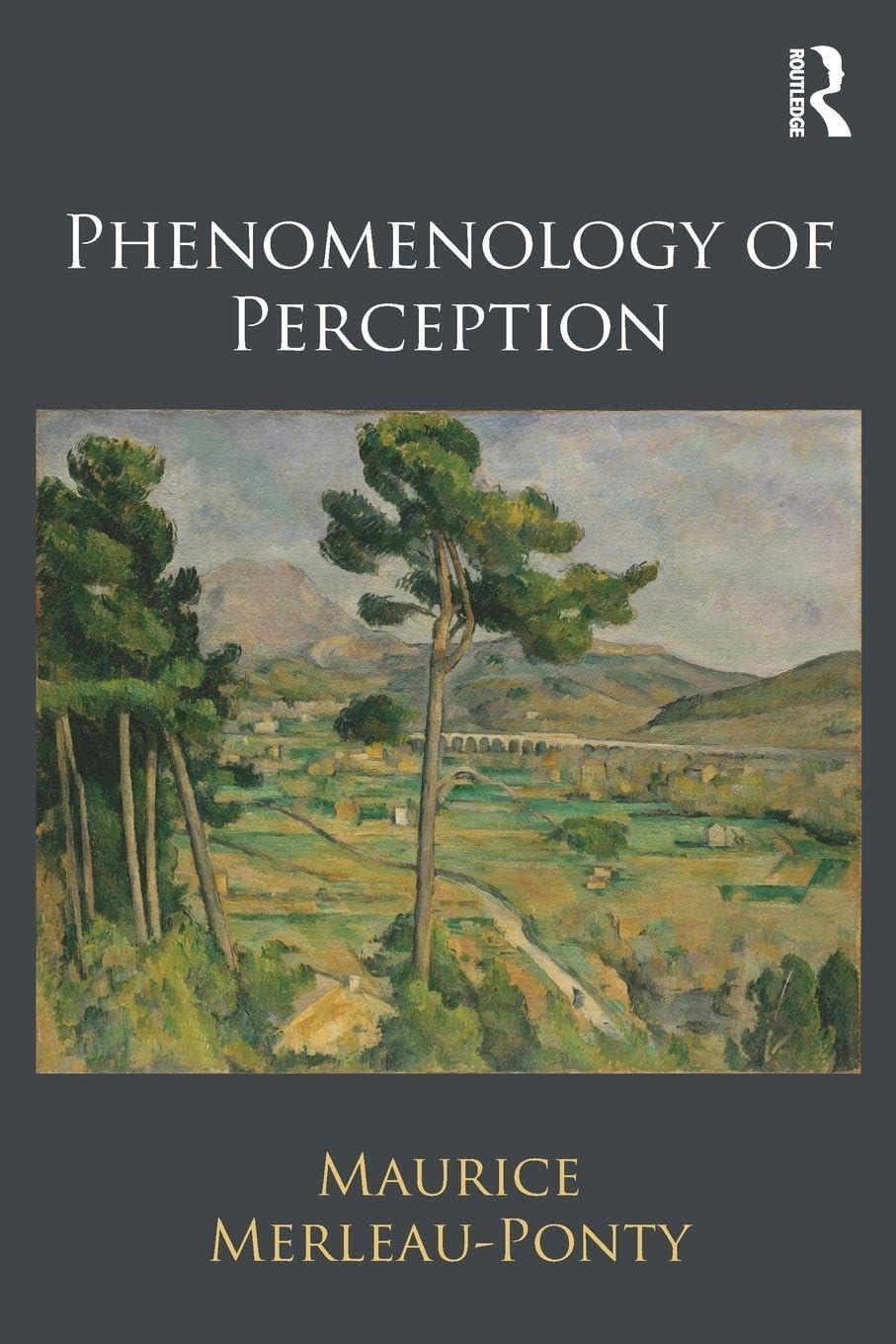
Phenomenology of Perception
Product ID: 3368108
Desertcart purchases this item on your behalf and handles shipping, customs, and support to Cyprus.
First published in 1945, Maurice Merleau-Ponty’s monumental Phénoménologie de la perception signalled the arrival of a major new philosophical and intellectual voice in post-war Europe. Breaking with the prevailing picture of existentialism and phenomenology at the time, it has become one of the landmark works of twentieth-century thought. This new translation, the first for over fifty years, makes this classic work of philosophy available to a new generation of readers. Phenomenology of Perception stands in the great phenomenological tradition of Husserl, Heidegger, and Sartre. Yet Merleau-Ponty’s contribution is decisive, as he brings this tradition and other philosophical predecessors, particularly Descartes and Kant, to confront a neglected dimension of our experience: the lived body and the phenomenal world. Charting a bold course between the reductionism of science on the one hand and intellectualism on the other, Merleau-Ponty argues that we should regard the body not as a mere biological or physical unit, but as the body which structures one’s situation and experience within the world. Merleau-Ponty enriches his classic work with engaging studies of famous cases in the history of psychology and neurology as well as phenomena that continue to draw our attention, such as phantom limb syndrome, synaesthesia, and hallucination. This new translation includes many helpful features such as the reintroduction of Merleau-Ponty’s discursive Table of Contents as subtitles into the body of the text, a comprehensive Translator’s Introduction to its main themes, essential notes explaining key terms of translation, an extensive Index, and an important updating of Merleau-Ponty’s references to now available English translations. Also included is a new foreword by Taylor Carman and an introduction to Merleau-Ponty by Claude Lefort. Translated by Donald A. Landes. Review: Brilliance in translation - This is the new definitive translation which returns the reader to reading much more of the text than trying to understand the translation of Phenomenology of Perception (PoP), incredibly helpful and scholarly notes, and a powerfully useful index. Included in the margins is reference to the 2005 French edition pagination. For other edition concordances you can google "Concordance of Editions" of MP's POP and thereby coordinate with all other versions, French and English. I think Simon de Beauvoir's quote on the cover jacket (above) summarizes it all--"the human condition is at stake in this book." For fun, here is my summary of the Introduction: Phenomoneology is about describing, not explaining or analyzing, neither constructing nor constituting. I am not a man or a consciousness, but the absolute source. My existence moves out and sustains my physical and social surroundings. I am in and toward the world and it is in the world that I know myself. I know about dreams and reality because I have an experience of the difference, so my problem is to make explicit my primordial knowledge of the "real, " the perception of the world as our idea of the truth. The world is what we perceive. Beauty: Kant demonstrated there is a unity of the imagination and the understanding, a unity of subjects prior to the object. As in beauty there is harmony between the sensible and the concept, between myself and another. The hidden art of the imagination gives rise to discovering of oneself and appreciating oneself, not just as the aesthetic which grounds the unity of consciousness, but also as knowledge. With true/radical reflection: we step back from the world (not withdraw from it) in order to see transcendences, revealing the world's strangeness and paradoxes. Intellectualism is unaware of the problem of others, the world ( they have no "thisness"). The old Cogito devalues the perception of others and of the world. Unless I find myself situated in the world, I can not find others (inter-subjectivity) or the world. Intellectualism breaks with the world by a constituting consciousness rather than by being grasped directly. Empiricism presents the absolute belief in the world as the totality of spatio-temporal events, and treats consciousness as a region of that world. Intellectualism and empricism are "naturalistic" positions which hide true perception. All signification of language is measured by the experience we have of ourselves and this consciousness that we are. Consciousness is the actual presence of myself to myself prior to words, concepts and thematizations. Operative intentionality (qua Husserl) establishes the natural and pre-predicative unity of the world and of our life as seen in our desires, evaluations and landscape. It is the text prior to precise language. Because we are in the world, we are condemned to sense, and to acquire a name in history. The analytic/empirical is the figure upon which the background of the phenomenal lies. Figure and background are thus the structures of consciousness, irreducible to qualities of consciousness. There is a misconception of judgment as perception when it loses its constituting function and becomes an explanatory principle, position taking, knowing for me across all moments. False judgment reduces sensing to appearance, denying evidence of phenomena everywhere. To perceive is not to judge but to grasp a sense immanent in the sensible. Judgment is only true if it follows spontaneous organization and the particular configuration of the phenomena. "I am a consciousness, a singular being who resides nowhere and can make itself present everywhere through intention. Everything that exists, exists as either thing or as consciousness, and there is no in between. The thing is in a place, but perception is nowhere, for if it were situated it could not make other things exist for itself." (p. 39, 2012) Review: Just As Fascinating and Well-Organized as Being and Nothingness - I read this slowly over the course of a few months, along with a commentary published by George Marshall. Much of my understanding of the book was informed by having read Sartre's Being and Nothingness about 10 months earlier. I would compare POP and BAN to a Windows vs. Mac scenario. Both works are approaching the same complex problem (what the hell is human reality?), with similar but slightly different approaches. Both books are long and quite comprehensive. By the end of each work, you find that you understand the author's overall system of ontological understanding, and can approach new every day problems and experiences from their perspective about how reality is formed. In comparison to Sartre, I found Merleau-Ponty to be more thoughtful about relating ontology to everyday life. Indeed, his embodied ontology moves through the phenomenological method to examine what reality looks like with normal human eyes, rejecting the various scientisms of his day in favor of direct experience (and its limitations). Sartre was much more effective at relating his ontology to human ethics, but I also found that I didn't care for some of his ideas. I don't think we nihilate when forming awareness of ontological objects. I think Merleau-Ponty's vision of a weakly held consciousness that provides the background and formational structures for all moments of objectivity to be a better fit for my experience of the human mind. Whatever you might think of either author, there is a lot of merit to reading both books if you can find the time. They complement and contrast with one another in a way that deepens your understanding of each. Both were intensely influenced by the work of Descartes Husserl, as well as Kant and (esp. for Sartre) Heidigger, whom I look forward to reading in the coming years. If you want a peak at the underlying machine code that's running within your mind, and want to see what it's like to be conscious from the outside, both Phenomenology of Perception and Being and Nothingness are thoughtful and comprehensive works.
| Best Sellers Rank | #69,755 in Books ( See Top 100 in Books ) #10 in Phenomenological Philosophy #36 in Existentialist Philosophy #168 in Cognitive Psychology (Books) |
| Customer Reviews | 4.4 out of 5 stars 299 Reviews |
W**E
Brilliance in translation
This is the new definitive translation which returns the reader to reading much more of the text than trying to understand the translation of Phenomenology of Perception (PoP), incredibly helpful and scholarly notes, and a powerfully useful index. Included in the margins is reference to the 2005 French edition pagination. For other edition concordances you can google "Concordance of Editions" of MP's POP and thereby coordinate with all other versions, French and English. I think Simon de Beauvoir's quote on the cover jacket (above) summarizes it all--"the human condition is at stake in this book." For fun, here is my summary of the Introduction: Phenomoneology is about describing, not explaining or analyzing, neither constructing nor constituting. I am not a man or a consciousness, but the absolute source. My existence moves out and sustains my physical and social surroundings. I am in and toward the world and it is in the world that I know myself. I know about dreams and reality because I have an experience of the difference, so my problem is to make explicit my primordial knowledge of the "real, " the perception of the world as our idea of the truth. The world is what we perceive. Beauty: Kant demonstrated there is a unity of the imagination and the understanding, a unity of subjects prior to the object. As in beauty there is harmony between the sensible and the concept, between myself and another. The hidden art of the imagination gives rise to discovering of oneself and appreciating oneself, not just as the aesthetic which grounds the unity of consciousness, but also as knowledge. With true/radical reflection: we step back from the world (not withdraw from it) in order to see transcendences, revealing the world's strangeness and paradoxes. Intellectualism is unaware of the problem of others, the world ( they have no "thisness"). The old Cogito devalues the perception of others and of the world. Unless I find myself situated in the world, I can not find others (inter-subjectivity) or the world. Intellectualism breaks with the world by a constituting consciousness rather than by being grasped directly. Empiricism presents the absolute belief in the world as the totality of spatio-temporal events, and treats consciousness as a region of that world. Intellectualism and empricism are "naturalistic" positions which hide true perception. All signification of language is measured by the experience we have of ourselves and this consciousness that we are. Consciousness is the actual presence of myself to myself prior to words, concepts and thematizations. Operative intentionality (qua Husserl) establishes the natural and pre-predicative unity of the world and of our life as seen in our desires, evaluations and landscape. It is the text prior to precise language. Because we are in the world, we are condemned to sense, and to acquire a name in history. The analytic/empirical is the figure upon which the background of the phenomenal lies. Figure and background are thus the structures of consciousness, irreducible to qualities of consciousness. There is a misconception of judgment as perception when it loses its constituting function and becomes an explanatory principle, position taking, knowing for me across all moments. False judgment reduces sensing to appearance, denying evidence of phenomena everywhere. To perceive is not to judge but to grasp a sense immanent in the sensible. Judgment is only true if it follows spontaneous organization and the particular configuration of the phenomena. "I am a consciousness, a singular being who resides nowhere and can make itself present everywhere through intention. Everything that exists, exists as either thing or as consciousness, and there is no in between. The thing is in a place, but perception is nowhere, for if it were situated it could not make other things exist for itself." (p. 39, 2012)
R**E
Just As Fascinating and Well-Organized as Being and Nothingness
I read this slowly over the course of a few months, along with a commentary published by George Marshall. Much of my understanding of the book was informed by having read Sartre's Being and Nothingness about 10 months earlier. I would compare POP and BAN to a Windows vs. Mac scenario. Both works are approaching the same complex problem (what the hell is human reality?), with similar but slightly different approaches. Both books are long and quite comprehensive. By the end of each work, you find that you understand the author's overall system of ontological understanding, and can approach new every day problems and experiences from their perspective about how reality is formed. In comparison to Sartre, I found Merleau-Ponty to be more thoughtful about relating ontology to everyday life. Indeed, his embodied ontology moves through the phenomenological method to examine what reality looks like with normal human eyes, rejecting the various scientisms of his day in favor of direct experience (and its limitations). Sartre was much more effective at relating his ontology to human ethics, but I also found that I didn't care for some of his ideas. I don't think we nihilate when forming awareness of ontological objects. I think Merleau-Ponty's vision of a weakly held consciousness that provides the background and formational structures for all moments of objectivity to be a better fit for my experience of the human mind. Whatever you might think of either author, there is a lot of merit to reading both books if you can find the time. They complement and contrast with one another in a way that deepens your understanding of each. Both were intensely influenced by the work of Descartes Husserl, as well as Kant and (esp. for Sartre) Heidigger, whom I look forward to reading in the coming years. If you want a peak at the underlying machine code that's running within your mind, and want to see what it's like to be conscious from the outside, both Phenomenology of Perception and Being and Nothingness are thoughtful and comprehensive works.
P**N
An Excellent Book
It is multidisciplinary and the best book so far that explains human condition in an adventurous and realistic fashion. To comprehend its themes and theses is surely very daunting, but it opens new horizons before you and makes your life and living very very interesting. You will learn that your life is ambiguous and contingent and that you are both *a pure consciousness* "who makes [or creates] others and the world (things, objects) exist for [you] and *a body* with "a psychological and historical structure". You are everything that you see and you have this means of escape. In other words, you are absolutely free (because you are a pure consciousness) despite the fact that you have a vulnerable and an aging body through which you are also part and parcel of this world. And you journey in this world towards your death. In brief, in the words of Simone de Beauvoir, Phenomenology of Perception by Maurice Merleau-Ponty is not only a remarkable specialist work but a book that is of interest to the whole of man and to every man; the human condition is at stake in this book."
C**T
A good quality paperback
I have the 2014 Routledge paperback, ISBN 978-0-415-83433-9. It is the paperback of the 2012 edition, translated by Donald A. Landes. It's a good quality paperback. The print is clear and easy to read.
M**E
I wrote my dissertation with assistance from this book.
This book has a comprehensive understanding of the art of phenomenology.
C**K
Wonderful edition
As the other reviewers of the work have mentioned, what a wonderful edition/translation of this work, published with such great care and in such fine quality. A source of pleasure showing that one can publish an important work in a form worthy of its contents, and this at quite an affordable price.
P**O
The rendering of Merleau-Ponty's french is unnecessarily difficult
I do not dispute the philosophical accuracy of the Landes translation, but the actual rendering of the french language is unnecessarily difficult. For example, part of the last paragraph at the bottom of p 68 reads: "If we did not want to follow reflective philosophy in placing ourselves immediately into a transcendental dimension that we would have to assume to be eternally given and if we did not want to miss the true problem of constitution, we had to frequent the phenomenal field and we had to familiarize ourselves with the subject of phenomena through psychological descriptions." The Smith translation reads: "We had to frequent the phenomenal field and become acquainted, through psychological descriptions, with the subject of phenomena, if we were to avoid placing ourselves from the start, as does reflexive philosophy, in a transcendental dimension assumed to be eternally given, thus by-passing the full problem of constitution." In my opinion, the Smith rendering is easier to read, and as a francophone I can say as a matter of fact that Smith's rendering is closer to the original french; Landes had to rearrange the sentence in order to make so difficult. My impression overall so far (up to p 65) is that this is typical: the Landes translation is technically correct but unnecessarily difficult to read. Merleau-Ponty is a much better writer.
A**N
Great edition of a fantastic text
Great edition of a fantastic text. The slightly larger font makes the text soooo much easier to get through, don't be intimidated by the length! Additionally this is a fantastic translation.
J**R
Buenísimo libro, como era de esperarse
Gran libro, como todo lo escrito por Merleau-Ponty.
D**S
Worst paper quality
Print paper quality is too poor to handle the pages. Customer should avoid this publisher/seller.
A**R
made over vintage version of a classic - with too small font
I bought this book, because I expected a normal reedited version of the classic Merleau-Ponty original. Unfortunately this version is absolutely useless to work with - even though I don't need glasses the print and the font used is too small and narrow so that after looking at one page your eyes get tired. The version also features supposed to be vintage-underlinings of the classic edition - with may seem charming to some readers, but if you actually plan to work with are as annoying as a library version, where other people have underlined stuff.. My advise for people who plan to actually read the book would be to use another version with a normal font-size or get a magnifying glass...
D**S
Do no buy hard cover version!
DO NOT BUY HARD COVER VERSION. All the positive reviews are for the paperback. All the negative reviews are for the hard cover. It is just a facsimile of a marked-up copy of the book. Like a photocopy of an old library book, basically. It has underlining and notes written in it. The print is small and hard to read and some of the typing is faded. I feel scammed.
M**A
LIBRO FOTOCOPIADO
Libro falso, no comprar.
Trustpilot
4 days ago
1 month ago