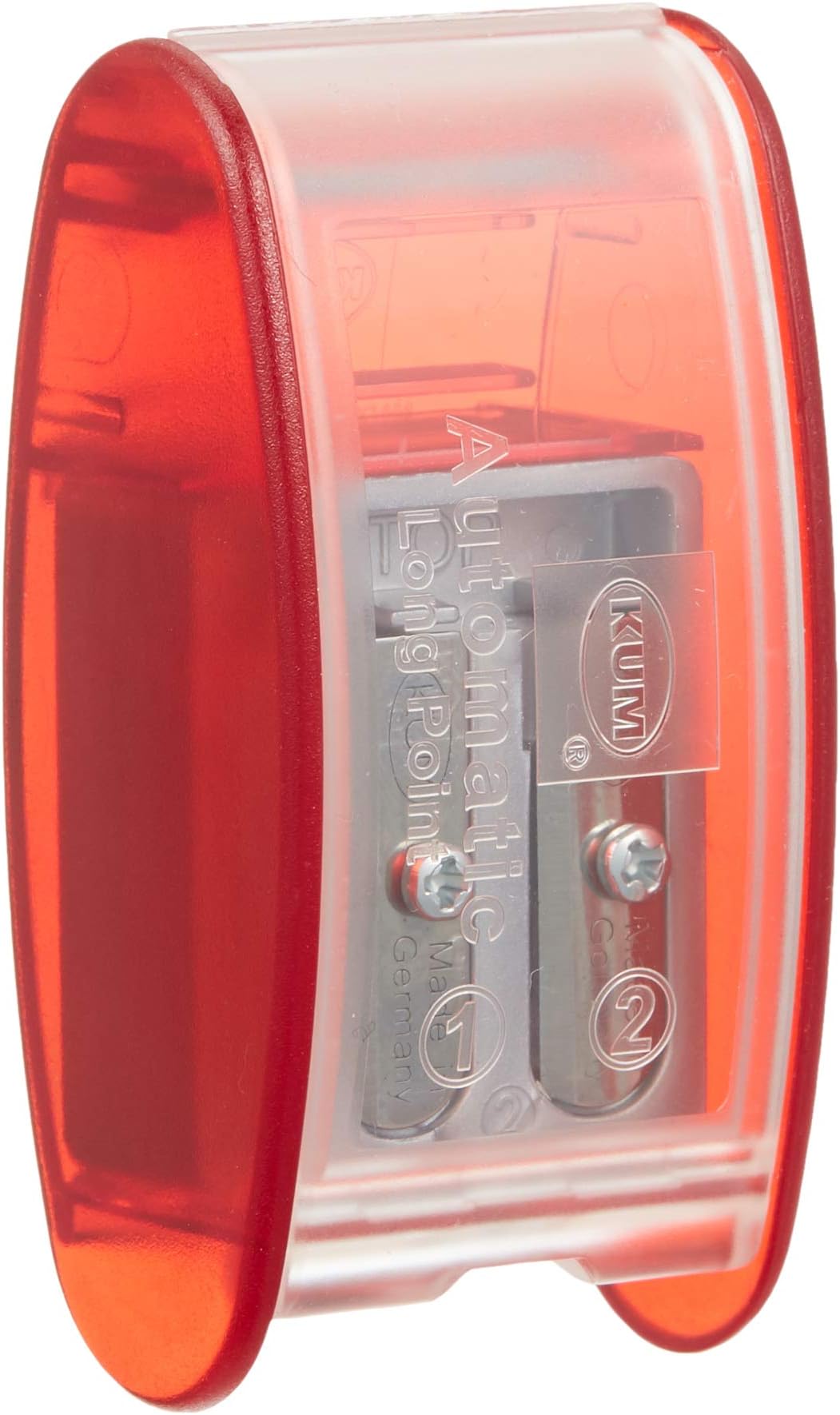
O.K. I'm a Philistine. I use fine-line mechanical pencils for most of my sketching and the early stages of my drawing and according to those that teach How to draw" in on-line courses, this is the wrong thing to do. I disagree, but I'll concede that there occasions when a traditional pencil is a much better solution - usually when very soft or hard lead grades are required or very subtle tone has to be laid in. The pencil has to be kept sharp to be controllable, however, and unless the wood-case is essential for the pending operation, normally it's simpler to reach for the mechanical pencil instead. When I was a student, pencil sharpeners were forbidden. We had to sharpen our graphites with a Stanley or Xacto knife or we'd be humiliated, marked down and suffer derision. In fear of the dunce's cap and ritual abuse, I consequently learned to sharpen pencils like obsidian spears, long and tapered and extremely sharp. Pencils you could lobotomise a gnat with. Pencils that made a zinging noise as you waved them through the air, cleaving the fabric of reality. Pencils that broke if anything but a masterful touch was used in executing a drawing. The process was - and still is - tedious, fraught and (pun alert) pointless. OK, a hand-crafted point is great for doing "finished" drawings with lots of subtle tone or very very fine dark details but for everything else, when no-one's looking, I happily use the Velos 55 desktop sharpener with its coffee-grinder helical blade that I acquired second hand about 35 years ago. It produces reasonably sharp - i.e. practically usable - points (even better since I drilled out the back stop slightly) and unless I'm showing off to visitors, I'll use it routinely on my "proper" pencils. It's effective and economical when used on good quality pencils but when used on el-cheapo ones full of broken leads, it fares no better than poor quality sharpeners. I'm still trying to learn that lesson but I'm stubbornly optimistic about saving money, which of course costs me dear in the long run. Those of you who aren't as stupid as I, take heed. The Veios is a good sharpener, even if not _quite_ as good as a new knife and a patient, steady hand. It wins hands down in real-life convenience though. It isn't exactly pocketable, unfortunately, and so I need something else for situations where I'm away from my desk, which is most of the time. Why Have I wasted your time dribbling on and on about knives and antique sharpeners cast in unobtainium alloy? It's to establish a baseline, so the product proper has some sort of context. I could just make comments in a vacuum, but how useful a review would that really be? I've tried dozens of sharpeners over the years. Most have been unable to produce the sort of point I could pretend had been made with a knife and those that started out acceptable became awful pretty quickly. Lead breaking in the process of sharpening is usually the main problem. The worst case I remember was my own fault. I bought a pack of thirty cheap HB from that well-known chain of everything's a pound retailers and got through the entire length of twenty of them without producing a single usable point. Twist twist snap, twist twist twist snap… and so in. False economy indeed. I didn't have opportunity to try them in the Velos so I wasn't certain whether they were pre-broken or just incredibly fragile, with the leads not bonded to the wood. As I'm digressing and being paid by the word, I'll confess I rather like the die-cast novelty sharpeners that come in a bronze effect finish and resemble old gramophones or railway engines, candlestick telephones and motorcycles. Some of them actually work quite well but they're fragile and don't last well. Ornaments, really, but when they're new some of them are great for non-critical use. The standard metal school-type single or double hole sharpeners are invariably crap and produce bluntish tapers and invariably start breaking leads after a few uses on anything other than a new, unshocked pencil.. They're also jolly uncomfortable to use for more than a few seconds. Plastic bodied "cheapies" tend to be better both for cutting and comfort, until the sharpener itself breaks or the blade stops seating tightly. Trying to reseat the blade never works, in my experience. I confess I've no experience of the fully enclosed tub style things since I was at dame-school and wrote on a slate. I suspect some of them are quite good but, like all the other portable sharpeners, tend to produce the steeply angled points that were the reason that my tutors made us learn to sharpen long shallow tapers with knives. Anyway, I happened upon the KUM Long Point Pencil & Lead Sharpener while browsing on Amazon and was impressed with the enthusiastic reviews. Yes, I read them all and decided it was worth a punt though I wasn't sure what _really_ to expect. I ordered. It came. I sharpened. I've only had it a couple of days but I've put a lot of mileage on the clock, hence my early review. It works beautifully. It also seems to work consistently, which is the biggest plus point, really. The cardboard "sleeve" box what it kums in is kleverly made without the usual locking tab slits on the folds, so instead of being the single-use point-of-sale packaging that nearly everything comes in today, it can be used to keep the sharpener in without it tearing or falling apart if you're the sort of person who likes keeping things in boxes. Kute. The company name is a bit smirkworthy if you're an internet roaming eleven year old but I haven't noticed so I won't comment… is it an acronym? Klein UberMesser or somesuch? I could research, but frankly… no. It's probably written on the box but it's on the other side of the room and I can't be bothered to look. GOOD little box though. Nice touch. The reviewers from sensible people will already have explained the principle of the thing. I concur. It's a great idea. Some reviewers have become upset by the description "automatic,"which is used rather unconventionally by the manufacturers and doesn't imply the thing has artificial intelligence or a self-changing gearbox but simply stops cutting when the exposed lead reaches the cut-limiting back-stop. Unfortunately popular inference is rather different from the specific implication of what I trust is an honest description rather than an attempt at misleading marketing. Maybe it should say "self-limiting" rather than "automatic" but then any traditional, ineert screwdriver could be described as "cordless" Not strictly inaccurate but equally and perturbingly unconventional. I can forgive the idiosyncrasy because the item is of German manufacture which now has the same cachet that "Made in England" once had. Then, of course, anything made in Germany tended to be simply labelled "Foreign" to avoid the stigma and contempt of the Blitz rememberers; hopefully irrelevant now. Maybe, just maybe, there is still a slightly foreign handle on the English language which would account for this slight oddness. I see no malice in it. Anyway, German made = quality, in popular perception and this little beauty has that Teutonic efficiency, good design look and feel which makes it a joy to own. It's a gorgeous piece of design; it really is. Simple, elegant and functional. It's operation is not, however, intuitive and I don't think you could simply pass it to a passer-by without instructions and expect them to use it to full advantage. The box has the - simplified - basics written on it and so keeping the box is probably a good idea if you're ever going to lend it out. I would tend to regard this as a one-man tool, like a fountain pen, toothbrush or fine chisel though. To recap on the operation (for pencils): The lead is exposed without being sharpened in the stage 1 orifice, marked "1". This takes longer than might be expected as quite a length of lead needs to be exposed ready for stage 2, but it is "automatic" in the sense that it is self-limiting and won't whittle your precious pencil away to nothing (which cheap electric sharpeners tend to do very efficiently.) You'll feel it stop cutting and you can stop turning, but you should keep turning the pencil on and on until you reach that point. A light touch is all that is required rather than screwing a pencil in with the gusto of hand cranking an Austin 7 into life which may make you miss your cue to stop and have you sharpening all the way up to your elbow. It's sharp, it cuts. Let the blade do the work without stressing it. The second hole, marked "2" simply applies a point to the exposed lead. Again a light twirling is all that's necessary. It's a VERY good point really, in practical terms as good as those produced after all the Jedi training and meditation even if not reaching into nether dimensions and capable of splitting atoms. I don't think it could be bettered by any mass-produced –:automatic:– solution and the sharpener is therefore the best pocketable one I have ever seen or used. The transparent lid has been criticised for flimsiness. The real issue is that it encloses quite a small space and the sharpener produces an awesome amount of shavings for each pencil. After a couple of new pencils, the shaving compartment is effectively full and needs emptying. Continued use will overfill the space and start to force the lid off and determinedly continuing to turn the pencil like the Hulk crank-starting Optimus Prime _will_ strain the lid, particularly if he attempts to hold it shut. It's a cover, not a trash-compactor and it's effective at stopping your hands getting covered in graphite when you're sharpening on the go. If you're having a full-on sharpening session, get thee to ye binne. I can't comment on the clutch pencil pointing holes as I have no clutch pencils, but if they work as well as the rest of the device, I'm tempted to buy one so I can use sepia leads like I did back in the days… nice for silverpoint effects, maybe. I've just put a new pencil through each of the KUM and the "tuned" Velos and compared them carefully. The KUM point is definitely longer and sharper, but not remarkably. That said it is streets ahead of any other hand sharpener I've encountered and gives a nice long taper. A couple of rather friable no-brand cheapy HBs that wouldn't sharpen without breaking in the last couple of sharpeners came up loverly in the KUM and a range of Derwents from 7H down to 5B were handled without fuss. THIS is confidence, though. I have a Staedtler 9H which I bought over forty years ago. It is still almost full length though i use it fairly regularly but due to its adamantine hardness I only hone, rather than fully sharpen it about every five or ten years and I use it for laying in subtle hilights on pencil works, twirling it as I work so it tends to keep sharp anyway. I risked it in the KUM, though admittedly without cutting back very far into new wood. It rewarded me with a longer point every bit as good as anything I could produce by any other method. I'm really impressed. Alas these remarkable pencils are no longer made. I know, I've looked hard, the 9H has been off the catalogue for over thirty years, I think, and the other grades just don't have the same feel as the older versions. Progress, I suppose. So far I'm happy to put any of my best graphites into the KUM, and on the strength of that alone I'd recommend it to any prospective purchaser. The Velos is probably 45+ years old and is still going strong on its original blade. I have no idea how long the KUM will last but I'd expect that if `i have to replace it in 5 years time, that would be good value. It may last far longer. I hope so; the quality appears adequate to this expectancy. I suspect that the blades may no longer be viable before that and I have no idea if replacements will be available for purchase though I've just read that someone has had good results rehoning the originals so that may be the way forward. Great, well-designed and rather attractive little product. Maximum stars.