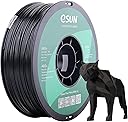



eSUN 1.75mm Black ABS+ 3D Printer Filament 1kg Spool (2.2lbs), Black
Product ID: 22004290
Details
- BrandeSUN
- MaterialAcrylonitrile
- ColorBlack
- Item Weight2.2 Pounds
- Item Diameter1.75
📏±0.05mm Accuracy
🔥220-260°C Temp
⚖️1.75mm Diameter
🖤 Print Boldly with eSUN's ABS+ Filament!
The eSUN 1.75mm Black ABS+ 3D Printer Filament is a high-quality, vacuum-sealed filament designed for optimal performance. With a net weight of 1kg (approximately 2.2 lbs) and a precise diameter of 1.75mm, it ensures dimensional accuracy of ±0.05mm. Recommended for extrusion temperatures between 220°C and 260°C, this filament is compatible with a variety of 3D printers, making it a versatile choice for both hobbyists and professionals.
| ASIN | B018F586ES |
| Additional Features | Less warp, High rigidity, Better layer bonding, Environmentally conscious (crafted from corn grain), Can be polished using acetone |
| Best Sellers Rank | #494,709 in Industrial & Scientific ( See Top 100 in Industrial & Scientific ) #4,013 in 3D Printing Filament |
| Brand | eSUN |
| Brand Name | eSUN |
| Color | Black |
| Customer Reviews | 4.3 out of 5 stars 362 Reviews |
| Item Diameter | 1.75 millimeters |
| Item Type Name | eSUN ABS+ filament, Black, 1 Count |
| Item Weight | 2.2 pounds |
| Manufacturer | ESUN |
| Manufacturer Part Number | ABS-PLUS175B1 |
| Material | Acrylonitrile Butadiene Styrene |
| Material Type | Acrylonitrile Butadiene Styrene |
| Model Number | ABS+175B1A |
| Number of Items | 1 |
| Number of Packs | 1 |
| Special Feature | Less warp, High rigidity, Better layer bonding, Environmentally conscious (crafted from corn grain), Can be polished using acetone Special Feature Less warp, High rigidity, Better layer bonding, Environmentally conscious (crafted from corn grain), Can be polished using acetone See more |
| UPC | 840249129021 |
| Unit Count | 35.27 Ounce |
M**N
Consistent, glossy LOWER print temp and BED temp or won't adhere layers!
Pros: Can be printed fast like abs and still have uniformity and strength. Glossy finish. Consistent printing once the temps are lowered. Cons: This stuff doesn't like to printed hot like ABS. Terrible layer adhesion be above 240C. Acetone does NOTHING to these prints, not even smoothing. However, the finish is nice and glossy similar to a PLA. Major warping above 85 degrees bed temp, major warping and shrinkage above 240 C extruder temp. I found success at 85C bed 235C extruder at about 50 mm/s perimeters, (70 mm/s infill etc.) My typical ABS is 250C nozzle and 103C Bed and prints a tiny bit faster. I print in an enclosure so ambient temperature around 42C. If acetone smoothing isn't your thing, this is a good choice black abs+.
D**E
Excellent ABS alternative
Great filament as an ABS alternative. The printing community knows that ABS holds up better for wear parts or parts that need to be resistant to heat or parts that need to flex more than PLA. We also know that ABS can be a royal pain to print with. This stuff is great! So far, I have had no issues with getting this ABS+ filament to stick to my bed. I am currently using a RepRap Prusa machine that I built. Printing on aluminum bed with a layer of blue painters tape on top. Printing the filament at 220 degrees and the bed is set to 90 degrees. Oh and the best part is I have no enclosure on my printer and using it in the basement which is at roughly 63 degrees F or 17 degrees for you celsius folks. Oh and no bed prep. I just make sure that the build plate is level and clean. Manual bed leveling too. No fancy stuff. So what am I trying to get at? I am trying to say that this filament, even though it is an ABS derivative, is extremely forgiving and easy to print with. I have yet to see any warp from it, even on larger prints, using the above settings. I will state that due to the relatively easy printing of this filament, that even smaller machines such as the Monoprice Maker Select Mini would have no problem printing it. This filament prints at a lower temperature than normal ABS and doesn't require the bed to heat as high either making it relatively easy to print on those smaller printers. The quality is great too. The filament diameter measures well within specifications for the company and for most prints. I consistently measured 1.72 to 1.725mm on this roll and the consistency is key. So even if the diameter is less than 1.75mm, as long as it is consistent, great prints will be achieved. To sum this review up, this filament is a quality alternative to regular and difficult to print with ABS. I highly recommend this to anyone in search of a more wear resistant plastic that doesn't have extremely expensive or fancy machines that can get up to the high heats of other plastics like polycarbonate.
B**4
Good Prints, But Not For Acetone Vapor Post-processing
The filament is of uniform quality and dimensions, which makes for a reliable print. The finish is not as glossy than some ABS, but depending on your need, that may or may not be important. If you are interested in acetone vapor bath for post print finishing, this does NOT work well with this material. It tends to get soft, but not melt on the exposed surface. The result is a part that sags, but doesn't smooth.
L**O
ABS sans warping?
As advertised, this filament warps significantly less than regular ABS. I have one particular part that is of necessity very tall and very thin and can only be printed in one orientation. Regular ABS, PETG, PC, ASA and more were all tried with varying degrees of success, but all warped to an unacceptable degree for a mass-produced part and adhesion became an issue as well because of the very small area in contact with the bed (despite all the usual tricks and a heated enclosure). ABS+ is so far the only material that suits this particular part (with the exception of Carbon Fiber PLA, which pushes up the unit cost and necessitates hardened steel nozzles with frequent changes). While there is still some warping, when the part is installed it is not noticeable. I would therefore recommend this filament to anyone who needs to use ABS but is having stubborn warping issues. As others have noted, it is significantly duller than regular ABS, but otherwise performs the same.
N**7
My Go-To Filament
This is my definitive go-to filament for all things that don't need to be flexible or translucent. I adore the look of PETG but constant problems with clogging and stripping have kept me away from it more often than not. This ABS Plus never jams or strips on me as long as I don't try to crush it to the bed on the first layer. I never have problems with layer adhesion as long as I print really hot. The definition is lovely, always looks great. Bed adhesion has never been too much of a problem for me with this until recently when I began printing fairly large, pistol grip style shells for an electronics project. Even then, it's always just one corner that starts to lift off the bed, so I've been working with it. I made a couple little mods to the printer config file and now I'm forcing the bed ridiculously hot, and it's working much better for me. My settings... maybe you'd better sit down for this... are: 260C extruder temp 125C bed temp 70mm/sec print speed 0.3mm Z offset 0.2mm or 0.3mm layer height, depends on how fast I need the print done My printer is a modified Robo 3D R1 Plus with a lexan enclosure all the way around, an exhaust fan feeding any fumes to the attic, and a 1/8" thick aluminum plate bed with a strong, large, 110VAC silicone heater run by a solid state relay controlled by the existing Robo hardware. It gets things done well but I do worry that the excessive bed and chamber heat will someday kill the printer, both structurally and electronically. In the summer I don't have as much trouble with warp, so I can come down to 115C or even 110C bed heat for this filament, as long as I keep the box closed and the print is less than several inches across at the first layers. I may be wrong about this, but I sort of feel like this black filament behaves better than the white. I need more time with both before I'm sure of that. I've printed quite a lot with this stuff, so when I have a chance, I'll put up a bunch of pictures of objects, some of which are pretty extreme for any FDM printer. I'll give you a good idea what's possible when you treat this stuff right. Oh, and I took away one star ONLY because of having to really push the bed and chamber temps so high to combat that little bit of warp. Other than that, the only nonperfect thing about this stuff is that it doesn't have that amazing, shimmery look of PETG, my arch nemesis. Edit: Oh, and my bed prep is 25% light Karo Corn Syrup in tap water. I pour about a tablespoon of it on the bed, warmed to say 40C, smear it around evenly, then when the bed goes full hot it forms a very shiny glaze like laquer. The extruded plastic is enough to melt the sugar to a goo, but the bed heat isn't, so it acts rather like plastic itself and it sticks to everything very well, keeping the print VERY bonded to the bed. I run my print at 100+C, and when it cools to about 60C the print pops and crackles like crazy till it breaks free at around 50C or just below. I mist the bed very lightly with water, smear the existing glaze around with my fingers, and it's ready for the next print. A single, relatively heavy sugar layer like this is good for many, many prints, as long as you wet and reglaze it between each. The underside of the prints will be slightly sticky, so a quick rinse is needed for cleanup. Brown sugar also works very well but I like the clear quality of corn syrup. Besides, repeated cookings slowly turn even the Karo mix brown over time. Brown sugar mixes become very dark as heating takes its toll, becoming almost black over time. NR417
J**R
Best ABS I own. But Important difference compared regular abs (much hotter)
I own a Flashforge Creator Pro. I mostly print in ABS with this machine about 220-230C. But this stuff needs 250-260C. Today I really wanted to print something in purple and the only stuff I had with this eSun ABS. In the past, I tried printing with it, had horrible results. Many calibration prints later and still could not figure this stuff out until I revisited this page to read the comments and saw most people where printing much hotter than I ever tried. -So, if you are reading these other bad reviews, I assure you it is simply because that user is not familiar with how to adjust their printer settings correctly and more importantly they don't use calibration prints. -Whenever you get a new brand of filament( sometimes even color of same brand) you need to at least do a temperature calibration print and a retraction calibration print after that. And if you are playing with a completely new material you should spend even more time doing all sorts of calibration prints(Flowrate Calibration). And of course, see what others are doing as well because my initial Temp calibration print only went up to 245C and I was about to write a bad review. I normally will spend 2-4 hours for calibration print time for each new filament and make some changes later on as I use it. Currently on my FFCP printer and S3D software. I'm printing this filament with these settings and hardware changes. -Glass bed with a layer of magigoo -Micro swiss, all metal hot end -0.4mm nozzle -Silicone sock on hotend block to keep the heat in and tested at 260C, 7mm/sec (higher than when I print) extrusion rate for 400mm and nozzle temp hovers around 258 and rock steady) -Drylin bushings for X and Y rails. -Enclosure Temp around (98-103F) (varies with bed temp and print temp) around 102 with these print settings. -Bed temp: 110 (not too important, adhesion is mostly based on what you are printing on) -First layer: 260C, then 255C. -No part cooling -Retraction: 1.2mm -Retraction speed: 20mm/s -Width: .48mm -Print speed of 45mm/s (I like printing slower, no need to rush perfection.) Many other settings of course but those are the main ones. Happy printing and remember, these are precision tools that require precision calibration.
J**A
Sucks
eSun pla+ is great , big fan from that perspective, so when I moved on to Abs I was sure I had to buy eSun again. Fist print was OK, nothing bad happened but as I kept going through adhesive problems and print quality I was sure it was something to do with my inexperience with abs. Lather I tried Polymaker ASA and had very successful prints, after that I moved on to their regular ABS and had pla quality results. Whent back to eSun Abs because I thought I had finally modified and tuned my printer for abs but was sad to see that the filament was a bust. I can honestly say I gave this abs a fair try and am definitely not a fan.
L**.
Looks amazing but breaks down over time
This filament is a great introduction to printing ABS and I initially loved it! Learning to print ABS can be a pretty daunting task and this is where the ABS+ filament shines. It is way more forgiving and easier to use than regular ABS, due to the additives that make it the "plus" version. First off, this may be one of the most visually attractive filaments I've ever used. The results came out absolutely perfect. The layer lines look so good and the black that I used had a beautiful finish in between matte and gloss. If it were not for the issues I experienced, I would probably switch over to this filament exclusively, it looks that nice. It goes down easy and I did not need the brims or support structures that other ABS filaments require. If this was my first ABS filament, I would have a hard time understanding all the fuss around printing ABS. It did not require very slow speeds and felt very similar to printing PLA, just at higher temperatures. My issues came in when using it for functional pieces. I switched over to ABS for parts that would be used in daily life, and for printer upgrades. Initially, parts come out very strong and stable, but after a couple of days, they would simply snap apart with almost no effort. This filament seems very sensitive to temperature changes and must break down because of them. I've come back to my printer to find broken parts and failed prints, simply because printer components that use this filament have inexplicably broken. With the 1/3 spool I have left I will probably use it to make things that will only be visual pieces. In the future I'll use regular ABS filament for functional parts.
O**N
Leider nicht die versprochenden 1.5kg in auf der SPule
Geliefert wurde ein in Plastikfolie verpackte halb gefüllte Spule. Es war keine Vakuumverpackung und nur 800g (inkl. Spule) statt 1.5kg. Das ist sehr Grenzwertig. Amazon hat immerhin 50% Rückerstattet.
A**.
La descrizione non corrisponde con l'articolo venduto
Nella descrizione si fa riferimento a 1.55Kg: eSUN ABSPlus Filamento, Nero, 1,55 kg L'articolo però arriva in una una bobina da 1Kg e non 1.55.
P**R
Issues with print quality
I didn’t have great results. To be fair, it’s my first time printing ABS and using a new slicer on a new 3D printer. I didn’t encounter bed adhesion issues, but most of my prints had layer separation problems. I managed to get decent results after slowing down the print speed and drying the filament for a few days
A**R
Printable
Vett er y good
P**R
1kg statt 1,55 zum Preis von 1,55
Laut Hersteller gibt es davon überhaupt keine 1,55kg. Diese werden hier aber zum Preis von 1,55 kg verkauft, erhalten habe ich jedoch nur 1kg. Das ging dann natürlich wieder zurück
Trustpilot
2 weeks ago
1 month ago