Desertcart purchases this item on your behalf and handles shipping, customs, and support to Cyprus.
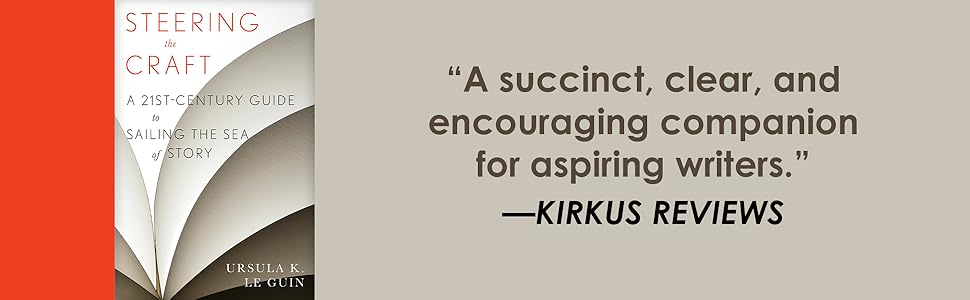
From the celebrated Ursula K. Le Guin, "a writer of enormous intelligence and wit, a master storyteller" ( Boston Globe ), the revised and updated edition of her classic guide to the essentials of a writer's craft. Completely revised and rewritten to address modern challenges and opportunities, this essential creative writing handbook is a short, deceptively simple guide to the craft of writing. Le Guin lays out ten chapters that address the most fundamental components of narrative writing, from the sound of language to sentence construction to point of view. Each chapter combines illustrative examples from the global canon with Le Guin’s own witty commentary and an exercise that the writer can do solo or in a group. She also offers a comprehensive guide to working in writing groups, both actual and online. Masterly and concise, Steering the Craft deserves a place on every writer's shelf. This celebrated guide to the art of storytelling focuses on the essentials: The Elements of Craft: Ten focused chapters on the essential tools of narrative, from the music of language and sentence construction to the strategic use of adjectives and adverbs. Point of View and Voice: A masterclass in choosing and maintaining a point of view, with witty commentary and clear examples that demystify narrative voice. Practical Writing Exercises: Engaging exercises at the end of each chapter, designed to sharpen your skills whether you work alone or with a group. Guidance for Writing Groups: An invaluable guide to participating in―and benefiting from―peer group workshops, both in-person and online. Review: A Banger - Not everyone who can do, can teach what they do, but Ursula K. Le Guin is excellent at writing, and excellent at teaching how to write. This book is full of practical advice, examples, and exercises. So much of writing advice these days centers on plot and conflict, how to make your writing more exciting, more attention grabbing. As a commercial fiction writer, I appreciate that type of advice. But this is different. Ursula Le Guin teaches you how to write a story, the story you want to write, the story that is waiting for you to write it. But the majority of this book focuses on very practical things: pacing, POV, tense, word choice. I went ahead and bought a physical copy of it as well after getting the digital version, which is not something I do for a lot of books these days with my limited shelf space. It's a treasure I will refer to for the years to come. My respects to the GOAT, wish she were still around. Review: Sailing the Sea of Story with an Expert Navigator - “Craft enables art” Ursula K. Le Guinn tells us in the introduction to her ‘Steering the Craft: A 21st-Century Guide to Sailing the Sea of Story’. “There’s luck in art. And there’s the gift. You can’t earn that. But you can learn skill ... You can learn to deserve your gift.” Overflowing with valuable insight and inspiration, 'Steering the Craft' is among the best single-volume works on writing I’ve ever read—and I’ve read a lot of them over the decades, positively devouring anything I can get my hands on. If Stephen King’s wonderful ‘On Writing’ is a helpful and encouraging introduction to the subject—call it Writing 101—Le Guinn offers a more advanced and rigorously focused 200-level course that will be most helpful to those already-experienced writers in search of self-improvement and a more acute understanding of how story works. There is a difference, Le Guinn tells us, between the kind of straightforward expository prose we all learned to write in school, and the language of effective fiction—a distinction far too many aspiring storytellers have yet to grasp. The important thing for a writer, she says, “…is to know what you’re doing with your language and why.” She then proceeds to enlighten us in the most pleasing of ways, gently but firmly, never dogmatic, often with humor, stressing fundamentals without coming off as a snob or a “correctness bully”. “To break a rule you have to know the rule,” she says. “A blunder is not a revolution.” Le Guinn challenges received and conventional wisdom at every turn. For instance, where Stephen King tells us that “the road to hell is paved with adverbs,” Le Guinn gently insists that adjectives and adverbs “add color, life, and immediacy … They cause obesity in prose only when used lazily or overused.” And again, she points out, “It’s a myth that short-sentence prose is ‘more like the way we speak’ … The marvelously supple connections of complex syntax are like the muscles and sinews of a long-distance runner’s body, ready to set up a good pace and keep going.” And there were so many more wonderful, refreshing observations throughout the book, I found myself obsessively marking and underlining to a point where my copy could never be resold—not that I would ever part with it! I very much appreciate the way Le Guinn draws parallels between music and prose, stressing the essential importance of rhythm and the physical sound of language: “The similarity of … incremental repetition of word, phrase, image, and event in prose to recapitulation and development in musical structure is real and deep.” Elsewhere, punctuation is brilliantly demystified as it is likened to the use of rests in a musical score. The volume is designed as a workbook, and includes a number of skill-enhancing exercises, with copious examples of the various concepts discussed, drawn from classic works from the Brontë sisters to Dickens, Hardy and Virginia Wolfe, always with fascinating, trenchant commentary from Le Guinn. ‘Steering the Craft’ is a treasure! Enthusiastically recommended.


| Best Sellers Rank | #10,641 in Books ( See Top 100 in Books ) #7 in Fiction Writing Reference (Books) #10 in Literary History & Criticism Reference #11 in General Books & Reading |
| Customer Reviews | 4.7 out of 5 stars 1,022 Reviews |
N**E
A Banger
Not everyone who can do, can teach what they do, but Ursula K. Le Guin is excellent at writing, and excellent at teaching how to write. This book is full of practical advice, examples, and exercises. So much of writing advice these days centers on plot and conflict, how to make your writing more exciting, more attention grabbing. As a commercial fiction writer, I appreciate that type of advice. But this is different. Ursula Le Guin teaches you how to write a story, the story you want to write, the story that is waiting for you to write it. But the majority of this book focuses on very practical things: pacing, POV, tense, word choice. I went ahead and bought a physical copy of it as well after getting the digital version, which is not something I do for a lot of books these days with my limited shelf space. It's a treasure I will refer to for the years to come. My respects to the GOAT, wish she were still around.
T**W
Sailing the Sea of Story with an Expert Navigator
“Craft enables art” Ursula K. Le Guinn tells us in the introduction to her ‘Steering the Craft: A 21st-Century Guide to Sailing the Sea of Story’. “There’s luck in art. And there’s the gift. You can’t earn that. But you can learn skill ... You can learn to deserve your gift.” Overflowing with valuable insight and inspiration, 'Steering the Craft' is among the best single-volume works on writing I’ve ever read—and I’ve read a lot of them over the decades, positively devouring anything I can get my hands on. If Stephen King’s wonderful ‘On Writing’ is a helpful and encouraging introduction to the subject—call it Writing 101—Le Guinn offers a more advanced and rigorously focused 200-level course that will be most helpful to those already-experienced writers in search of self-improvement and a more acute understanding of how story works. There is a difference, Le Guinn tells us, between the kind of straightforward expository prose we all learned to write in school, and the language of effective fiction—a distinction far too many aspiring storytellers have yet to grasp. The important thing for a writer, she says, “…is to know what you’re doing with your language and why.” She then proceeds to enlighten us in the most pleasing of ways, gently but firmly, never dogmatic, often with humor, stressing fundamentals without coming off as a snob or a “correctness bully”. “To break a rule you have to know the rule,” she says. “A blunder is not a revolution.” Le Guinn challenges received and conventional wisdom at every turn. For instance, where Stephen King tells us that “the road to hell is paved with adverbs,” Le Guinn gently insists that adjectives and adverbs “add color, life, and immediacy … They cause obesity in prose only when used lazily or overused.” And again, she points out, “It’s a myth that short-sentence prose is ‘more like the way we speak’ … The marvelously supple connections of complex syntax are like the muscles and sinews of a long-distance runner’s body, ready to set up a good pace and keep going.” And there were so many more wonderful, refreshing observations throughout the book, I found myself obsessively marking and underlining to a point where my copy could never be resold—not that I would ever part with it! I very much appreciate the way Le Guinn draws parallels between music and prose, stressing the essential importance of rhythm and the physical sound of language: “The similarity of … incremental repetition of word, phrase, image, and event in prose to recapitulation and development in musical structure is real and deep.” Elsewhere, punctuation is brilliantly demystified as it is likened to the use of rests in a musical score. The volume is designed as a workbook, and includes a number of skill-enhancing exercises, with copious examples of the various concepts discussed, drawn from classic works from the Brontë sisters to Dickens, Hardy and Virginia Wolfe, always with fascinating, trenchant commentary from Le Guinn. ‘Steering the Craft’ is a treasure! Enthusiastically recommended.
P**A
Calisthenics for writers
There is a certain kind of aspiring writer who will do everything to master their craft except the one thing that really matters -- writing. Unsurprisingly, most writing guides ask as little of the reader as possible. They are full of inspiration, encouragement, and even wacky exercises to stimulate creativity. But they don't demand that you sit down and use your keyboard or pen. This book is not for them; it's for people who want to become better writers by writing. Each of the short chapters follows a formula: a new concept is introduced, a few excerpts from great writers are used to illustrate the concept, and then it's on to writing exercises. These are short (generally a paragraph to a page), and less stories than building blocks of scenes. The reader is asked to write scenes using only dialogue, or cross-cut between different timelines as a character remembers something. LeGuin recommends that you write quickly, take a day to cool off, then revise until it's polished. This is not a publishing guide, and it's not about creativity or writer's block per se. It's focused narrowly on practicing the fundamentals. I think it'll be useful for a writer at any point on their journey, just as anyone from couch potato to pro athlete benefits from a stretching or calisthenics routine. The rewards are proportional to the effort you're willing to put in. Reading this book does't *feel* as good as some fluff about how everyone is already an artist, but it is more likely to help your writing. And "reading" is the wrong word anyway, because most of your time with this book will be spent practicing. I suspect the rewards would be even greater if used as part of a group with peer critique, but I found it valuable as a solo exercise too, as long as I stayed diligent.
P**S
Excellent ... with some exceptions
This is an excellent book and has exercises that are worthwhile for writers to work through, so they are more aware of some of the choices to be made in writing. It’s an improvement over the first edition … … except for the mostly new Chapter 6. Contrary to what LeGuin claims, screenplays are NOT written in the imperative and are NOT instructions to actors and cameramen; they ARE story descriptions that are written in the present tense. And the example LeGuin gives of tense-switching is NOT “incoherence”, but a perfectly valid choice for some kinds of narration. Aside from that, there is good advice here.
L**E
Great for writers!
Steering the Craft: A Twenty-First-Century Guide to Sailing the Sea of Story by Ursula K. Le Guin is a fantastic book, but don't read it thinking it will teach you how to write a novel. Instead, read Write and Revise for Publication by Jack Smith to learn how to take an idea from an outline to a novel. Then, when you finish with that, buy this book, Steering the Craft. In Steering the Craft, Ursula Le Guin talks about all the things that make good prose such as the sound of the language, rhythm, descriptions, story verse plot. She brings up all the rules we have heard over and over again such as: show don't tell; write in active voice, not the passive voice; don't use "be" verbs; and more -- and then tells you how to break them. She talks about grammar only to explain how not to be afraid of the semicolon or comas. She slices through so much of the bad advice I see over and over again online with an effortless logic that had me laughing at the truth of her statements. This is not a humorous book, but I tend to laugh at things gives me relief. Writing as contortionist around such arbitrary rules is tough! This book gives you the license and freedom to use all the tools the English language provides without fear or guilt. This book is orchestrated in such a way that it could be used in a writing group. Every chapter has exercises at the end to help you explore and learn the concepts by doing them. I am not a great team player, but I can see these activities would be beneficial for me to do on my own. I intend to go back and do them. This book makes a lot of sense once you are already writing and discover that something just doesn't sparkle. It is specifically for fiction writers and covers a lot of the vague frustrations of crafting elegant sentences, paragraphs, and chapters. I honestly would understand how vital her advice in this book was before I started writing. It is like learning to paint or play an instrument; certain lessons on make sense after you have been doing it some. So if you are a writer, I highly recommend this book!
C**C
Steering the Craft
This book is a great read for any writer attempting to better their writing. The exercises and advice are wonderful for a writer to hone their variety of skills in the art of writing.
E**E
Cleared my writers block
This book is amazing. Within the first few chapters it completely cleared a week's worth of writers block for me and helped me realize exactly what the problem stopping up my story was.
A**.
Mildly ueful
I lowered my expectations four lines into the intro when it said, “Fifteen or more years ago.” After that, the thin volume offers advice that is taught in high school English classes.
M**R
hilfreicher Ratgeber
Dieser Ratgeber verzichtet auf schnelle Lösungen und Formeln und ist daher vor allem für fortgeschrittene Autoren hilfreich. Am besten fand ich die Erklärung des Unterschiedes zwischen Story und Plot.
R**R
Nice little book
Great book, though not large.
D**H
A masterclass in writing, beautifully written.
Wonderful book. If you want to take your writing to the level of greatness, this text will help you to do so. Le Guin is as eloquent in this masterclass as she is in her fiction, which is saying a great deal. The book also arrived quickly.
A**L
Best for Fantasy authors
Relly helpfull
M**N
Un maitre de fiction
Ursula K. Le Guin est une des plus grandes écrivaines de 20ème siècle, alors ses mots sur la fiction ne sont pas une perte de temps.
Trustpilot
2 months ago
2 months ago