
Buy anything from 5,000+ international stores. One checkout price. No surprise fees. Join 2M+ shoppers on Desertcart.
Desertcart purchases this item on your behalf and handles shipping, customs, and support to Cyprus.
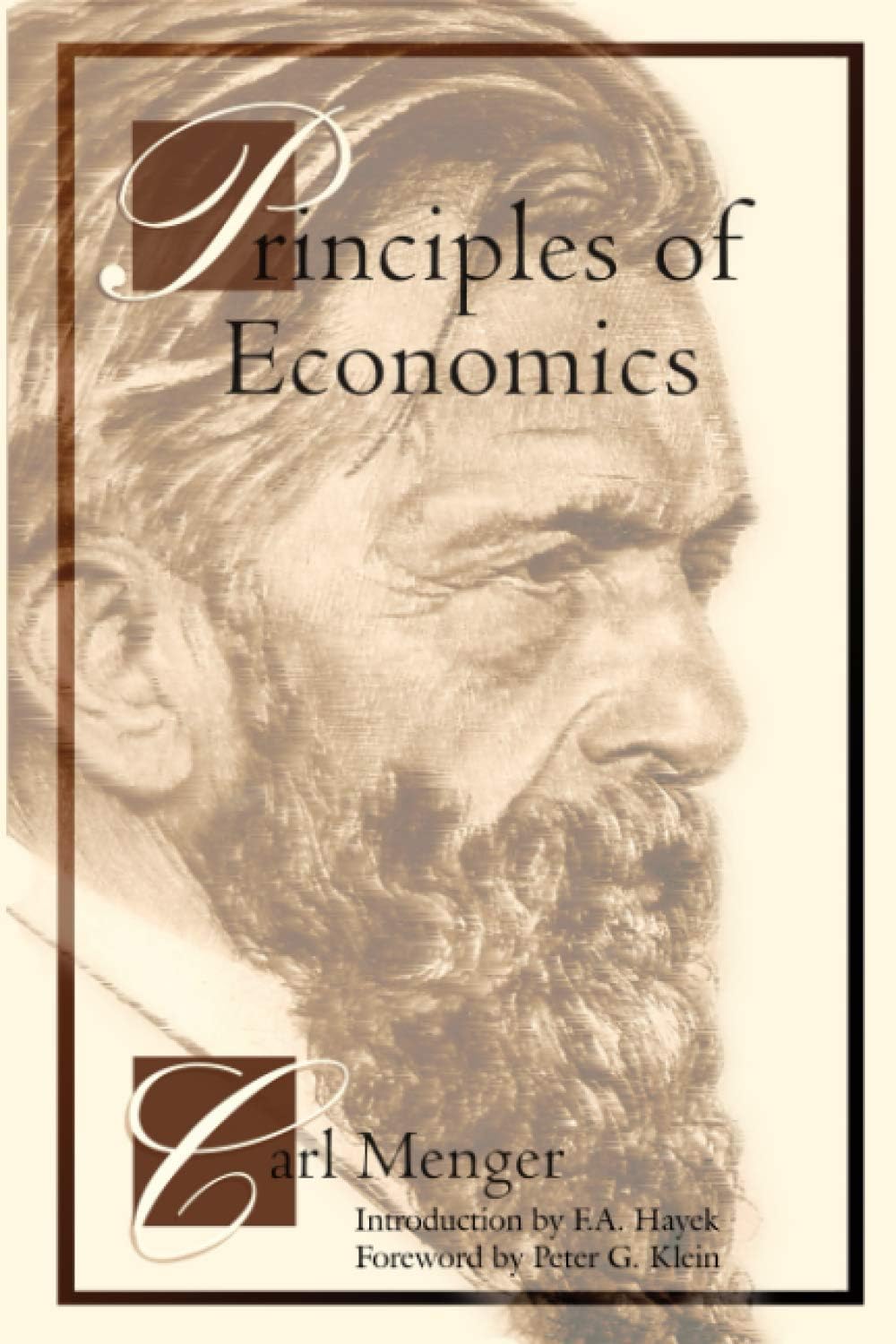
In the beginning, there was Menger. It was his Principles of Economics that reformulated — and really rescued — economic science from the theoretical errors of the old classical school.Menger set out to elucidate the precise nature of economic value, and to root economics firmly in the real-world actions of individual human beings. In Principles of Economics, he advances the theory that the marginal utility of goods is the source of their value, rather than the labor inputs that went into making them. The implication of this theory is that the individual mind is the source of economic value — a point that touched off the marginalist revolution and started a departure from the flawed classical view of economics.For this reason, Carl Menger (1840–1921) is considered to be the founder of the Austrian School of economics. Principles of Economics is the book that Ludwig von Mises said turned him into a real economist. What's striking is how, nearly a century and a half later, the book still retains the incredible power of both its prose and its relentless logic.The Mises Institute's new edition features a new foreword by Peter G. Klein, which summarizes Menger's contribution and places him in the history of ideas. Klein also explains Menger's continued relevance in present times. F.A. Hayek contributes the introduction.Economics students still say that it is the best introduction to economic logic ever written. The book also deserves the status of a seminal contribution to science in general. Truly, no one can claim to be well read in economics without having mastered Menger's argument.To search for Mises Institute titles, enter a keyword and LvMI (short for Ludwig von Mises Institute); e.g., Depression LvMI Review: Must Read - Great book! A breakdown of economics in a way that is clear and concise without complex calculations and applies to this very day across all nations. Review: Before Rothbard, Hayek and Von Mises- There was Menger - If you are a student of Austrian School Economics this work represents a priceless history that reaches back to its beginnings. A number of facts emerge out of this work that might surprise you not the least of which is the Austrian School of Economics is the direct result of the German Intellectual Tradition. Menger was steeped in a Germanic rationalism as characterized by Hegel who posited History itself being an expression of the world spirit whose goal, humanly speaking, would be the bringing about of the fullest expression of the highest state of reason. This work was published in 1871 and was translated in only a handful of languages – all European. The English-speaking world was wholly ignorant of Menger’s “Principles of Economics”. In the “Principles of Economics” a fully working out of the bedrock concept of “Marginal Utility” is tediously delineated. But a curious fact is Menger never used the term “Marginal Utility”. The honor of coining the term “Marginal Utility” goes to a contemporary. What is evident however from a careful reading of Menger’s “Principles of Economics” is the undeniable fact that he built the logical systematic framework that establishes the foundational Austrian School concept that value is always subjective, hierarchical in nature (individuals value some goods above other goods), and goods that are valued by the individual are valued because they satisfy that individual’s needs- the very structural underpinning for the concept of “Marginal Utility”. In chapter 4 , “Theory of Exchange”, Menger broadens the theoretical concept of “Marginal Utility” logically into the wider social system of human economic interaction. What we know as the Free Market. Human civilization for millennia was grounded in the organic self-assembling of economic interactions by and between “Economizing Individuals” operating in a world of scarcity. Starting with isolated individuals but quickly expanding to large networks of individuals all vying for goods and services to meet their individual needs: This is the motive force for development of Individual Specialization or what is commonly called Division of Labor. Ultimately Menger makes it abundantly clear that Trade is the business of Free Men. What is important to note is that much of what is presented in chapter 4 was mirrored decades later in Rothbard’s Magnum Opus “Man, Economy, and State” (see chapter 1 Fundamentals of Human Action). This work was published in 1962, 91 years after Menger published “Principles of Economics” (1871). Rothbard wrote “Man Economy and State” within the context of an expanded understanding of economic history (particularly modern economic history). It was this updating and elaboration of Menger’s work that is Rothbard’s genuine contribution to the science of economics but not the original concept(s). These concepts in particular “Marginal Utility” were all Menger’s. In Chapter 5, “Theory of Price”, Menger meticulously establishes Price Formation as the outcome of a competitive market consisting of multiple economic players, again, vying for goods or services. Starting with a monopoly producer of a good or service he later extends the analysis to include multiple producers offering a good or service to the free market. Here Menger establishes a controversial but very Austrian School concept. Monopolies according to Menger are not Evil, although completely self-serving, but are the natural outcome of Economizing Individuals or Entities attempting to maximize value. Maximizing Value is the keystone. When any Economic player attempts to maximize value it ultimately redounds to the benefit of the entire economic eco-system. Why? According to Menger monopolies are incapable of maintaining hegemony as they are inherently fragile and in the long run spur competition or alternatives. Further in Chapter 5 the author delves into the historical evolution of money itself. The takeaway: Menger establishes the bare fact that money emerged organically out of the need for free men to establish a means to facilitate exchange between multiple market players offering a variety of economic goods. Money made it happen. Over time a concensus evolved around metallic money. Starting with copper, incorporating silver than ultimately gold. Here Menger touches on the history of standardization & coinage and the overlay of government involvement to these ends. The point not to be missed is first and foremost money was not a creation of the State. True money is 1) an invention of free men and as Aristotle pointed out 2) a unit of account and 3) a store of value. And without true money free men will face challenges in meeting their individual needs thru trade in a free market. This may be of particular import in the current historical era characterized by government sponsored fiat and electronic digitalized currency. 151 years after the publishing of Menger’s “Principles of Economics” these three principles stand as pillars of Austrian School Economics.
| Best Sellers Rank | #168,870 in Books ( See Top 100 in Books ) #133 in Theory of Economics |
| Customer Reviews | 4.8 out of 5 stars 273 Reviews |
R**N
Must Read
Great book! A breakdown of economics in a way that is clear and concise without complex calculations and applies to this very day across all nations.
C**R
Before Rothbard, Hayek and Von Mises- There was Menger
If you are a student of Austrian School Economics this work represents a priceless history that reaches back to its beginnings. A number of facts emerge out of this work that might surprise you not the least of which is the Austrian School of Economics is the direct result of the German Intellectual Tradition. Menger was steeped in a Germanic rationalism as characterized by Hegel who posited History itself being an expression of the world spirit whose goal, humanly speaking, would be the bringing about of the fullest expression of the highest state of reason. This work was published in 1871 and was translated in only a handful of languages – all European. The English-speaking world was wholly ignorant of Menger’s “Principles of Economics”. In the “Principles of Economics” a fully working out of the bedrock concept of “Marginal Utility” is tediously delineated. But a curious fact is Menger never used the term “Marginal Utility”. The honor of coining the term “Marginal Utility” goes to a contemporary. What is evident however from a careful reading of Menger’s “Principles of Economics” is the undeniable fact that he built the logical systematic framework that establishes the foundational Austrian School concept that value is always subjective, hierarchical in nature (individuals value some goods above other goods), and goods that are valued by the individual are valued because they satisfy that individual’s needs- the very structural underpinning for the concept of “Marginal Utility”. In chapter 4 , “Theory of Exchange”, Menger broadens the theoretical concept of “Marginal Utility” logically into the wider social system of human economic interaction. What we know as the Free Market. Human civilization for millennia was grounded in the organic self-assembling of economic interactions by and between “Economizing Individuals” operating in a world of scarcity. Starting with isolated individuals but quickly expanding to large networks of individuals all vying for goods and services to meet their individual needs: This is the motive force for development of Individual Specialization or what is commonly called Division of Labor. Ultimately Menger makes it abundantly clear that Trade is the business of Free Men. What is important to note is that much of what is presented in chapter 4 was mirrored decades later in Rothbard’s Magnum Opus “Man, Economy, and State” (see chapter 1 Fundamentals of Human Action). This work was published in 1962, 91 years after Menger published “Principles of Economics” (1871). Rothbard wrote “Man Economy and State” within the context of an expanded understanding of economic history (particularly modern economic history). It was this updating and elaboration of Menger’s work that is Rothbard’s genuine contribution to the science of economics but not the original concept(s). These concepts in particular “Marginal Utility” were all Menger’s. In Chapter 5, “Theory of Price”, Menger meticulously establishes Price Formation as the outcome of a competitive market consisting of multiple economic players, again, vying for goods or services. Starting with a monopoly producer of a good or service he later extends the analysis to include multiple producers offering a good or service to the free market. Here Menger establishes a controversial but very Austrian School concept. Monopolies according to Menger are not Evil, although completely self-serving, but are the natural outcome of Economizing Individuals or Entities attempting to maximize value. Maximizing Value is the keystone. When any Economic player attempts to maximize value it ultimately redounds to the benefit of the entire economic eco-system. Why? According to Menger monopolies are incapable of maintaining hegemony as they are inherently fragile and in the long run spur competition or alternatives. Further in Chapter 5 the author delves into the historical evolution of money itself. The takeaway: Menger establishes the bare fact that money emerged organically out of the need for free men to establish a means to facilitate exchange between multiple market players offering a variety of economic goods. Money made it happen. Over time a concensus evolved around metallic money. Starting with copper, incorporating silver than ultimately gold. Here Menger touches on the history of standardization & coinage and the overlay of government involvement to these ends. The point not to be missed is first and foremost money was not a creation of the State. True money is 1) an invention of free men and as Aristotle pointed out 2) a unit of account and 3) a store of value. And without true money free men will face challenges in meeting their individual needs thru trade in a free market. This may be of particular import in the current historical era characterized by government sponsored fiat and electronic digitalized currency. 151 years after the publishing of Menger’s “Principles of Economics” these three principles stand as pillars of Austrian School Economics.
C**E
Better Than Expected
The book was used and described as in Good Condition. However, I found the book to be closer to Excellent Condition. It came in a simple plastic bag type mailer. But it survived the trip to the State of Hawaii (often called the most remote place on earth) with no damage.
F**F
Clear and correct.
The book explains the basis of what it is: a human being.
T**N
Good product
If you're looking for history of economics this is a good book. It's a slog to read (for me anyway). This theory has fallen by the wayside but it shows the foundation of the discipline of this topic.
J**P
Read this book if you are a student of economics, if not, it may not be helpful
This reads much like a textbook and is difficult to read and sometimes not easy to understand. It is technical. It is highly recommended from major players in the field of Austrian economics. That being said, I doubt I will ever read it again. It may be better suited for professional economists. Menger lived from 1840 to 1921 and founded the Austrian school of economics. All economists have rejected his view that all things are subject to cause and effect, except the Austrian school. His students include Ludwig von Mises and F.A. Hayek. His discussion is in depth and he uses minute details. Bohm-Bawerk and Wieser were his first and most enthusiastic disciples. He had written disputes with other economists. I recommend this book for students of economics. In my case it wasn't helpful and wasn't what I thought it would be. On the other hand, Hayek's "The Road To Serfdom" was very beneficial.
S**M
And then somebody tops your theory!
Carl Menger is the founder of the Austrian School.More telling is how the reaction of the German Historical School resulted in hostility from the Austrians.Gustav Schmoller refused to even read and review one of his works.He claimed he sent it back to him before he could read it.Schmoller went further than that.People that agreed with Menger were refused the credentials to teach it in school.Probably a sore loser. That being said,it is worth noting that Carl Menger,for many years taught Economics.This is what he taught.This book is divided into eight sections: 1)The General Theory of the Good 2)Economy and Economic Goods 3)The Theory of Value 4)The Theory of Exchange Catalactics to von Mises. 5)The Theory of Price 6)Use Value and Exchange Value The average concrete need unit is the general expression for objective use value. 7)The Theory of the Commodity 8)The Theory of Money Starting with Menger and carried on with people like von Mises,the Austrians were searching for knowledge beyond economics.They knew economics would pertain to selfish interests.Thus Schmoller's reaction to the Austrians was really no surprise.By the time of Menger's death in 1921,the powers that be in those days were gone.Sadly,this is pretty much all we get from Menger.Sure,he testified in front of the Currency Commission;but he wanted to put more of his academic work in print.This would not be.Nowadays,we would get his lectures on computer or video.He was really that student friendly.
B**D
Superb Introduction to economic value and price
One hundred and fifty years after it was written, this book still excels at explaining economic value and price formation. The author takes extraordinary care in explaining why some things have economic value and others do not, and how prices emerge.
O**R
Could be better
small print and very large margins
A**O
Buen libro para todo economista.
Es un buen libro pero el padre de la Escuela Austriaca de Economía (los terraplanistas de la economía) hace un análisis muy general de lo que es la economía política y de su época. Pero no deja de ser un autor obligado a leer.
Y**N
Fondamentale
Basé sur d’anciennes théorie mais reste tres intéressant pour comprendre les fondamentaux
A**R
Great book by a Great Man
Good print by the publisher, with helpful notes by translators. After reading "Economics in one lesson" by Henry Hazelit, this is your next step to understand Economics.
J**S
Great product
Great product
Trustpilot
2 weeks ago
1 month ago