
Desertcart purchases this item on your behalf and handles shipping, customs, and support to Cyprus.
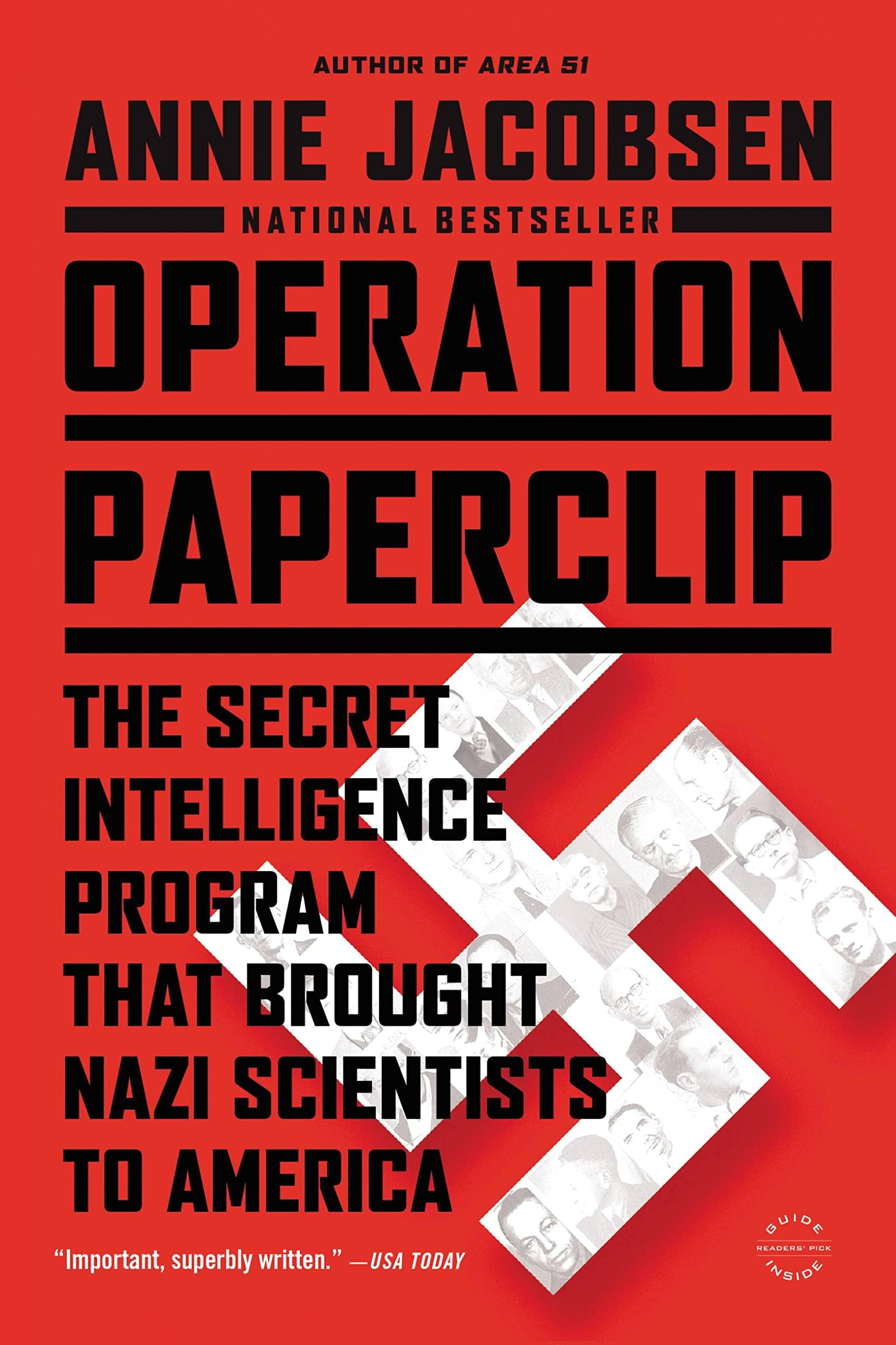
The fascinating story of America's secret post-WWII science programs, from the New York Times bestselling author of Area 51 and Biological War . “This book is a remarkable achievement of investigative reporting and historical writing.” ― Boston Globe In the chaos following World War II, the U.S. government faced many difficult decisions, including what to do with the Third Reich's scientific minds. These were the brains behind the Nazis’ once-indomitable war machine. So began Operation Paperclip, a decades-long, covert project to bring Hitler’s scientists and their families to the United States. Many of these men were accused of war crimes, and others had stood trial at Nuremberg; one was convicted of mass murder and slavery. They were also directly responsible for major advances in rocketry, medical treatments, and the U.S. space program. Was Operation Paperclip a moral outrage, or did it help America win the Cold War? Drawing on exclusive interviews with dozens of Paperclip family members, colleagues, and interrogators, and with access to German archival documents (including previously unseen papers made available by direct descendants of the Third Reich’s ranking members), files obtained through the Freedom of Information Act, and dossiers discovered in government archives and at Harvard University, Annie Jacobsen follows more than a dozen German scientists through their postwar lives and into a startling, complex, nefarious, and jealously guarded government secret of the twentieth century. In this definitive, controversial look at one of America's most strategic―and disturbing―government programs, Jacobsen shows just how dark government can get in the name of national security. “Harrowing ... How Dr. Strangelove came to America and thrived, told in graphic detail.” ― Kirkus Reviews ★ “Highly recommended for readers in World War II history, espionage, government cover-ups, or the Cold War.” ― Library Journal (starred review) ★ “An engrossing and deeply disturbing exposé that poses ultimate questions of means versus ends.” ― Booklist (starred review) “Darkly picaresque.” ― The New Yorker “The most in-depth account yet of the lives of Paperclip recruits and their American counterparts.” ― New York Times Book Review “Important, superbly written.” ― USA Today Review: Good read. - Annie Jacobsen lays it all out. A disgusting story, really. But one all Americans should know. Review: View Into a Rapidly Spinning Moral Compass - In World War II, Germany waged some of the most technically advanced warfare ever witnessed. They leveraged advances in aerodynamics, rocketry, chemicals and medicine to rain destruction and terror on their enemies. As the war ended, the fate of the scientists and engineers who created these innovations were of major interest to the victorious allied forces. There was, however, a huge problem with these Nazi scientists: Many were significant war criminals, some personally responsible for committing atrocious crimes during the conflict. In the war’s aftermath, the US was left with a dilemma: Should they take advantage of the scientist’s expertise? Prosecute them for their crimes? Or risk having them captured by the Soviets, just as the Cold War was beginning? Author Annie Jacobsen chronicles the rapidly spinning moral compass the US faced dealing with the fate of the German experts. Using a wide range of documents (including some only recently de-classified for this book) she traces the stories of many notable scientists, and the “Operation Paperclip” the US set up to sanitize their Nazi past. Wernher von Braun, for example, is known to most Americans as the heroic NASA designer who designed the Saturn-V rocket carrying astronauts to the moon. But in WWII, his V-2 missiles killed thousands of civilians in England and northern Europe. The underground factory constructing these missiles worked thousands more concentration camp prisoners to their deaths. This book traces the frantic search for the scientists and their work as WWII wound down, then the bureaucratic push and pull as various agencies struggled with the scientists fates as well as prosecuting others for war crimes. Finally, she traces the ultimate fate of some of the scientists. Some had prosperous new lives as successful engineers and businessmen. Others ultimately died in disgrace as their Nazi past caught up to them. The book is an important chapter of post-war history just now coming to light.


| Best Sellers Rank | #14,865 in Books ( See Top 100 in Books ) #2 in Scientific Experiments & Projects #4 in Conventional Weapons & Warfare History (Books) #6 in History & Philosophy of Science (Books) |
| Customer Reviews | 4.7 out of 5 stars 3,562 Reviews |
P**R
Good read.
Annie Jacobsen lays it all out. A disgusting story, really. But one all Americans should know.
O**T
View Into a Rapidly Spinning Moral Compass
In World War II, Germany waged some of the most technically advanced warfare ever witnessed. They leveraged advances in aerodynamics, rocketry, chemicals and medicine to rain destruction and terror on their enemies. As the war ended, the fate of the scientists and engineers who created these innovations were of major interest to the victorious allied forces. There was, however, a huge problem with these Nazi scientists: Many were significant war criminals, some personally responsible for committing atrocious crimes during the conflict. In the war’s aftermath, the US was left with a dilemma: Should they take advantage of the scientist’s expertise? Prosecute them for their crimes? Or risk having them captured by the Soviets, just as the Cold War was beginning? Author Annie Jacobsen chronicles the rapidly spinning moral compass the US faced dealing with the fate of the German experts. Using a wide range of documents (including some only recently de-classified for this book) she traces the stories of many notable scientists, and the “Operation Paperclip” the US set up to sanitize their Nazi past. Wernher von Braun, for example, is known to most Americans as the heroic NASA designer who designed the Saturn-V rocket carrying astronauts to the moon. But in WWII, his V-2 missiles killed thousands of civilians in England and northern Europe. The underground factory constructing these missiles worked thousands more concentration camp prisoners to their deaths. This book traces the frantic search for the scientists and their work as WWII wound down, then the bureaucratic push and pull as various agencies struggled with the scientists fates as well as prosecuting others for war crimes. Finally, she traces the ultimate fate of some of the scientists. Some had prosperous new lives as successful engineers and businessmen. Others ultimately died in disgrace as their Nazi past caught up to them. The book is an important chapter of post-war history just now coming to light.
J**H
An Intriguing Dive Into History
I was first introduced to Annie Jacobsen on Joe Rogan's podcast, and I have been intrigued by her work ever since.Annie Jacobsen's "Operation Paperclip" is a captivating and meticulously researched exploration into one of the most enigmatic chapters of post-World War II history. In this compelling book, Jacobsen delves deep into the covert operation that brought German scientists, engineers, and technicians to the United States after the war, shedding light on the complex moral and ethical dilemmas faced by the U.S. government in the pursuit of scientific advancement. One of the standout features of "Operation Paperclip" is Jacobsen's ability to weave together a gripping narrative while maintaining academic rigor. She presents a wealth of archival material and firsthand accounts, allowing readers to truly grasp the magnitude and implications of this secretive mission. From the early days of the program to its lasting impact on American scientific achievements, Jacobsen leaves no stone unturned. What sets this book apart is Jacobsen's balanced approach. She skillfully navigates the gray areas of history, presenting the motivations behind Operation Paperclip without shying away from its controversial aspects. Readers are encouraged to ponder the ethical implications of recruiting former Nazi scientists, a topic that remains relevant and thought-provoking. Furthermore, Jacobsen's writing style is both accessible and engaging, making this complex historical account a page-turner. Whether you're a history buff or simply intrigued by the intersection of science and politics, "Operation Paperclip" offers a comprehensive and insightful examination. Operation Paperclip is a must-read for anyone interested in the untold stories of post-World War II America. It is a testament to her skill as a writer and researcher, offering a nuanced perspective on a controversial yet pivotal moment in history. This book not only educates but also challenges readers to consider the complexities of the past, leaving a lasting impact long after the final page.
M**S
Great savings!
The book is in excellent conditions and better than expected,thank you.
L**A
Extraordinary detailed and well written
I had difficulty reading this book because I am Jewish and I could not reconcile American’s government complicity in shielding nazis who committed crimes against humanity. But it was a different era of “red scare” and Joe McCarthy.
A**Z
Great and Disturbing Book
For those (like me) who only have a rudimentary understanding of the history of the US bringing the "Nazi scientists" over to the US, this was a disturbing and eye-opening book. Contrary to what I believed, a number of the scientists that were brought over to the US were not "innocent" and/or totally unaware of Nazi atrocities. In truth, a number of these scientists should have (at a minimum) been imprisoned for the rest of their lives for war crimes. Given the exigencies of the Cold War, I do not condemn the U.S. government for Operation Paperclip. But I think it's a damn close call regarding whether America made the "right call" with Paperclip. This book made me put myself in the shoes of Harry Truman, Dwight Eisenhower, and the other POTUS during the Cold War to think about whether I would have acted as they did. I don't envy the choice they had to make on this issue.
D**S
A Book That Raises Important Ethical Questions
This history of Operation Paperclip is very detailed yet quite readable. The author, Annie Jacobsen, raises important ethical questions about America’s recruitment of Nazi scientists to work on scientific research in the United States following the end of World War II. I still don’t know how I feel about Operation Paperclip. I certainly want to see evildoers punished for their crimes, but when I understood that Operation Paperclip was devised in large part as an effort to deny the Soviets access to scientists whose knowledge had enormous strategic potential — even the potential to change the outcome of the Cold War — it really made me wonder what the right course of action with regard to these Nazi scientists was. For example, if the Soviets had succeeded in capturing Wernher von Braun, the American space program certainly would have taken longer to reach the moon, possibly five or ten years more than it did. Not only that, but the Soviet space program would likely have developed at a faster pace than it did, very possibly allowing the Soviets to put humans on the moon first. Such a high profile achievement could in turn have decisively altered the balance of power between the Soviet Union and the United States, even to the point where the Soviet Union could have won the Cold War. Whatever your views about Operation Paperclip, this book is a worthwhile examination of the origins, controversies, and legacy of this program, and well worth the time spent reading it.
H**D
Good source of information, especially for those of us who were directly affected and come over as children.
This part of the history of rocket science was of particular interest to me as someone who was brought to the USA as a baby because of Operation Paperclip. My father had worked in Berlin and we ended up in Wright Field. I knew we had travelled to Niagara Falls when I was 2 or 3 to officially enter the USA across the Rainbow Bridge. Now I know exactly how/why that happened and all the politics behind it. For me it was fun to find a few names (but not mine) that I recognized from childhood memories in a major historical event. But then I am a history buff and a genealogist. As for the book itself, it is well written and presumably well researched. My parents had always said that von Braun was a very conceited individual (they used much stronger language though) so I can attest to that research information personally. My father was amazed at what the Americans did NOT know technically about rocket design, even in the 1950's as he had learned all that at University in Munich the 30s! Also another member of my extended family was a rocket scientist in Berlin at the same company and was dragged off to Russia. His house was surrounded by machine guns and the family had 24 hours to get their stuff together.They were there for 10 years before being released. So the competition between Russia and the USA to get these German rocket experts was very real.
B**X
A compelling and beautifully researched work.
In this day and age, taking the likes of Bluebird and Paperclip out of the fringe basket and carefully looking at all the forces and people and contradictions that make up this heady and complex period is no mean feat. I think Annie Jacobsen has done a job praiseworthy of not only investigative enquiry but perhaps most importantly, historical research as a vital tool for posterity. She alludes to lines of enquiry such as not simply the Cold War and the Space Race but more importantly, things we take for granted now in the world of aeronautics and medicine. Benzinger’s thermometer comes to mind. Going to the doctor for a simple checkup will never be the same. A truly worthwhile and gripping read. I look forward to reading more of her work.
H**C
Ouvrage le plus complet sur ce sujet
C'est un ouvrage très complet sur ce sujet longtemps soumis aux restrictions d'accès aux documents classés américains (il y a d'ailleurs certains pans qui restent classés). L'ouvrage démontre au-delà des faits connus (programme spatial) l'ampleur du pillage scientifique du Reich par les US dans de très nombreux domaines: chimie (gaz sarin, et autres), médecine spatiale, explosifs. De très nombreuses armes américaines des années 1950/1960 sont directement issues des "travaux" nazis". Ouvrage vivement recommandé
J**.
Outstanding
Outstanding! The amount of research carried out for this book really shows in the level of detail in every page.
E**D
Muy bueno
Muy recomendable.
J**A
Operation Paper Clip
I very rarely experienced reading a book in which the love and passion are so tangible, I`m enjoying myself readin this, amazing research too! Annie Jacobsen is one hell of a writer, I will purchase her other books in the future!
Trustpilot
1 month ago
2 weeks ago